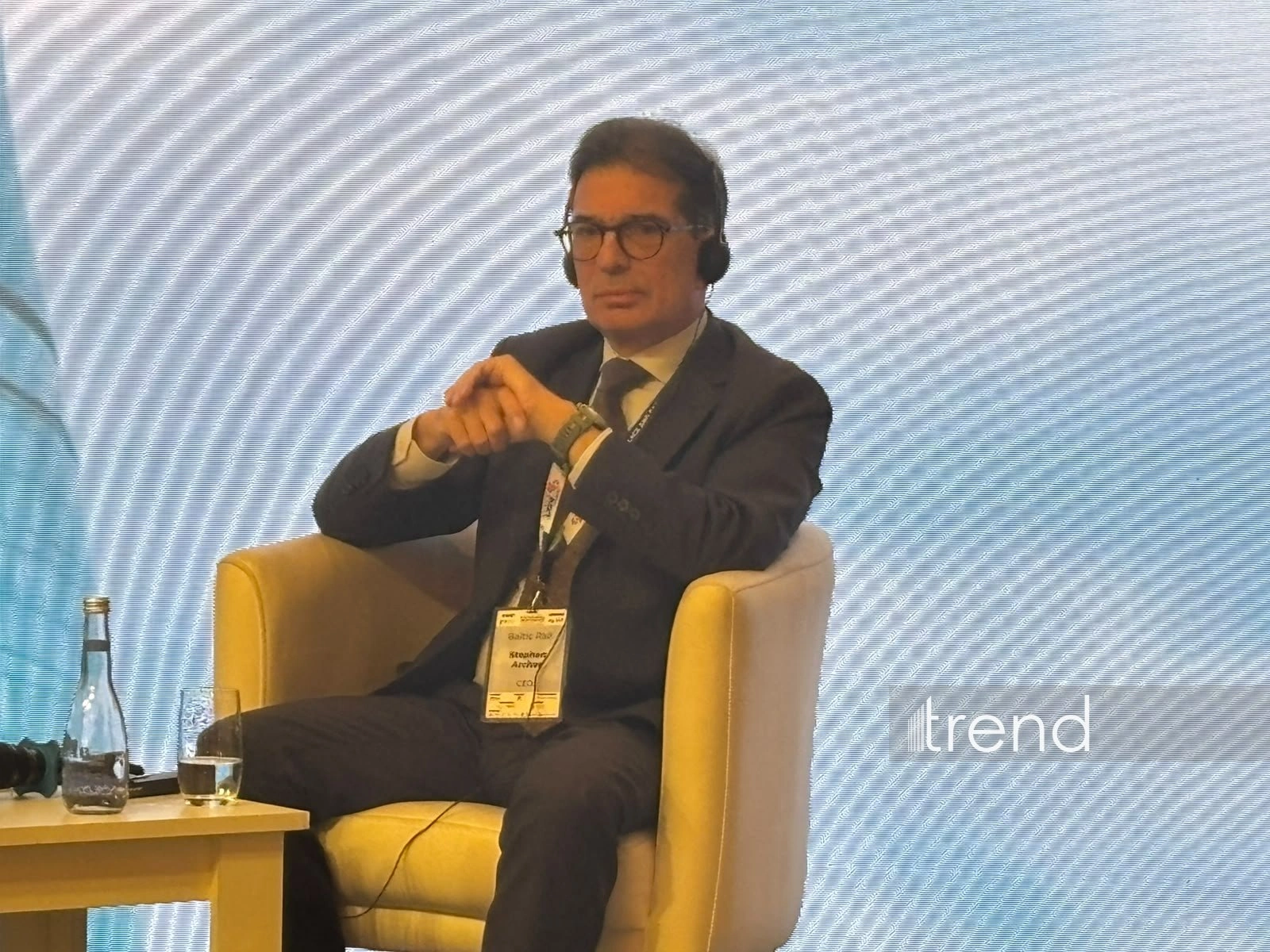
BAKU, Azerbaijan, September 8. Western Europe's
industrial base is shifting eastward, bringing it closer to the
Middle Corridor, CEO of Baltic Rail, Stephen Archer, said at the
5th International Conference and Exhibition, Black and Caspian
Freight Forum 2026 in Baku, Trend's correspondent reports from the event.
According to him, building its business on trade links with
China, Japan, and South Korea via maritime routes, the company is
considering alternative routes due to difficulties in the Red
Sea.
"After we reach Baku, Poti, or Türkiye, we continue through
Constanta or Bulgarian ports, then through Romania and Serbia to
Central Europe. These routes are an extension of the Middle
Corridor. Significant investments are being made to strengthen the
connection with Türkiye and Poti," he explained.
According to Archer, Western Europe's industrial base is
currently shifting east.
"The Middle Corridor is becoming much closer to Europe's
industrial base than it was a few years ago," he pointed out
The CEO also noted the importance of this factor in the
development of infrastructure and the transport corridor.
"Hungary is currently the most attractive investment destination
in Europe. It's no longer Western Germany or France. From a
European perspective, industry is moving closer to the Middle
Corridor," he added.
The Middle Corridor is a transport and trade route connecting
Asia and Europe, passing through several countries in the region.
It serves as an alternative to the traditional Northern and
Southern Corridors.
The route begins in China and passes through Central Asian
countries such as Kazakhstan, Uzbekistan, and Turkmenistan,
reaching Europe via the Caspian Sea, Azerbaijan, Georgia, and
Türkiye. The Middle Corridor offers a land route connecting East
Asia, including China, with Europe, bypassing the longer sea
routes.