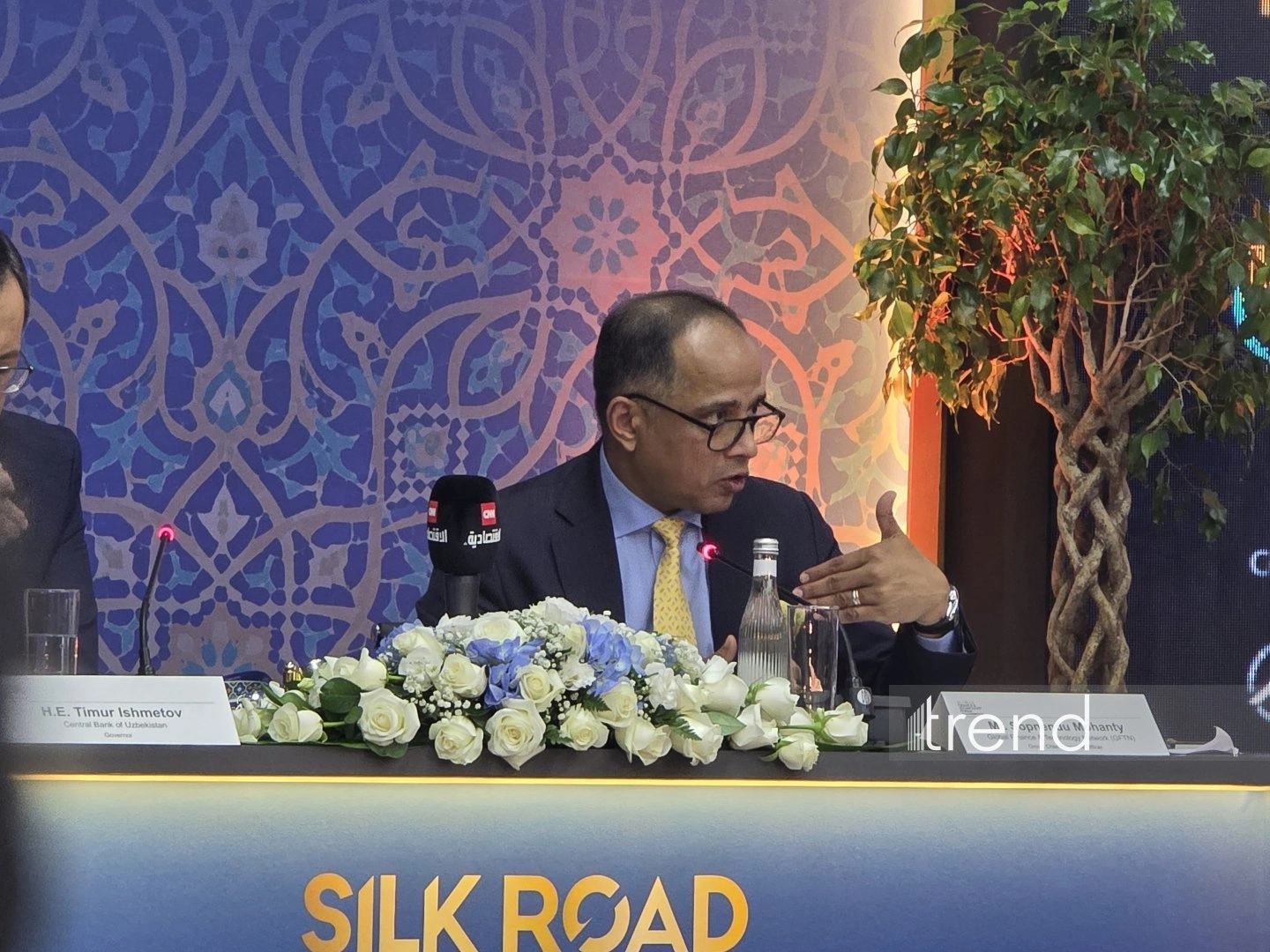
TASHKENT, Uzbekistan,
August 24. Uzbekistan’s development of open
banking, payment infrastructure and regulatory sandboxes could
create a foundation for greater interoperability between domestic
and international financial systems, Sopnendu Mohanty, Co-Founder
and Group CEO of the Global Finance & Technology Network (GFTN),
said, Trend’s special
correspondent reports from Tashkent.
He made the remarks during a press briefing held as part of the
Silk Road Finance & Technology Forum.
According to Mohanty, interoperability should be a key element
of the country’s financial technology development, allowing
infrastructure developed in Uzbekistan to interact with systems in
other markets, including the Middle East and Singapore. “The anchor
of this discussion is infrastructure which has to interoperate,
whether it is Uzbekistan or the Middle East or Singapore,” he
said.
Mohanty also addressed the evolving role of different forms of
money, including central bank money, bank deposits, tokenized
deposits, and stablecoins.
He said the global discussion increasingly points toward
wholesale central bank digital currencies (CBDCs) being used as
settlement infrastructure, while the case for retail CBDCs remains
less clear given the efficiency of existing payment systems.
At the same time, he highlighted the potential role of tokenized
bank deposits in transactions involving tokenized assets. “If you
want to buy an asset on a network where the asset is in a tokenized
form, you need money. The money can be wholesale or could be a
tokenized deposit,” Mohanty said.
He also pointed to the growing adoption and regulation of
stablecoins, saying they could help make cross-border payments
cheaper. “To me, my argument on stablecoin always has been it is
infrastructure, not money itself, and stablecoins can solve
cross-border payments and make them cheaper,” he said.
However, Mohanty stressed that the choice of settlement
instruments should correspond to the priorities and regulatory
approach of each country.
Regarding Uzbekistan’s financial sector development, he
highlighted the importance of open banking and payment system
interoperability, saying these two elements can help digital and
legacy banks operate alongside each other. “Open banking allows
whether you are a legacy system or a new digital bank, you should
be able to interoperate using APIs,” Mohanty said.
He added that payment system interoperability represents another
key component, enabling money to move across markets in a more
efficient manner. “The payment system and open banking together
address the question of what is the best practice we should follow
when it comes to young banks or legacy banks trying to work
together with the market innovation in place,” he said.
Mohanty also emphasized the importance of international
cooperation in developing Uzbekistan’s fintech ecosystem.
He said GFTN’s role is to bring global best practices,
technologies and fintech expertise to Uzbekistan while ensuring
that solutions are adapted to local conditions and the regulatory
framework established by the Central Bank. “The only way a country
can succeed is through collaboration. It’s not always necessary
that you should import everything from overseas and do it here. It
has to work in the local context within the framework of the
central bank,” Mohanty said.
He noted that regulatory sandboxes can help test international
technologies and business models before they are introduced to the
wider market. “No single tech company can solve all these issues.
So there is a need to collaborate,” Mohanty said, citing Singapore
as an example of a market where collaboration has played an
important role in the development of the financial technology
ecosystem.