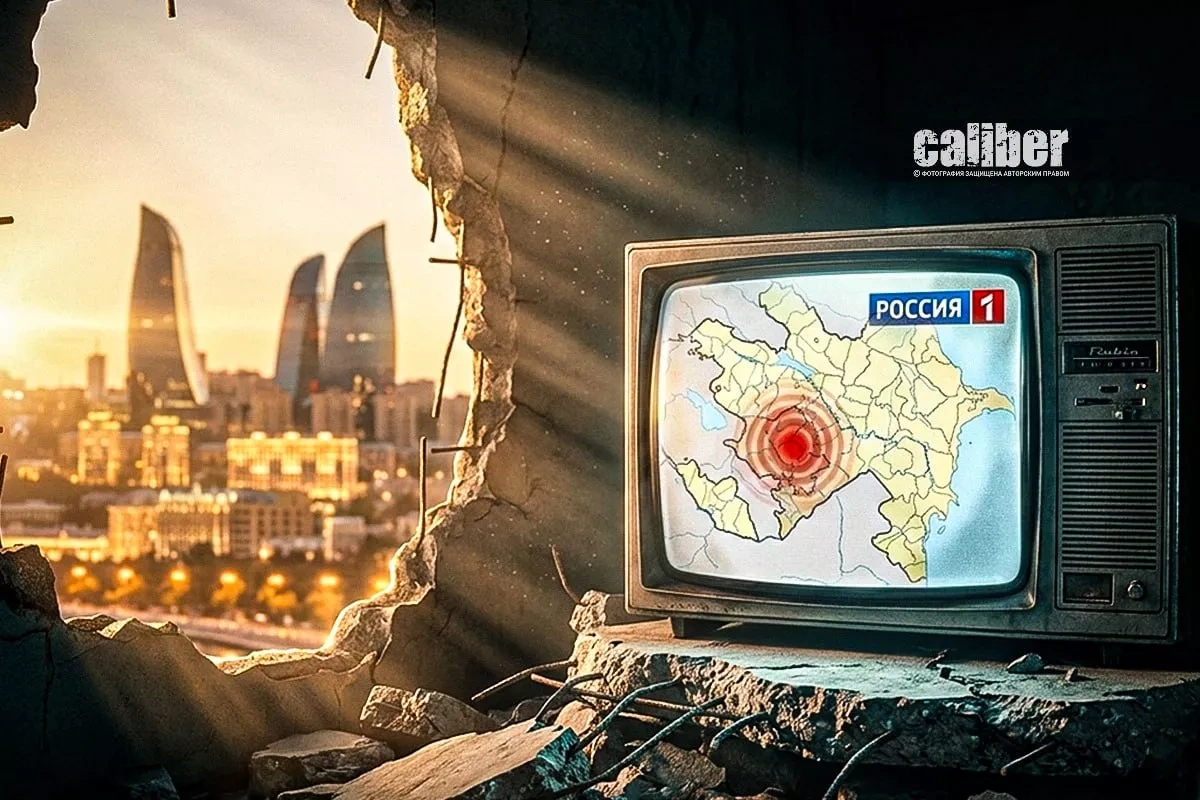
A recent story aired on the federal TV channel “Russia-1” can hardly be described as anything other than an information operation, as it combines elements such as the glorification of war criminals, distortion of concepts, historical revisionism, and a clear political message.
To avoid making unfounded claims, let us take a closer look at the report. Russian journalists speak about the “heroism” of units operating within the Southern Group of Forces, but, as the saying goes, the devil is in the details, and they are quite revealing.
Viewers are introduced to a fighter with the call sign “Maraga,” without a name or surname, but with an important biographical detail: he first picked up a weapon at the age of 14 during the Karabakh war. In other words, the federal Russian channel is presenting a person who participated in the occupation of Azerbaijani territories and is now fighting in Ukraine.
Thus, Russian television is effectively legitimising and romanticising a figure whose “career” began with participation in the seizure of foreign lands.
Just as revealing is another character — a sapper with the call sign “Engineer,” who, according to the report, also began his “
The story claims that he “clears mines from residential houses, restoring safety to people.” The wording is cynical in essence, considering that it refers to Ukrainian lands that have come under the control of the Russian army.
As we can see, two conflicts are merged within a single report — the now-ended Armenian–Azerbaijani conflict and the ongoing Russia–Ukraine war — through participants of these two confrontations, and this factor is packaged under the label of “heroic continuity.”
Even more telling is another participant in the report — a sapper with the call sign “Moska,” who is allegedly being persecuted by Armenian authorities for participating in the war on Russia’s side, and this is presented as an injustice and a “punishment for loyalty to an ally.”
However, looking deeper, this is an attempt to justify the involvement of foreign mercenaries in armed hostilities on the territory of another state.
Particularly noteworthy is the display of patches with the symbolism of the so-called “Artsakh,” which is presented in a deliberately demonstrative manner: Latin script, visual stylisation, emphasis on identity. All of this is direct political signalling, addressed not only to the domestic audience but also to external observers, and represents pure propaganda of a specific narrative that contradicts the territorial integrity of Azerbaijan.
Baku has repeatedly faced openly biased and provocative reports from Russian channels. In this regard, it is worth recalling that Russian media had previously aired stories about the “ArBat” battalion formed from ethnic Armenians. In particular, the blessing ceremony held before the deployment of its fighters at an Armenian church in July 2023 was widely covered.
At that time, they openly spoke about their intention to fight in Ukraine, and some of them referred to their experience in other conflicts. The issue of financing such structures is also not a secret.
In public discourse, the name of the Russian–Armenian oligarch Ruben Vardanyan has been repeatedly mentioned as one of those who supported such initiatives.
From what has been said, a set of logical questions arises: “Why does a state-run Russian channel broadcast such stories?” and “What specific objectives are being pursued?”
In this context, it can be assumed that the management of “Russia-1” cannot be unaware that such reports contradict Moscow’s official line, which, according to a statement by Russian Deputy Foreign Minister Mikhail Galuzin, is “fundamentally committed to the progressive development of the entire range of relations with Baku.”
However, it is for the Russian authorities themselves to decide how exactly to respond to such broadcasts. Baku, for its part, reserves the right to respond to such provocations and has all the necessary means to do so.
Azerbaijani media are capable of shaping their own agenda — firmly, argumentatively, and consistently, including in coordination with Ukrainian media. And the Russian side has been convinced of this more than once.