BAKU, Azerbaijan, June 26. Freight volumes
transported along the Middle Corridor via Georgia have increased by
21%.
According to information published by Georgia’s Ministry of
Economy and Sustainable Development, the figure was announced by
Minister of Economy and Sustainable Development Mariam Kvrivishvili
at a ceremony marking the start of the second phase of construction
of the new Poti Sea Port.
According to the minister, the project represents a direct and
effective response to growing demand in Georgia’s transport and
logistics sector.
“This project opens up new opportunities for the country’s
economic development and strengthens regional connectivity. Over
the past few years, the Middle Corridor has become one of the
fastest-growing international transport routes. Accordingly, the
volume of cargo passing through Georgia has also increased
significantly.
In the first five months of this year, freight volumes along the
Middle Corridor grew by 21%, while the tonnage of vessels calling
at Georgian ports increased by 19%. Growth has been recorded across
almost all key directions, further confirming Georgia’s growing
role in regional and international logistics,” the minister
said.
Kvrivishvili noted that amid these developments, an additional
investment of $40 million is of particular importance, as it will
significantly expand the capabilities of the new Poti Port.
“Once the second phase is completed, the port’s capacity will
reach 3 million tonnes, operational efficiency will improve, and
cargo handling will become faster, which will have a positive
impact on Georgia’s competitiveness,” she said.
The ministry noted that $93 million has already been invested
during the first phase of the project, creating 360 jobs. At the
current stage of implementation, an additional 50 jobs will be
created.
“I would like to express my special gratitude to the US
International Development Finance Corporation (DFC), which
continues to support Georgia’s economic development, as well as to
Pace Group, which has transformed a private initiative into a
successful project of national importance,” Kvrivishvili said.
She added that the public and international partners are well
aware of the Georgian government’s consistent and clearly defined
policy in this area.
“This strategy includes the development of the new Poti Port,
the construction of the Anaklia deep-sea port, the modernization of
railway infrastructure and the development of the East-West
Highway. Today’s investments mean increased cargo volumes, new
jobs, greater economic activity and an even stronger position for
Georgia in regional and global trade,” Kvrivishvili said.
The ministry said the ceremony was attended by U.S. Chargé
d’Affaires Alan Pursell, U.S. International Development Finance
Corporation (DFC) Managing Director Kenneth Angell, and Pace
International President Ioseb Dolidze.
A symbolic time capsule ceremony was held following the
event.
“The second phase of the project envisages further expansion of
port infrastructure and an increase in handling capacity. In
particular, a new 250-metre-long berth with a depth of 13 metres
will be constructed, dredging works will be carried out in the
approach channel, a modern ship loader will be installed, and a
700-metre conveyor line will be built to connect the existing urea
storage facility with the new berth,” the ministry said.
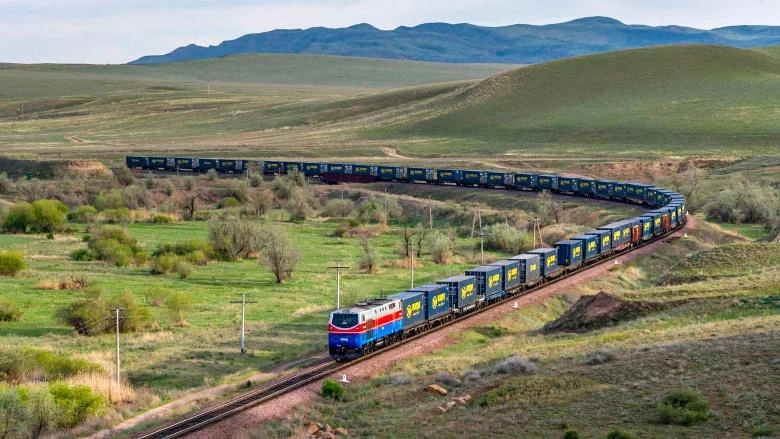
The Middle Corridor is a multimodal trade route connecting Asia
and Europe through several countries in the region. It serves as an
alternative to the traditional Northern and Southern corridors.
The route begins in China and passes through Central Asian
countries before crossing the Caspian Sea, Azerbaijan, Georgia and
Türkiye, and reaching Europe. The Middle Corridor is a land-based
route that bypasses longer maritime routes, connecting eastern
parts of Asia, including China, with European markets.