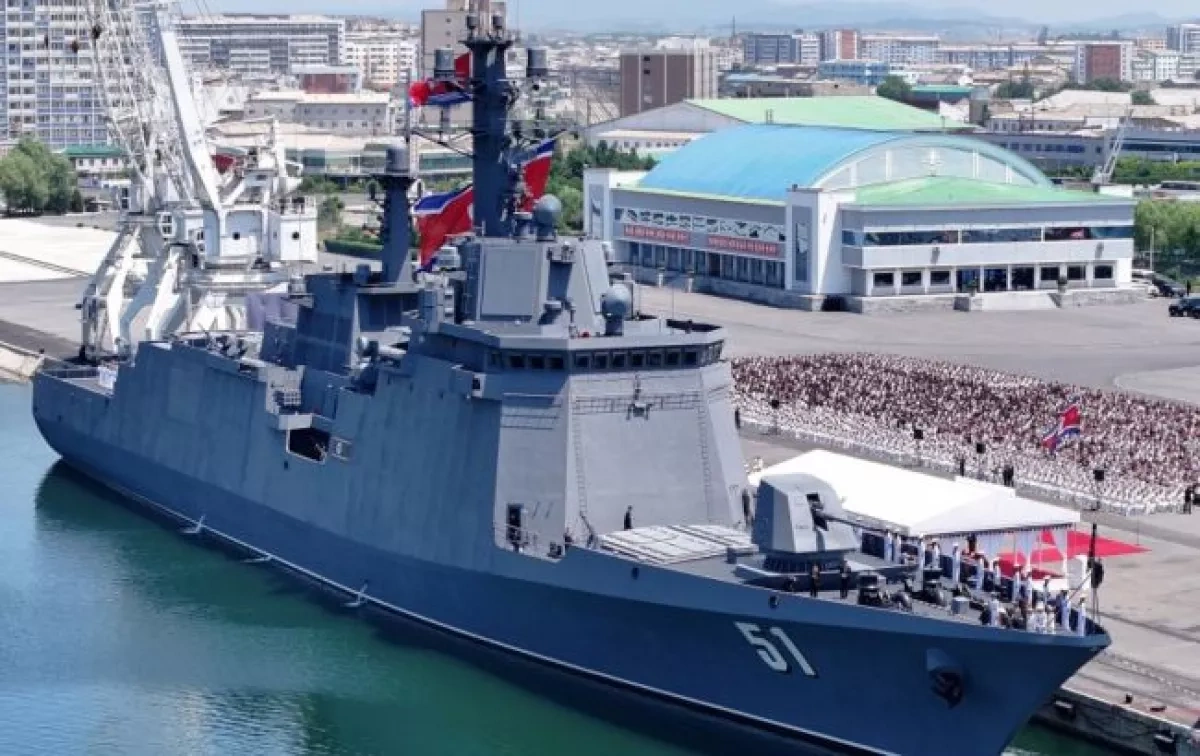
North Korean leader Kim Jong Un has overseen the commissioning of a 5,000-ton destroyer that state media says marks progress in Pyongyang’s push to develop a nuclear-armed navy, according to official reports.
The vessel, named Choe Hyon, was formally placed into service at the western port of Nampo following a ceremony on June 23, Caliber.Az reports via foreign media.
Kim said the warship would be tasked with defending North Korea’s western coast and reflected what he described as the “planned course” of the country’s naval nuclearisation.
State media quoted Kim as saying that North Korea’s navy was “rising into a full-fledged service equipped with strategic means”, underscoring the leadership’s ambition to expand military capabilities beyond land-based missile systems.
KCNA has previously said the destroyer is equipped with anti-aircraft and anti-ship weapons, as well as systems capable of launching nuclear-capable cruise and ballistic missiles. The claims could not be independently verified.
North Korea has conducted a series of tests involving the vessel in recent months, including reported launches of what it described as nuclear-capable cruise missiles from the ship. Analysts, however, have questioned whether the destroyer is fully operational.
South Korean officials and defence experts say the ship may have benefited from technical assistance from Russia, reflecting deepening military cooperation between Pyongyang and Moscow, an assertion neither side has confirmed.
The commissioning comes as Pyongyang accelerates naval modernisation efforts, including the development of additional destroyers and a reported nuclear-powered submarine. North Korea has also reiterated its rejection of the Northern Limit Line maritime boundary with South Korea, a disputed demarcation that has previously been the site of military clashes.
Tensions on the Korean Peninsula have risen since the collapse of Kim’s nuclear diplomacy with Donald Trump in 2019, with Pyongyang expanding its missile and nuclear programmes while signalling limited openness to future talks if U.S. denuclearisation demands are dropped.
By Aghakazim Guliyev