BAKU, Azerbaijan, June 23. President Shavkat
Mirziyoyev visited a major poultry production complex and reviewed
agricultural development projects in the Namangan region as part of
efforts to boost food production, create jobs, and expand rural
incomes.
This was reflected in the statement by the press service of the
Uzbek president.
During the visit, the President toured Uychi Parranda, an
integrated poultry enterprise in the Turakurgan district that
combines breeding, incubation, and meat production within a single
industrial operation.
The project, financed with $50 million from a commercial bank,
spans 121 hectares and includes the raising of 60,000 pedigree
chickens imported from Hungary’s Aviagen, one of the world’s
leading poultry genetics companies.
It was said that the facility’s key advantage is its fully
integrated production cycle, covering everything from breeding and
incubation to the production of finished poultry products.
Using modern genetic technologies, the enterprise produces up to
60,000 hatching eggs per day and has the capacity to hatch
approximately 50,000 chicks daily through its incubation
facilities.
The company’s meat production units are also designed for
large-scale output. Each poultry complex can accommodate 100,000
birds, with broiler chickens raised over a 45- to 50-day cycle. The
operation can produce up to 120 metric tons of poultry meat per
production cycle.
Officials noted that similar poultry facilities are planned for
several districts across the Namangan region, including Mingbulak,
Namangan, Naryn, Pap, Uychi, Chust, and Chartak. Once completed,
the projects are expected to increase the region’s poultry
population to 12 million birds.
The expansion is projected to create approximately 500 direct
jobs and up to 1,000 jobs overall through related cooperative
activities and supply chains.
Authorities said the integrated production model could help
stabilize poultry meat and egg prices not only in Namangan but
across the broader Fergana Valley, while also increasing export
potential as production volumes grow.
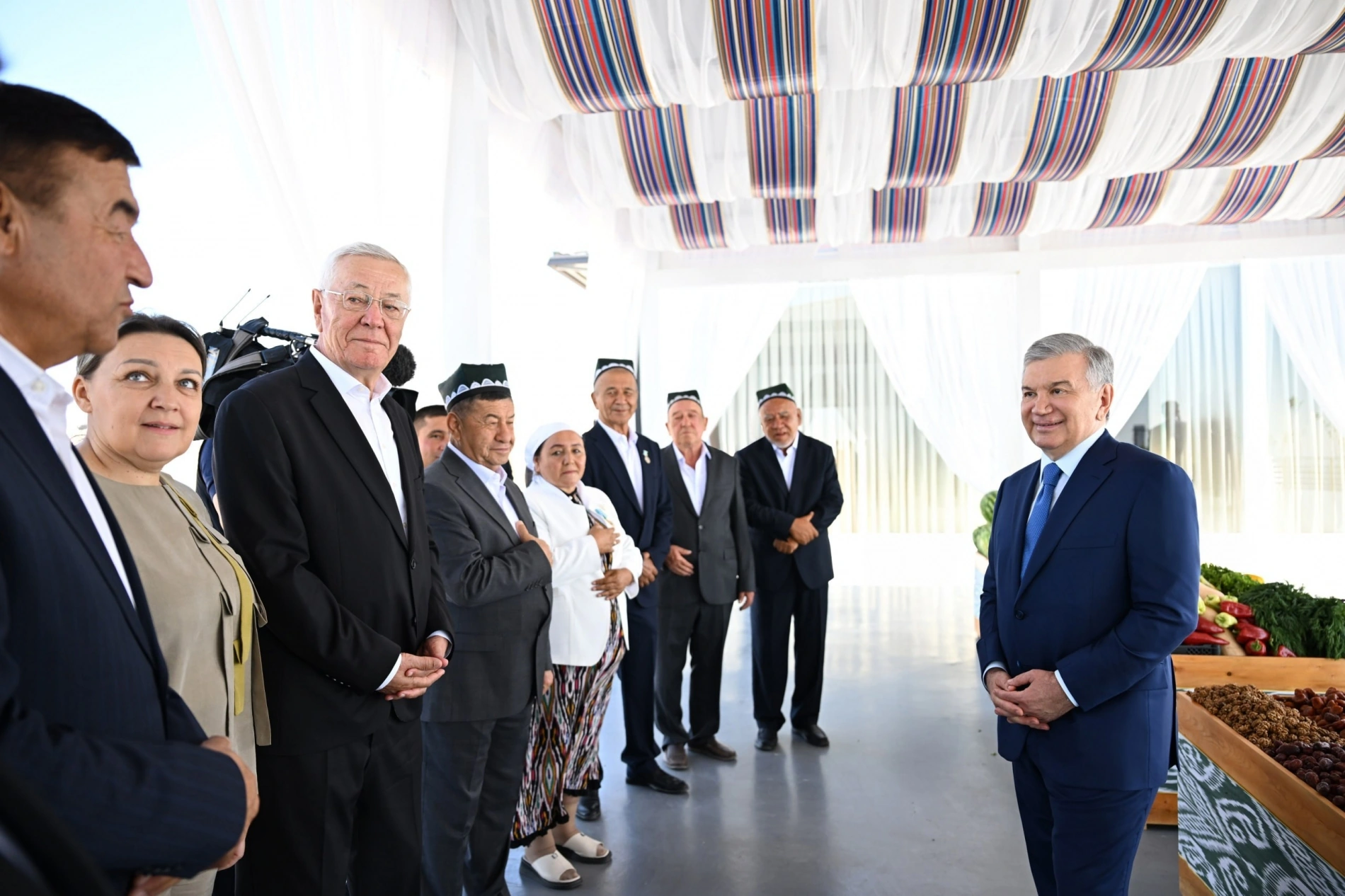
During the visit, Mirziyoyev also met with local farmers,
agricultural producers, and entrepreneurs to discuss rural
development and agricultural modernization.
Officials presented plans aimed at bringing unused land into
agricultural production, including a 100-hectare super-intensive
orchard established in the Pap district.
The orchard, developed with an investment of 20.7 billion soms
(about $1.7 million), was designed to match local soil and climate
conditions and has transformed previously underutilized land with
limited water access into productive farmland.
The project includes 66,600 fruit trees, with 40,000 apricot
trees planted on 60 hectares, 16,600 peach trees on 25 hectares,
and 10,000 cherry trees on 15 hectares.
"Thanks to modern irrigation and cultivation methods, the plan
here is to produce an average of 20 metric tons of high-quality
fruit per hectare. This figure is several times higher than the
yield of conventional orchards." the press service said.
As part of a cooperative farming initiative, 300 low-income
families have each been allocated 0.3 hectares of land, creating
additional opportunities for household income generation.
Officials said the region has made substantial progress in
returning unused land to productive agricultural use. Between 2019
and 2024, approximately 38,900 hectares were brought back into
cultivation, while an additional 7,028 hectares have been restored
in 2025 alone.
Under current plans, another 18,000 hectares of previously
unused land are expected to be developed by 2028, supporting
Uzbekistan’s broader strategy to increase agricultural
productivity, strengthen food security, and expand rural
employment.