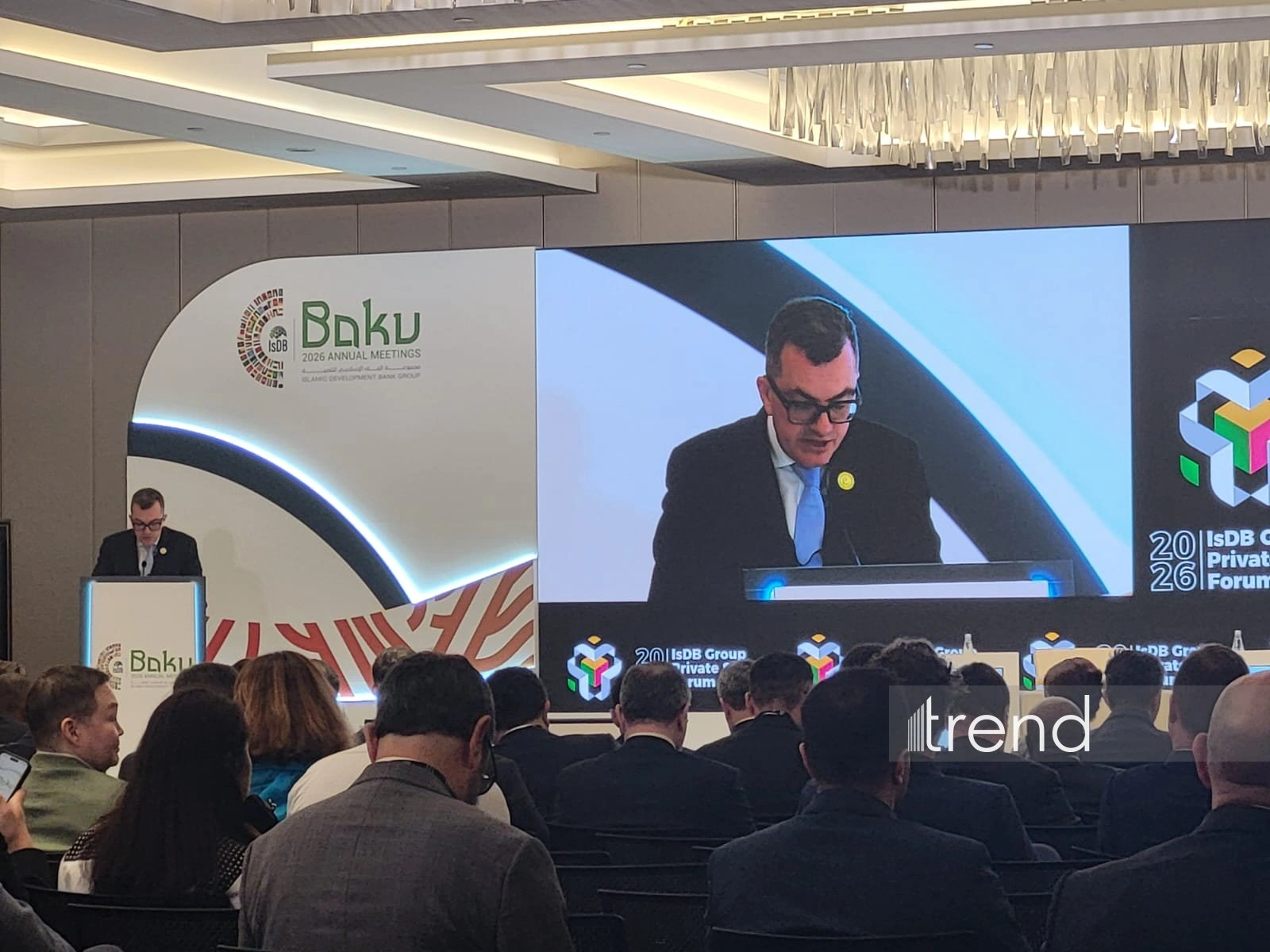
BAKU, Azerbaijan, June 17. To successfully
implement cross-border infrastructure projects, it is necessary to
more actively utilize public-private partnership (PPP) mechanisms,
as well as the instruments of multilateral development banks to
reduce investment risks, Ahmed Rostom, Egypt's Minister of Planning
and Economic Development and Governor for Egypt at the Islamic
Development Bank, said, Trend's correspondent reports from the event.
He made the remark during a panel session on "Cross-Border
Infrastructure PPPs for Regional Connectivity" within the framework
of the annual meetings of the Islamic Development Bank (IsDB) Group
in Baku.
According to the minister, one of the main obstacles to
attracting private capital today remains high investment risks.
"Private capital will remain on the sidelines until we directly
mitigate the long-term risks associated with regulatory alignment,
revenue stability, and political risks in projects involving
multiple states," Rostom said.
The minister emphasized that multilateral development banks must
play a more active role in reducing these risks.
According to him, the necessary conditions have been created
today for a larger-scale development of cross-border projects.
"We now possess all the capabilities to smartly de-risk
cross-border public-private partnership projects, and platforms
such as this current meeting help us move in this direction,"
Rostom stated.
The minister noted that combining financial resources, technical
expertise, and increasing operational efficiency will allow for the
formation of a high-quality portfolio of investment projects.
"Combining private capital, exchanging technical knowledge, and
increasing project implementation efficiency will help form a
viable pipeline of initiatives attractive to investors," he
said.
Rostom urged IsDB member countries to more actively utilize the
bank's comprehensive set of financial instruments.
"I would like to call for a highly coordinated approach using
the full suite of instruments of the Islamic Development Bank
Group—sovereign and non-sovereign financing, guarantees, trade
facilitation mechanisms, and advisory support—to scale up
public-private partnership projects in member countries," the
minister emphasized.
He also advocated for a broader application of Islamic finance
and blended finance mechanisms.
"Now is the right moment to promote Islamic finance, blended
finance models, and robust guarantee mechanisms that will mitigate
risks and significantly boost the investment attractiveness of
infrastructure projects," Rostom noted.
As successful examples of regional cooperation, the minister
named the Trans-Saharan Highway, as well as the transport and
energy corridors of Azerbaijan.
"These projects demonstrate how landlocked developing countries
can be connected to deep-water ports and world markets, opening up
new opportunities for their economic growth," he said.
Rostom called on ministries of finance, transport and energy
authorities, as well as public-private partnership units to work
together on harmonizing legislation and regulatory frameworks.
"It is necessary to move from theoretical discussions to
practical actions—to prepare a concrete list of risks, identify
opportunities for the implementation of cross-border projects, and
ensure their alignment with the strategy of the Islamic Development
Bank for 2025–2026," the minister emphasized.
Concluding his speech, he reaffirmed Egypt's commitment to
developing regional infrastructure interconnectivity.
"We reaffirm our unwavering commitment to developing regional
economic corridors, strengthening cooperation between institutions,
and transforming cross-border interconnectivity from a political
goal into real investment projects capable of ensuring the
prosperity of our countries," the minister concluded.