BAKU, Azerbaijan, June 17. Azerbaijan plans to
increase the installed capacity of renewable energy sources to 8 GW
by 2032 and views the export of "green" electricity as one of the
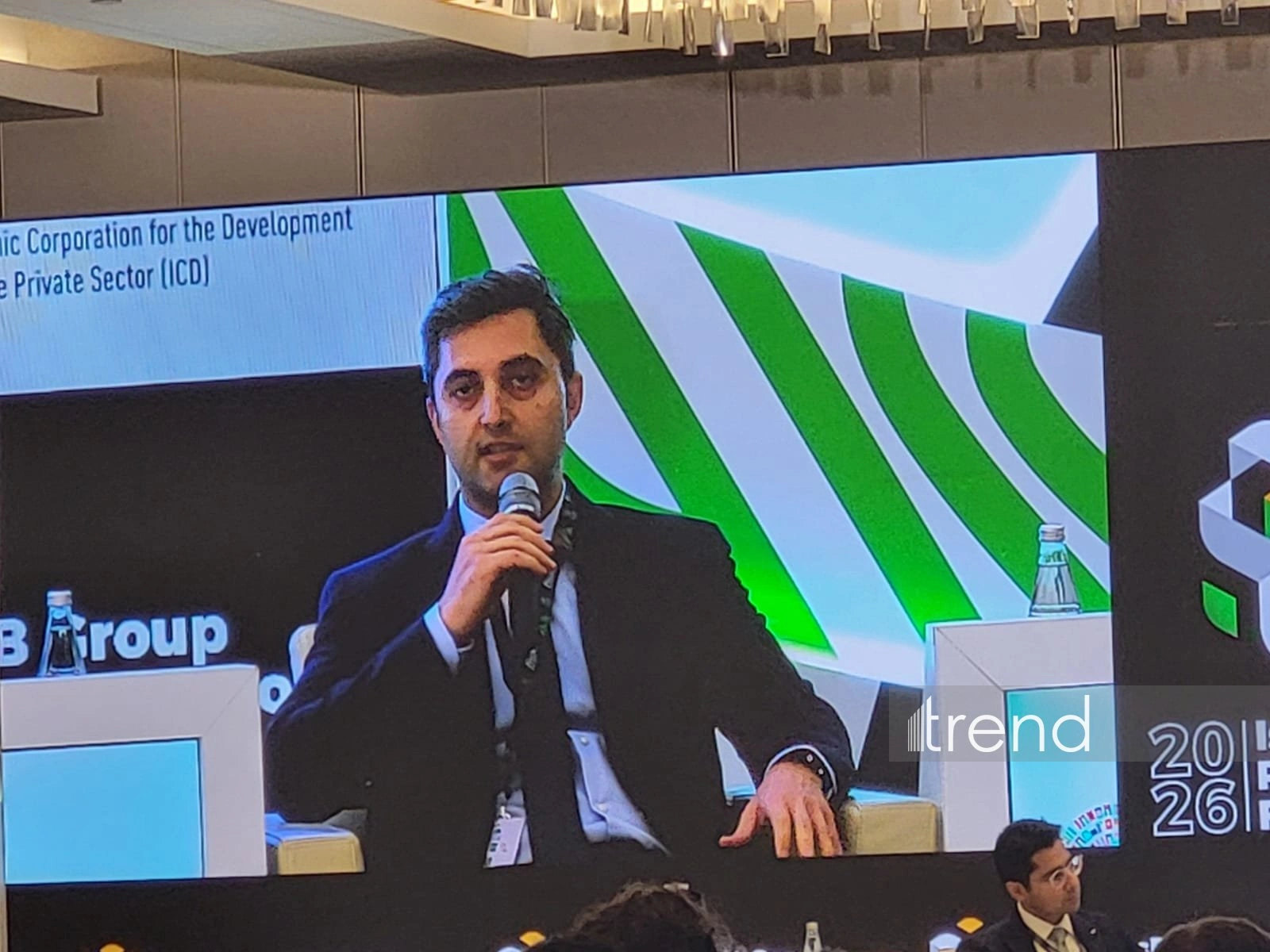
key directions for the development of the energy sector, Elmir
Musayev, CEO of SOCAR Green, stated during a panel session within
the framework of the annual meetings of the Islamic Development
Bank (IsDB) Group in Baku, Trend's correspondent reports from the event.
According to Musayev, SOCAR Green's current projects are only
the first stage of a large-scale capacity ramp-up in renewable
energy.
"Today, SOCAR Green already has a formed portfolio of projects.
These are only the projects of our company, whereas other
initiatives involving foreign investors are also being implemented
in Azerbaijan. We view them as the first stage of the country's
transition to 'green' and clean energy," he said.
The CEO of SOCAR Green noted that the further development of the
industry will require the modernization of the national power
grid.
"To integrate a larger volume of energy from renewable sources,
it is necessary to modernize and optimize the national power grid.
This is precisely where cross-border projects acquire special
significance," he emphasized.
Musayev recalled that the country's leadership has set ambitious
goals in the field of renewable energy. "By 2032, Azerbaijan
expects to bring the capacity of renewable energy facilities to 8
GW. Already, projects for approximately 2 GW are in the
implementation stage. We expect the share of renewable sources in
installed capacity to reach 34 percent by 2028 and about 38 percent
by 2030," he noted.
According to the CEO of SOCAR Green, this figure is planned to
increase to 43 percent by 2035.
"This demonstrates the scale of the steps being taken by the
state to develop renewable energy. These volumes significantly
exceed Azerbaijan's domestic electricity needs," he stated.
Musayev noted that, in this regard, the country is banking on
the export of ecologically clean electricity.
"The next stage is the export of 'green' energy. The growth of
domestic demand will not be that high, so we must focus on external
markets," he said.
He emphasized that Azerbaijan already possesses successful
experience in implementing large-scale international energy
projects.
"First, there was the Baku-Tbilisi-Ceyhan oil pipeline, which
opened access for Azerbaijan to European and world markets. Then,
the Southern Gas Corridor project was implemented. These projects
proved that even in the presence of numerous political, technical,
construction, and environmental risks, a long-term vision allows
for achieving success," Musayev noted.
As one of the key directions for development, he named the
creation of international "green" energy corridors.
"The flagship project is the subsea energy cable along the
bottom of the Black Sea, which will connect Azerbaijan, Georgia,
Romania, and Hungary. Its length will be about 1,100 kilometers,"
Musayev said.
In addition, according to him, a route is being worked out that
will connect the countries of Central Asia with Azerbaijan and
further onward to Europe.
"We are talking about connecting Kazakhstan and Uzbekistan to
the green electricity export system through Azerbaijan and the
subsea cable along the bottom of the Black Sea. This will allow for
utilizing the huge potential of Central Asia's renewable energy,"
Musayev said.
He also announced work on another export direction.
"The third 'green' corridor provides for supplies through
Nakhchivan to Turkey, and then to Bulgaria, utilizing already
existing export routes," the CEO of SOCAR Green noted.
According to Musayev, the implementation of such projects is
impossible without unified regulatory rules.
"Stable and predictable regulatory conditions are necessary.
Investors must understand what the tariffs will be, how timely
permits will be issued, and how aligned the rules are between
countries. Fragmented regulation significantly increases the cost
and timeframe of project implementation," he emphasized.
He also highlighted the need to strengthen institutional
capacity and modernize energy grids.
"It is not enough to connect countries with power transmission
lines. It is necessary to have modern national power systems
capable of receiving and distributing additional volumes of
electricity," Musayev stated.
According to him, a decisive role in the implementation of such
initiatives belongs to the private sector.
"States and international financial institutions will play an
important role; however, the main driver of such projects will be
precisely the private sector. It is more efficient, more flexible,
and more interested in implementing such initiatives," the CEO of
SOCAR Green said.
Concluding his speech, Musayev emphasized that access to
long-term financing remains a key condition for the implementation
of cross-border projects.
"If we are talking about projects costing billions of dollars,
it is impossible to achieve results without accessible and
long-term financing," he said.