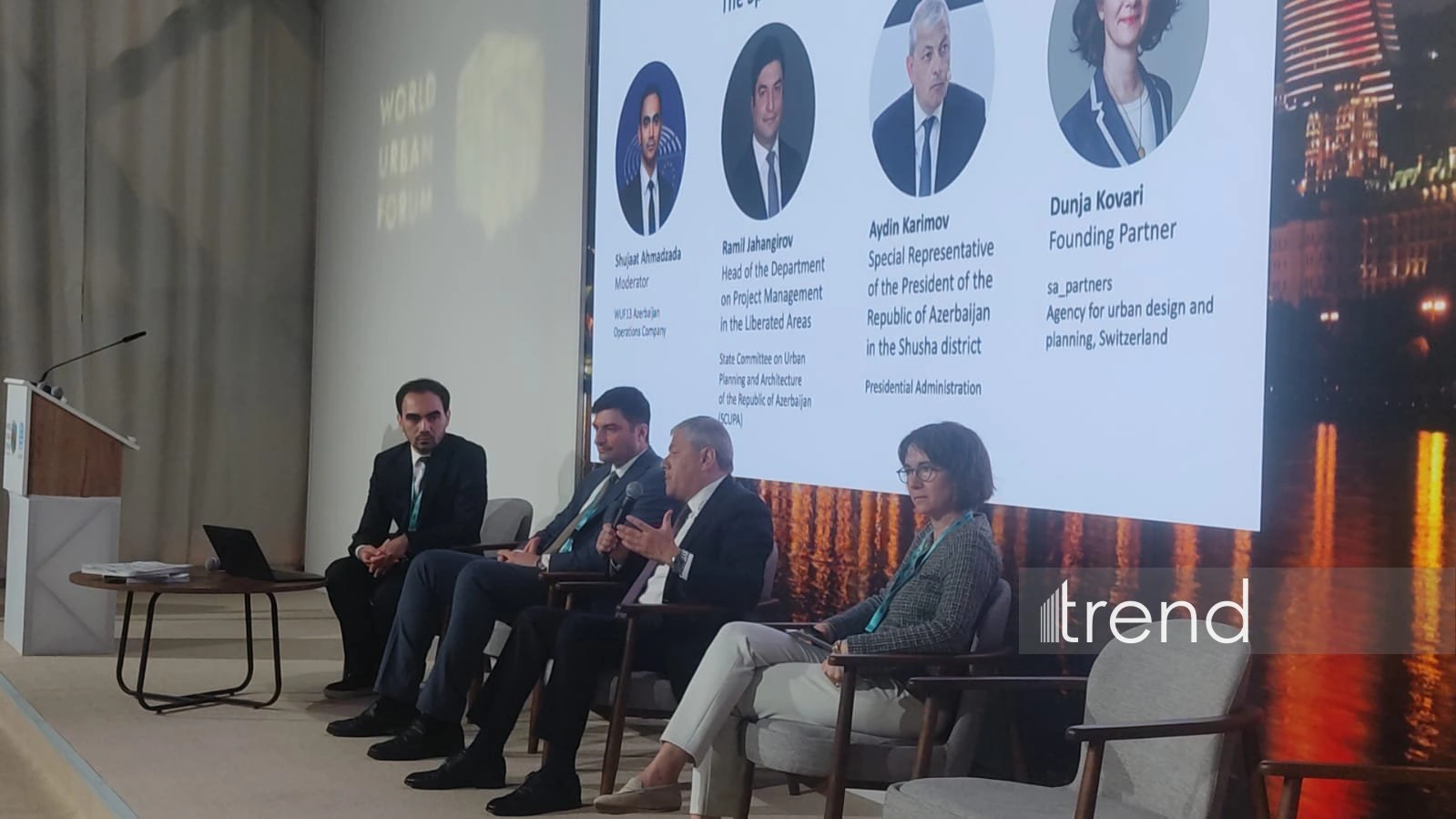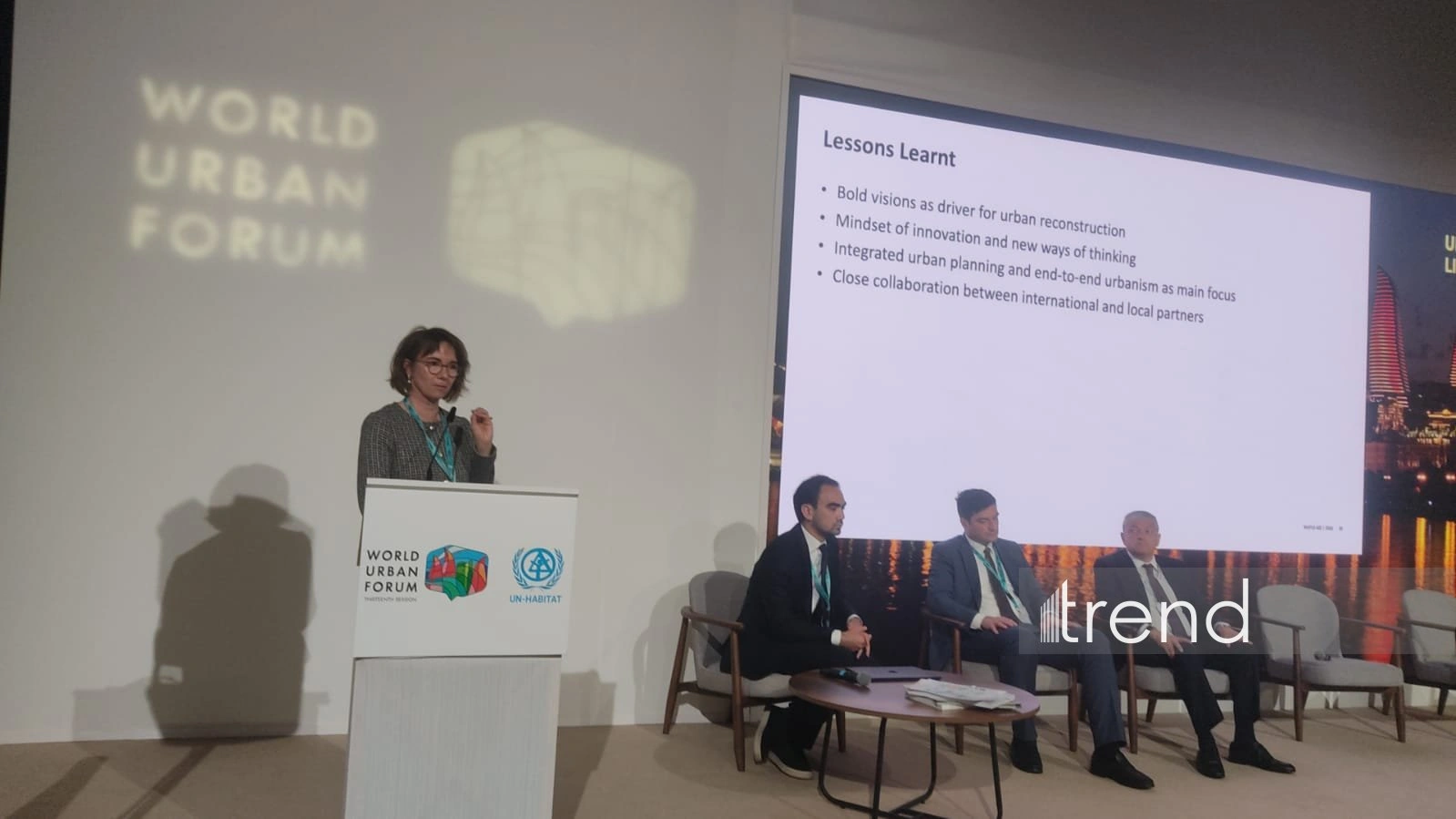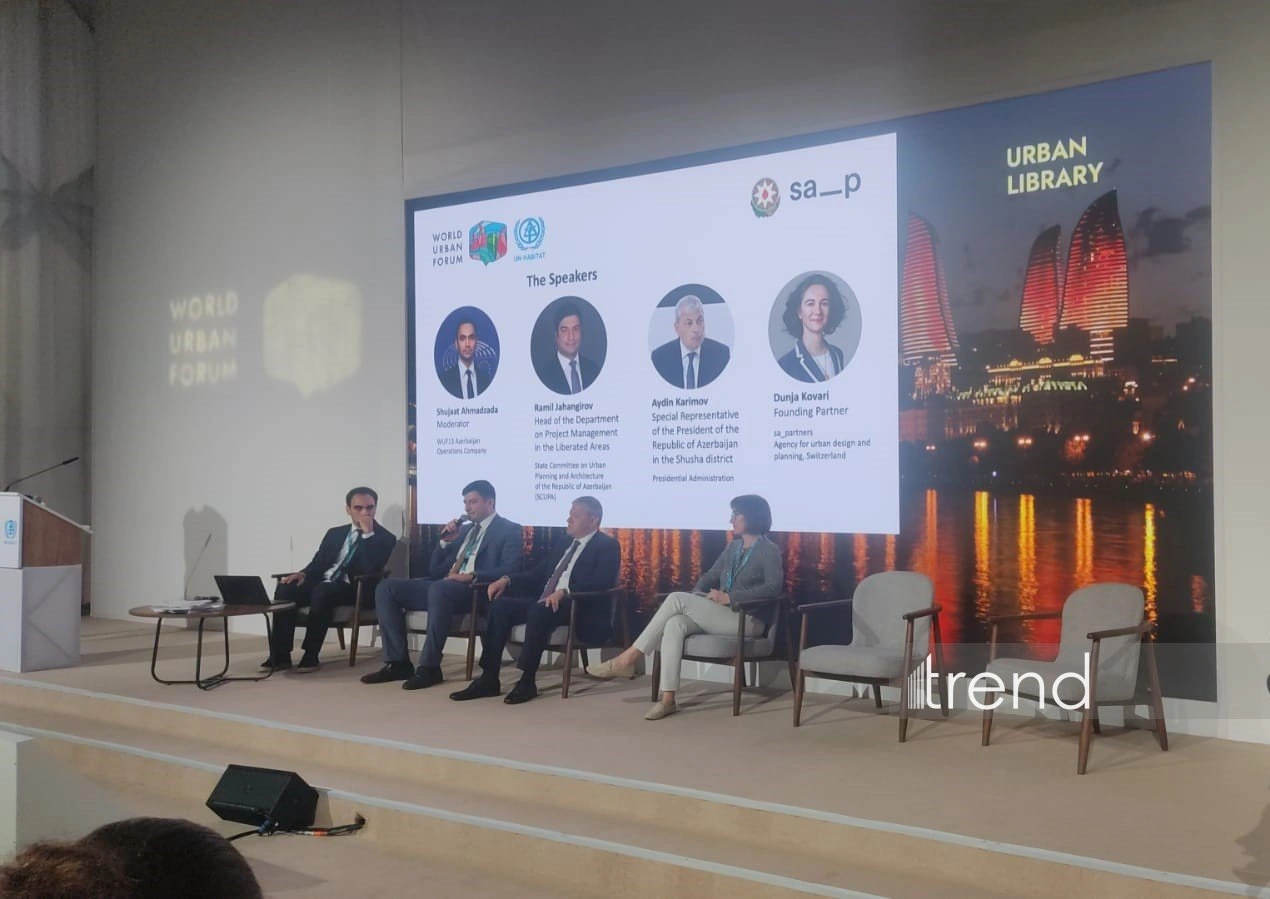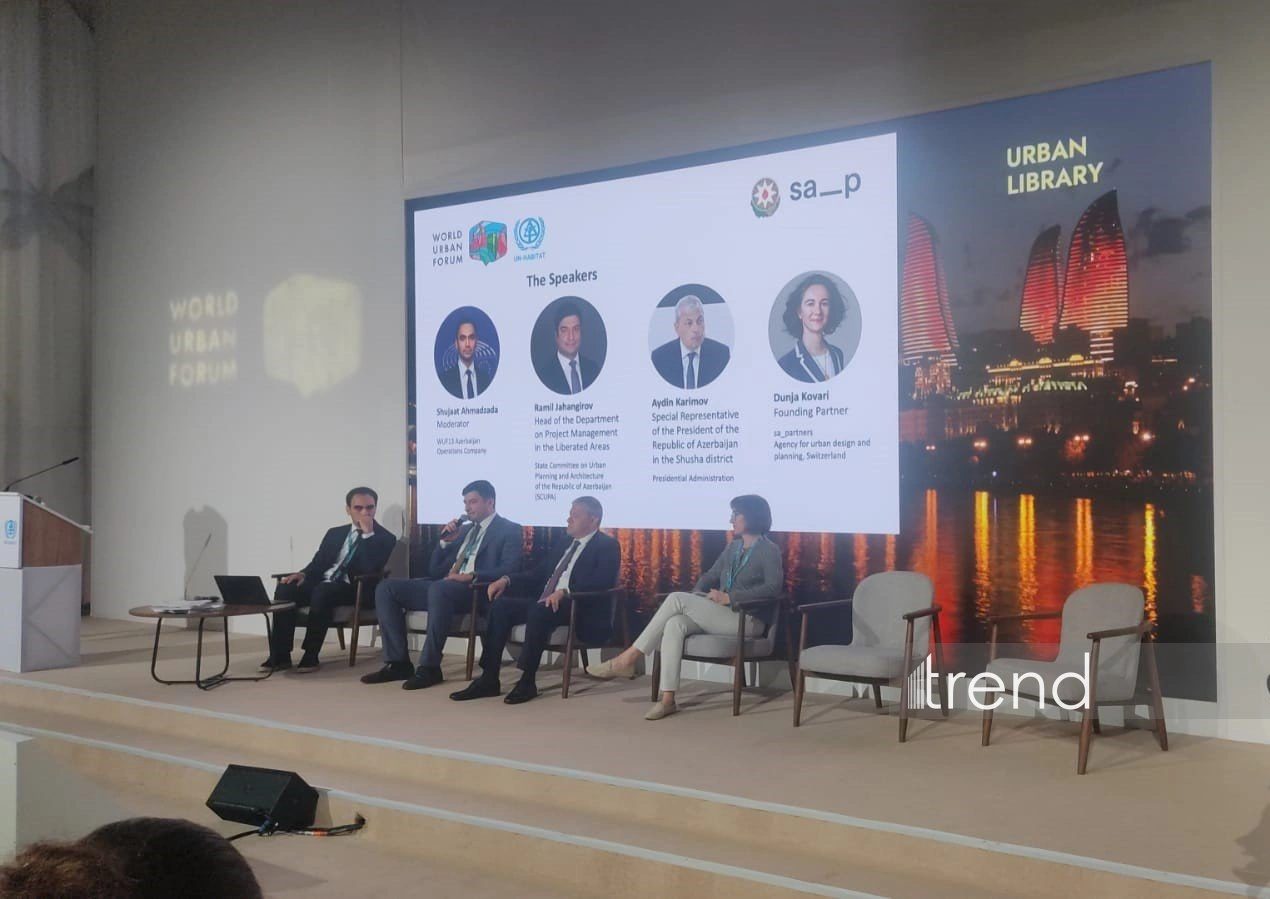
BAKU, Azerbaijan, May 21. A panel discussion
titled “Rebuilding Urbanism: How It Created an Innovation
Laboratory for Urban Transformation in Azerbaijan” was held within
the framework of the 13th session of the World Urban Forum (WUF13)
in Baku, Trend
reports.
Azerbaijani and international experts discussed urban planning
and reconstruction efforts in the territories liberated from
occupation. Speaking during the session, Ramil Jahangirov,
department head at the State Committee for Urban Planning and
Architecture, said that developing master plans involves not only
urban planning but also defining the long-term development
directions of cities.
According to him, international companies such as Chapman Taylor
and SAI Partners were involved in the process, while different
architectural approaches were applied to various cities.
Jahangirov noted that the “15-minute city” and “green city”
concepts are being implemented in Zangilan, Gubadli, and Kalbajar,
where new residential neighborhoods, schools, and kindergartens
have already been built or are under construction.
He stressed that the main goal is to ensure the safe and
comfortable return of internally displaced persons to their native
lands.
Later, Aydin Karimov, Special Representative of the President of
Azerbaijan in the Shusha district, said that the preparation of
master plans is a long-term and complex process.
According to him, because post-war reconstruction had to be
carried out within a limited timeframe, Azerbaijan adopted a
parallel learning and implementation model.
Karimov noted that the Coordination Headquarters established
under the leadership of the Presidential Administration enabled
centralized management of all processes.
He also emphasized that special attention has been paid to
preserving national heritage in Shusha’s architectural approach,
including the use of local stone materials, while transforming the
city into a modern and functional living environment.
Dunja Kovari, founding partner of the Urban Planning and
Planning Agency, highlighted that the core idea of Zangilan’s
Master Plan is integration with nature.
According to her, preserving trees, applying the “cool air
corridors” concept, and adapting urban regeneration to mountainous
terrain were adopted as key principles in city planning.
Kovari said the “Alpine typology” approach implemented in
Kalbajar creates a balanced residential model suited to the natural
and mountainous environment.
She also stressed the importance of reducing car dependency in
Baku and making public spaces more people-oriented.
Overall, the session demonstrated that Azerbaijan’s
post-conflict urban planning model is being built around
innovation, sustainability, and social integration.
In the mean time, today marks the fifth day of WUF13 in
Baku.
The first day included a ministerial meeting dedicated to the
New Urban Agenda, a ministerial roundtable, assemblies for women
and civil society, business sessions, and discussions on urban
prosperity. An official ceremony marking the raising of the UN and
Azerbaijani flags also took place.
The second day stood out for the inaugural Leaders' Summit,
featuring high-level discussions on the global housing crisis,
urbanization policy, and urban resilience. Concurrently, the
opening of the Mexico City pavilion took place, serving as a
significant platform for expanding cooperation with the Latin
American region and preparing for WUF14.
The third day of WUF13 featured a comprehensive program of
events covering the global housing crisis, the formation of safe
and inclusive cities, climate resilience, artificial intelligence
and urban governance, green urbanization, social equity, and
sustainable transport.
One of the highlights of the third day was the signing of a
sister-city memorandum between the Azerbaijani city of Shusha and
the Turkish city of Trabzon.
The fourth day of WUF13 featured a broad program of events
dedicated to urbanization, climate change, inclusive urban
development, housing policy, and sustainable governance.
One of the important events of the UN Special Programme for the
Economies of Central Asia (SPECA) Cities Forum, held on the fourth
day, was the announcement of Almaty’s official accession to the
“Declaration of Intent on the Establishment of the SPECA Smart
Climate-Resilient Cities Forum.”
Also, for the first time in WUF history and at Azerbaijan’s
initiative, the “WUF13 NGO Forum: Global Partnership and
Decision-Making” was held.
WUF13, which has attracted more than 40,000 registered
participants from 182 countries, will continue until May 22. Held
under the theme “Housing the world: Safe and resilient cities and
communities,” the forum brings together governments, international
organizations, experts, and representatives of civil society to
strengthen global cooperation in the field of sustainable urban
development.