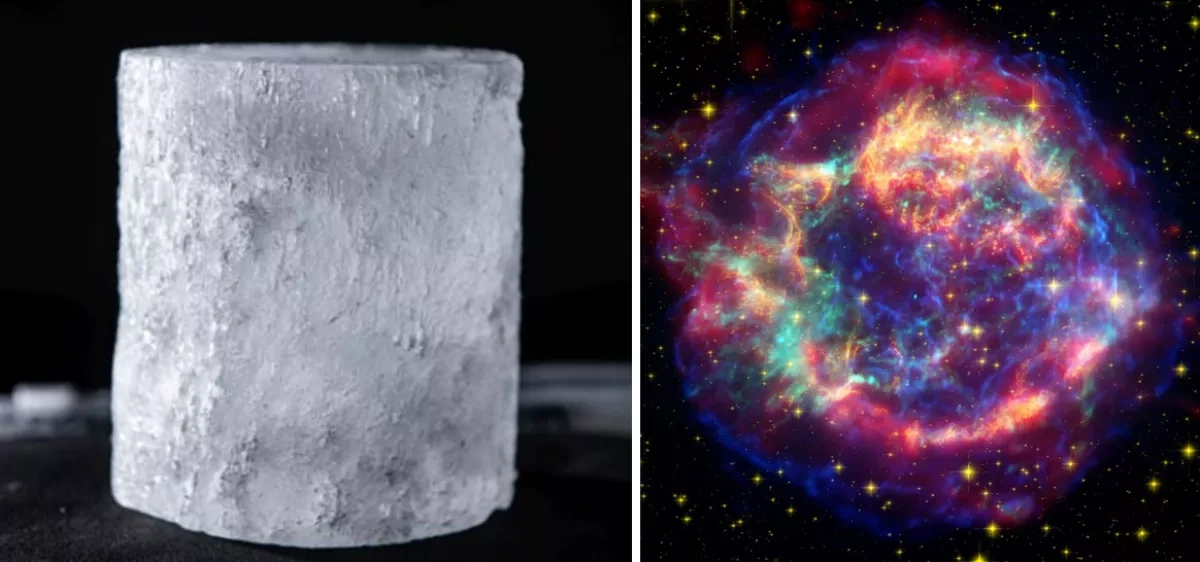
The Earth and the rest of the Solar System are constantly moving through the galaxy, passing through clouds of interstellar dust along the way. Scientists now say traces of one such cloud have been preserved deep within Antarctic ice, offering a rare glimpse into the Solar System’s journey through space over the past 80,000 years.
Researchers at Helmholtz-Zentrum Dresden-Rossendorf detected the rare isotope iron-60 in Antarctic ice cores, as reported on by the Science Alert platform, which described it as a substance believed to form almost exclusively during massive stellar explosions known as supernovas.
Iron-60 is not naturally produced on Earth in meaningful amounts, and any reserves dating back to the planet’s formation roughly 4.5 billion years ago have long since disappeared because the isotope fully decays after about 15 million years. Scientists therefore say any measurable traces found today must have originated from space.
To conduct the study, the team, led by nuclear astrophysicist Dominik Koll, analysed samples collected through the European Project for Ice Coring in Antarctica. Researchers melted nearly 295 kilograms of Antarctic ice and counted individual iron-60 atoms embedded within the samples.
The concentration of iron-60 discovered in the ice cores exceeded normal background levels caused by cosmic rays, although it remained significantly lower than levels found in fresh Antarctic snow.
According to the researchers, this suggests the Solar System was passing through a less dense region of an interstellar cloud at the time the ice formed.
The Solar System currently sits inside a region known as the Local Interstellar Cloud — a vast area of gas, dust and plasma thought to have formed from material ejected by ancient supernova explosions.
Scientists believe fluctuations in iron-60 concentrations preserved within the Antarctic ice reflect changes in the density of this cloud over time.
Their analysis suggests that around 80,000 years ago, the Solar System entered a thinner region of the cloud before gradually moving into a denser area, where it remains today.
Researchers say the Local Interstellar Cloud may effectively function as a “cosmic archive” preserving traces of long-past stellar explosions, while Antarctic ice provides scientists with a unique way to study that history directly from Earth.
By Nazrin Sadigova