BAKU, Azerbaijan, May 15. Azerbaijani President
Ilham Aliyev’s personal commitment to the idea of Turkic unity
provides a solid foundation for further consolidation within the
Organization of Turkic States (OTS), Secretary General of the OTS
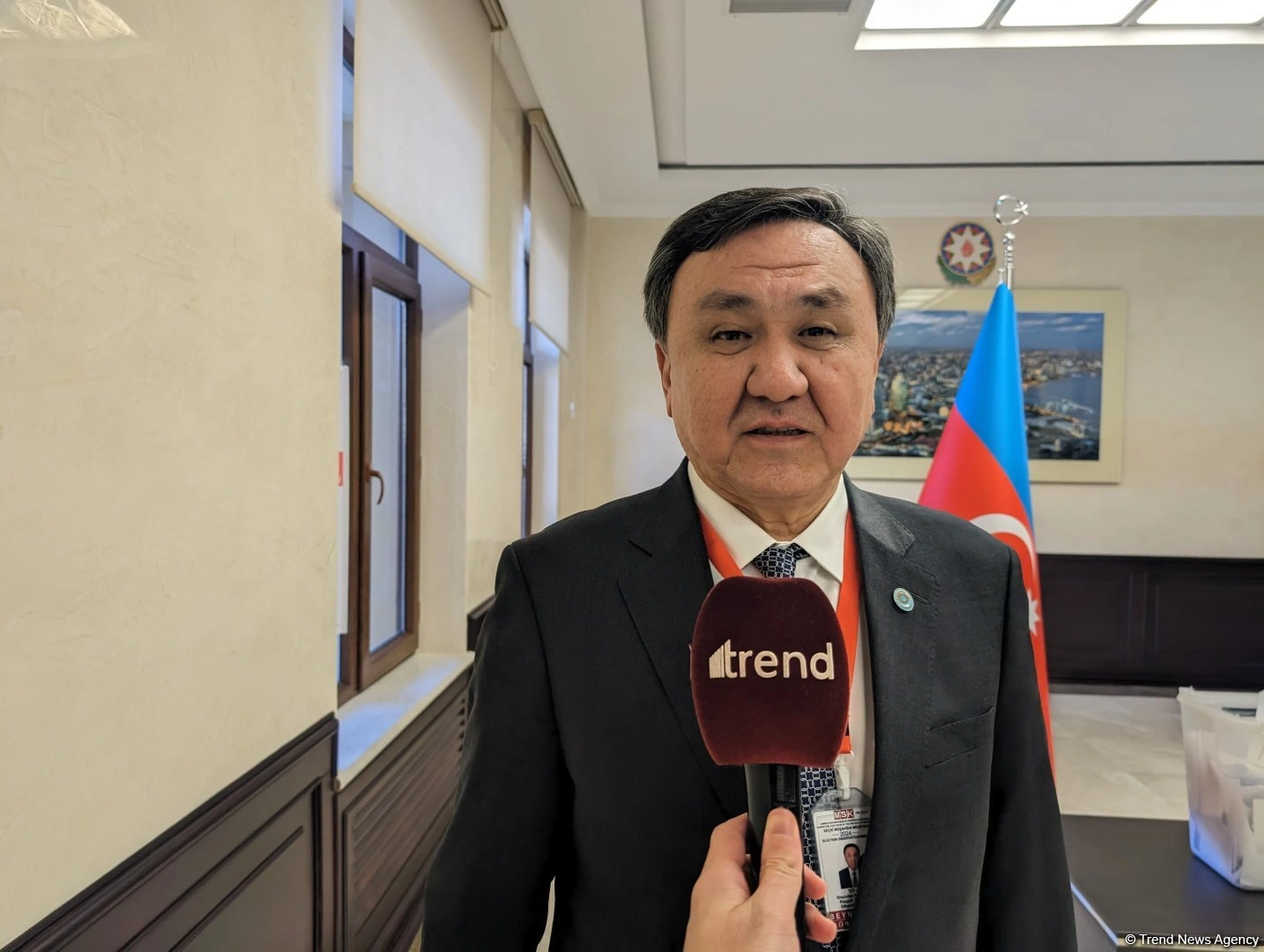
Kubanychbek Omuraliyev said in an exclusive interview with Trend on the occasion
of the organization's Informal Summit, to be held in Turkistan,
Kazakhstan.
"Azerbaijan plays a very important role within the Organization.
Being one of its founding members, it has been involved in shaping
the process from the very beginning. Equally important is the
strong political will demonstrated by the leadership of Azerbaijan
and H.E. President Ilham Aliyev’s personal commitment to the idea
of Turkic unity, which provides a solid foundation for further
consolidation within the OTS," he said.
Omuraliyev recalled that during his inauguration on 14 February
2024, President Ilham Aliyev emphasized: “This [the
Organization of Turkic States] is the main international
organization for us, because it is our family. We have no other
family. Our family is the Turkic world.”
"These words clearly reflect Azerbaijan’s determination to
further strengthen the OTS and elevate it as an influential and
respected actor on the global stage," he added.
The OTS secretary general pointed out that at the same time,
Azerbaijan’s strategic location between Europe and Asia gives it a
natural advantage as a bridge connecting the Turkic world with
wider international markets.
"Under the leadership of esteemed President Ilham Aliyev, the
country has implemented major energy and transport projects,
including the Baku–Tbilisi–Ceyhan oil pipeline, the Southern Gas
Corridor, the Baku–Tbilisi–Kars railway, as well as the
modernization of the East–West transport corridor. Today,
Azerbaijan is also a central part of the Middle Corridor. The
Baku–Tbilisi–Kars railway, for example, continues to expand its
capacity and plays an important role in East–West transport. In
practical terms, the corridor is already helping reduce delivery
times between Asia and Europe and making land transport a more
realistic alternative," he noted.
Omuraliyev went on to add that energy remains a key area of
cooperation within the OTS.
"Taken together, the Turkic states rank as the third-largest
energy supplier globally. Joint projects not only strengthen energy
security but also create a platform for the green transition. A
clear example is the agreement between Azerbaijan, Kazakhstan, and
Uzbekistan on strategic partnership in renewable energy, which is
creating a “green energy bridge” along the Middle Corridor. In
addition, Azerbaijan, Georgia, Hungary, and Romania are advancing
energy cooperation within the “Green Corridor” project. Its central
element is a high-voltage submarine cable across the Black Sea,
connecting the South Caucasus with the EU energy system. The
project foresees the transmission of several gigawatts of mainly
renewable electricity, primarily wind and solar energy from
Azerbaijan and Georgia via an undersea interconnector to Romania,
with further integration into Hungary and the wider European grid,"
said the OTS secretary general.
He pointed out that Azerbaijan continues to strengthen its
economic ties within the Organization.
"In 2025 alone, trade with OTS countries reached nearly 7.3
billion USD, with Türkiye and Kazakhstan remaining the main
partners. One of the key cooperation mechanisms is the Turkic
Investment Fund, the creation of which was first proposed by
President Ilham Aliyev at the 4th OTS Summit in Bodrum in June
2014. Initially established with a capital of 500 million USD, the
Fund has now grown to 600 million USD following Hungary’s
accession. It supports mutual investments, promotes innovation, and
fosters entrepreneurship, especially among small and medium-sized
enterprises. At the same time, Azerbaijani direct investments in
OTS countries have already exceeded 20 billion USD, forming a
strong basis for joint projects and deeper economic integration. So
overall, I would say Azerbaijan’s role is very practical. It
connects regions, supports energy and transport flows, and helps
turn cooperation into real projects that actually work. And in
today’s world, this kind of connectivity is becoming more and more
important," added Omuraliyev.
Talking about the Informal Summit of the Organization of Turkic
States, to be held under the theme “Artificial Intelligence and
Digital Development,” the secretary general said that it represents
an important milestone in advancing the organization's shared
strategic vision under the Turkic World Vision 2040.
" The selected theme is highly relevant in today’s global
context, where artificial intelligence and digital development are
rapidly reshaping economies, governance models, and international
cooperation. Turkistan is a particularly meaningful venue for this
gathering. As a spiritual center of the Turkic world, it reflects
our shared heritage while we continue to build a common future,” he
said.
Omuraliyev pointed out that in recent years, Informal Summits
have become a valuable part of the organization’s engagement.
“They complement formal meetings by providing a more flexible
setting for regular dialogue among our Heads of State. This allows
us to stay aligned, strengthen mutual understanding, and ensure
steady progress on our joint initiatives. We expect the Summit to
result in practical outcomes, including the adoption of the
Turkistan Declaration, which will help guide our cooperation in the
coming period. The agenda is focused and forward-looking, with an
emphasis on strengthening collaboration across key areas,” noted
the OTS secretary general.
He noted that the meeting will also give a chance to review
progress since the Gabala Summit and maintain momentum in priority
areas.
“Overall, we see it as an opportunity to further strengthen
cooperation and reinforce the role of the Organization as a
relevant and effective regional platform,” Omuraliyev added.
He further touched upon the mechanisms for deepening
intra-regional trade, investment, and value chain connectivity
among member states.
“The OTS continues to make significant strides in strengthening
economic cooperation among its Member States. Currently, 58
cooperation mechanisms exist under OTS umbrella, which cover almost
all areas in the economic field. Key mechanisms supporting these
efforts include the $600 million Turkic Investment Fund (TIF),
which supports mutual investments, stimulates innovation, and
develops entrepreneurship, particularly for SMEs. Equally important
is the Union of Turkic Chambers of Commerce and Industry (TCCI),
which unites over 2 million companies and fosters practical
cooperation among entrepreneurs. At the moment we are working on
proper institutionalization of TCCI,” he said.
Omuraliyev recalled that last year the Turkic Investment
Promotion Network (TurkIPAnet) was launched within OTS, which will
foster collaboration that drive investment, innovation, and
sustainable development throughout the Turkic region.
“Additionally, last year we held the 1st meetings of the newly
established Council of Central (National) Banks of the OTS and the
Turkic Green Finance Council (TGFC), which aims to develop the
capital market in the OTS region for the green economy, as well as
enhance cooperation among OTS Member States in the field of
monetary policy, payment systems development and financial
technologies. Last year we also started full-fledged cooperation
among the Financial Intelligence Units and Competition Authorities
of OTS Member States, which will further strengthen our economic
cooperation.
Besides, concluding an agreement on free trade in services and
investments is also vital for increasing the intra-regional trade
within the OTS and I am hopeful that the OTS Member States will
reach a consensus in the near future on this matter. Moreover,
after entry into force of the Digital Economy Partnership Agreement
(DEPA), which was signed within the framework of the 11th Summit of
OTS in Bishkek, we expect that the development of trust in the
electronic transactions between OTS Member States will increase,
which will pave the way to increasing the e-trade in OTS region,”
said the OTS secretary general.
Omuraliyev pointed out that all these initiatives within the OTS
serve to integrate the economies of Turkic States, which has
positive impact on deepening trade and investments in the
region.
Talking about the growing importance of the Middle Corridor, the
secretary general noted that it has a real potential to better
connect the OTS region with global trade flows.
“Indeed, the Middle Corridor is becoming more and more important
in today’s global context. As supply chains are being reshaped,
countries are looking not only for faster routes, but also for more
reliable and diversified options. In this sense, the Middle
Corridor is emerging as a very practical link between Asia and
Europe. For us, its development remains a key priority under the
Turkic World Vision 2040. It is one of the shortest overland routes
between East and West and has real potential to better connect our
region with global trade flows,” he said.
At the same time, the OTS secretary general pointed out that
infrastructure alone is not enough.
“What really matters is coordination between countries and how
efficiently the system works in practice. That is why we are
focusing on both strengthening connectivity and simplifying
operations along the route. A good example is the
China-Kyrgyzstan-Uzbekistan railway, which is expected to
significantly increase capacity and improve transit efficiency,
with volumes reaching up to 15 million tons annually,” noted
Omuraliyev.
He said that strong emphasis is also placed on digitalization in
customs and logistics.
“Azerbaijan and other member states have been successfully
implementing systems such as ePermit (electronic transport
permits), eCMR (electronic consignment notes), and eTIR (electronic
customs transit system), making international shipments faster,
simpler, and more transparent. A key milestone in this regard was
the adoption of the regional roadmap for the full implementation of
eTIR at the OTS Heads of Customs Meeting in Baku in January 2025,
as well as the signing of a Memorandum of Understanding on the
implementation of eCMR in April 2026 by the ministries responsible
for transport of the OTS Member States,” noted the OTS secretary
general.
Omuraliyev belives that together with the decisions taken at the
Samarkand Summit in 2022 on simplifying customs procedures and
international freight transport, these efforts are steadily making
the Middle Corridor more efficient and predictable.
“Over time, this is what will ensure its role as a truly
competitive and reliable route for all partners involved,” he
added.