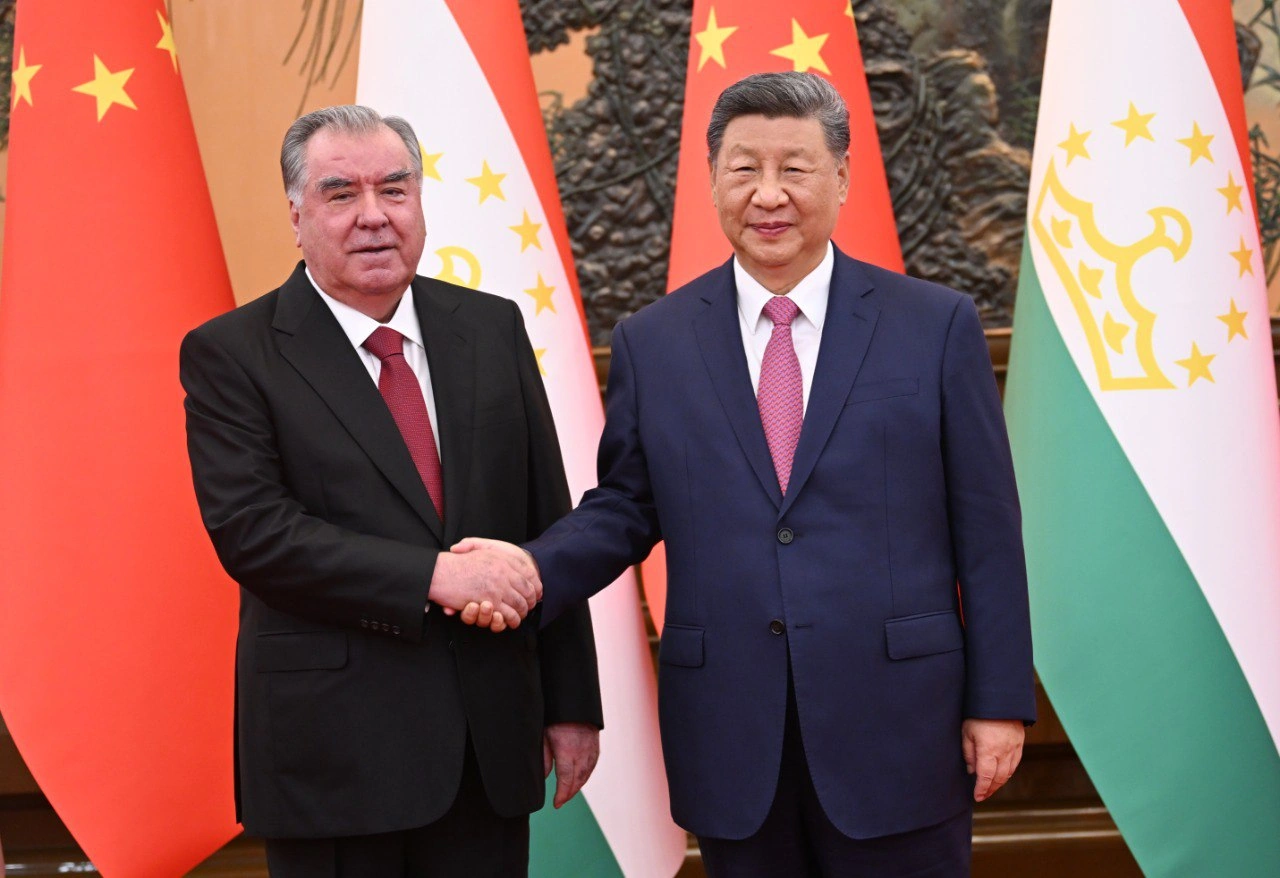
BAKU, Azerbaijan, May 11. President of
Tajikistan Emomali Rahmon will pay a state visit to China on May
11-14 at the invitation of President of the People’s Republic of
China Xi Jinping.
The visit comes amid a notable expansion of Tajik-Chinese
cooperation, ranging from trade and industry to logistics,
scientific exchange, and infrastructure security. In recent years,
China has firmly established itself as one of Tajikistan’s key
economic partners, while the bilateral agenda has expanded
significantly beyond traditional investment cooperation.
Trade turnover between Tajikistan and China reached $790.2
million from January through March 2026, increasing by 152.7%
compared to the same period last year. Tajik exports to China
amounted to $204.9 million, while imports stood at $585.3 million.
China accounted for 39.9% of Tajikistan’s total exports and 27.1%
of its imports.
In 2025, China’s share in Tajikistan’s foreign trade turnover
reached 26.4%. Tajik exports to China exceeded $523.8 million,
while imports reached $2.33 billion. Overall trade turnover with
China increased by 145.7% compared to 2024.
Against this backdrop, Dushanbe and Beijing continue to expand
cooperation in industry and technology. In early May, Tajik
Minister of Industry and New Technologies Sherali Kabir held talks
with Chinese Ambassador to Tajikistan Guo Zhijun. The sides
discussed the implementation of agreements reached at the level of
heads of state, as well as new joint projects and modernization of
the industrial sector.
Transport and logistics cooperation is also strengthening. The
region has already begun practical implementation of new routes
involving Tajikistan. In particular, the first container train was
launched along the China-Kyrgyzstan-Uzbekistan-Tajikistan route.
The project is being implemented with the participation of the
Uzbek "O'ztemiryo'lkonteyner" company and the Uzbek-Chinese joint
venture UTK International Logistics Co., Ltd. The route, spanning
more than 3,500 kilometers, is expected to reduce cargo delivery
times and expand transit opportunities in Central Asia.
At the same time, Tajikistan and Uzbekistan have launched a
pilot multimodal transport corridor
China-Tajikistan-Uzbekistan-Turkmenistan-Iran-Türkiye-Europe. The
project aims to develop transit infrastructure, digitalize
international transportation, and increase the capacity of border
crossings.
Security remains another key area of cooperation. Recently,
Tajikistan’s parliament ratified an agreement with China on the
construction of nine border posts along the Tajik-Afghan border,
worth around $60 million. The project is fully financed by the
Chinese side. In addition to the facilities themselves,
construction of roads, water supply systems, and energy
infrastructure is also planned. Although the exact locations have
not been disclosed, experts link the initiative to strengthening
control over the southern borders amid ongoing instability in
Afghanistan.
Scientific and educational cooperation is also expanding.
Representatives of the National Academy of Sciences of Tajikistan
participated in an international conference at Southwest University
in China, where issues of genetics and crop selection were
discussed. Following the event, a memorandum on scientific
cooperation was signed between the Chinese university and the
Institute of Botany, Plant Physiology and Genetics of
Tajikistan.
The upcoming visit of Emomali Rahmon to China may serve as a
platform to consolidate ongoing projects and discuss new
initiatives in industry, transport, energy, and digital
infrastructure. Potential outcomes include the signing of new
investment agreements, expansion of logistics routes across Central
Asia, deeper industrial cooperation, and enhanced collaboration in
the field of security.
At the same time, the further trajectory of relations will
largely depend on Tajikistan’s ability to effectively utilize
emerging economic and infrastructure opportunities, global trade
conditions, and the pace of development of the Chinese economy.
Another important factor is Tajikistan’s participation in
integrating new transport corridors into regional and Eurasian
supply chains, which could strengthen the country’s export
potential and reinforce its transit role in Central Asia.