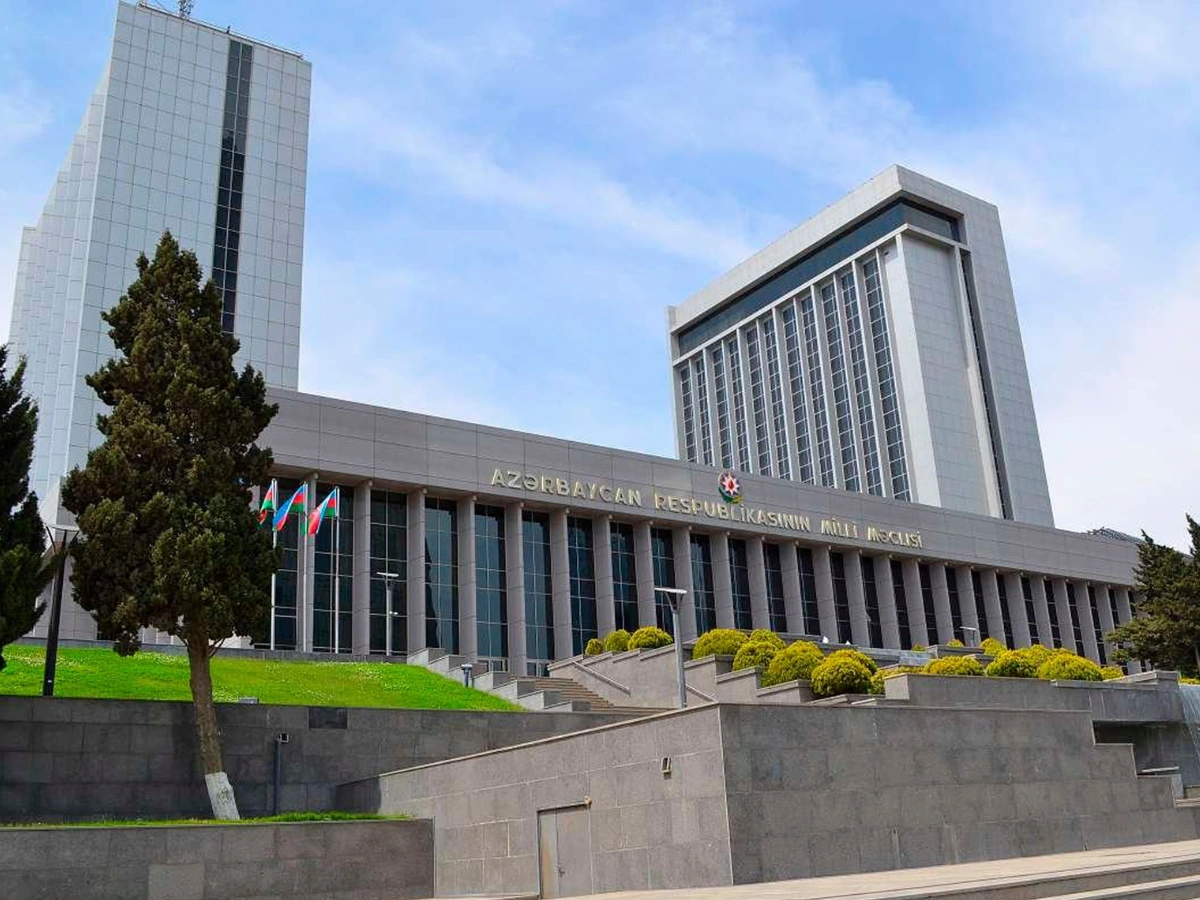
BAKU, Azerbaijan, May 4. The Temporary
Commission of the Azerbaijani Parliament against Foreign
Interference and Hybrid Threats has issued a statement on the
hybrid attack campaigns carried out against Azerbaijan by
pro-Armenian circles based in the West.
Trend presents
the statement.
Against the backdrop of the continuous successes achieved by
Azerbaijan under the leadership of President Ilham Aliyev and the
implementation of the peace agenda between Azerbaijan and Armenia,
as well as on the eve of the 13th session of the UN World Urban
Forum (WUF13) to be held in Baku, the use of hybrid threat elements
against Azerbaijan by pro-Armenian circles based in Western
countries has been recently observed.
The similarity of the observed activity with the activities
carried out on the eve of and during the COP29 conference held in
Azerbaijan necessitated an investigation by the Temporary
Commission of the Azerbaijani Parliament against Foreign
Interference and Hybrid Threats (the commission) within its
powers.
At that time, two main types of hybrid threats against
Azerbaijan were widespread - "Lawfare", that is, pressure through
legal means, and disinformation campaigns.
The commission issued a statement on May 2 of this year
regarding the coordinated disinformation campaign conducted by
pro-Armenian circles. At the same time, the Azerbaijani Parliament
gave the European Parliament, the House of Representatives of the
Belgian Federal Parliament, and the House of Representatives of the
Netherlands, who wanted to put pressure on Azerbaijan, the
appropriate responses, took the necessary steps, and expressed its
strong protest against the unfair and anti-Azerbaijani resolutions
adopted.
The commission first exposed fraud after a comparative analysis
of the texts of both the draft version (04.02.2026) and the adopted
version (16.04.2026) of the resolution adopted by the Chamber of
Representatives of the Belgian Federal Parliament, which also has
no legal force and is not binding.
Thus, while the draft was presented to the committee by author
Michel De Maegd and four other co-authors with a mild language, a
neutral title ("Resolution calling on Belgium to use the European
Union-Armenia and European Political Community summits to be held
in Yerevan in May 2026 to strengthen the peace process between
Armenia and Azerbaijan"), the final version was more radical,
"enriched" with demands for tough steps against Azerbaijan and
interference in the internal affairs of the country.
The purpose of using such tactics was to pass the draft
resolution through the Foreign Affairs Committee and recommend it
to the plenary session in a convenient form.
Another fact that increases the doubts in this regard is related
to the processes that took place during the plenary session on
April 16. First of all, according to the rules of procedure in the
Belgian parliament, all issues put to a vote during the plenary
session (whether a resolution or another document) are put to the
vote at the end of the session, not immediately after the
discussion.
As can be seen from the video footage of the discussion and
voting on this resolution against Azerbaijan, the meeting hall was
almost empty during the discussions, and only 30-35 out of 150 MPs
were present. This suggests that for about 80% of Belgian MPs,
neither the speeches made on the resolution nor its content were
important. However, since there were other important issues on the
agenda that day and participation in the vote was necessary, all
MPs in the hall (134 people) automatically voted for the resolution
against Azerbaijan.
Another noteworthy point about this resolution is that it
explicitly calls for "acting in accordance with the examples of the
Netherlands and Luxembourg in relations with Armenia." The
inclusion of such a phrase in the resolution suggests that MPs from
a number of European Union member states, operating under the
influence of the Armenian lobby, have formed a coordinated
"pro-Armenian bloc".
The facts established that the lobby organization "European
Armenian Federation for Justice and Democracy (EAFJD)",
headquartered in Brussels and operating in 13 European countries,
played a key role in this matter, that it had close relations with
several members of the Belgian Parliament Foreign Affairs
Committee, and that it made a presentation to that committee in
April 2025.
Considering Michel De Maegdin's activities in parliament from
2019 through 2026, seven of all the draft resolutions he authored
or co-authored were exclusively against Azerbaijan. Within the
framework of this activity, he addressed a total of six written
questions to government officials of Belgium regarding
anti-Azerbaijani issues or issues mentioning Azerbaijan. The number
of verbal questions he asked during plenary sessions was three, and
the number of such questions during committee meetings was 19.
The investigation determined that De Maegd was in institutional
cooperation with Armenian officials and Armenian lobby groups
operating in Belgium, including the "EAFJD". The analysis of his
social media and media activities showed that he often gave
interviews to Armenian media outlets and unequivocally displayed a
pro-Armenian position. De Maegd's statements in an interview with
Armenian media in March last year clearly demonstrate that the
parliamentarian was used as a tool of a hybrid threat by the
Armenian lobby.
"We must raise our voice. We must increase the pressure on
Azerbaijan by all possible means. I have discussed this issue again
with the Foreign Minister and the Prime Minister. This issue is
urgent. This draft resolution serves this purpose precisely. It
calls on the Belgian Government to take action and use its
influence. The resolution calls for sanctions against the Aliyev
regime. I will be as active on this issue as ever, and I will never
give up in this fight," he said.
The investigation into the "motion" document against Azerbaijan,
initiated by Don Ceder in the Dutch House of Representatives, has
determined that the Armenian lobby was behind these activities.
First of all, such documents, called "motions," are a form of
proposal addressed in writing by MPs and adopted by vote on any law
or policy document in committee meetings, and on any issue
discussed in plenary sessions.
On April 16, one of the "motions" voiced by Don Ceder was against
Azerbaijan, and the other was against Türkiye, mentioning
Azerbaijan by name. A noteworthy fact about the second "motion"
regarding the recognition of the so-called "Armenian genocide" by
the Dutch Government is that it also calls for using the experience
of other states, as in the resolution of the Belgian Parliament
dated April 16. If the experiences of the Netherlands and
Luxembourg were referred to there, Don Ceder's proposal requests
"to turn to Belgium and Luxembourg for advice and expert support,
if necessary."
An analysis of his anti-Azerbaijani and anti-Turkish activities
in the Dutch Parliament, written requests (Note: 12 of the total
requests he has submitted since he was elected as a member of
parliament have been anti-Azerbaijani and anti-Turkish), social
media and media posts and posts shows that, within the framework of
close cooperation with the lobby organization "Federation of
Armenian Organizations of the Netherlands (FAON)", he's also used
as a tool of hybrid threat against Azerbaijan, like his Belgian
colleagues. The official website of the Dutch Parliament indicates
that on January 28, 2024, he accepted two concert tickets as a gift
from the "Armenian Foundation of the Netherlands".
An analysis of the resolution "Supporting democratic stability
in Armenia", adopted by the European Parliament (EP) on April 30,
also revealed a number of interesting points.
The European Parliament consists of 720 members (currently this
figure is 719), which unite eight political groups and
independents.
The first striking point about the aforementioned resolution was
the date of the proposed changes to its draft. Thus, although each
of the six political groups represented in the EP submitted their
proposals separately, the fact that the date coincides with the
anniversary of the so-called Armenian genocide - April 24 - and the
reference there to the EP resolution "100th anniversary of the
Armenian genocide" dated April 15, 2015, further increases
suspicions about the role of the global Armenian network.
Examination of the identities and connections of a total of 36
people who submitted the proposals determined that almost all of
them had connections with the Armenian lobby and occasionally spoke
out with pro-Armenian positions.
On April 28, the final draft of the resolution was proposed by 42
people represented in diverse political groups and submitted to the
plenary session. On April 30, out of the actual 719 MPs, 571 people
participated in the vote, of which 476 were in favor of the
resolution, 47 were against, and 48 abstained. Later, two MPs also
expressed their intention to vote in favor of the document.
The country representation of those 42 people is as follows:
• Poland – 8 people;
• Belgium and Lithuania – 5 people each;
• Czech Republic and Slovakia – 3 people each;
• Germany, Netherlands, Portugal, Spain, Croatia, and France – 2
people each;
• Austria, Bulgaria, Greece, Italy, Luxembourg, and Romania – 1
person each.
By political group:
• European People's Party – 19 people;
• European Conservatives and Reformists – 9 people;
• Renew Europe – 8 people;
• Socialists and Democrats – 5 people;
• Greens/European Free Alliance – 1 person.
Although the resolution is directly related to Armenia, all
points criticizing the country's domestic policy in the proposals
for the draft were removed from the final version.
At the same time, although two of the projects proposed by the
six political groups do not contain any negative points regarding
Azerbaijan, the analysis of the proposals of 34 MPs representing
the Left, Socialists and Democrats, European People's Party and
European Conservatives and Reformists groups shows that they
contain several unfair, biased and extremely biased statements
regarding Azerbaijan, which imply interference in the internal
affairs of the country, contradict the norms and principles of
international law. The parliamentarians who came up with the most
strongly anti-Azerbaijani initiatives were Giorgos Georgiou
(Cyprus) and Marina Mesure (France) on behalf of the Left
group.
The analysis of the initiatives used against Azerbaijan in the
resolution itself and the proposed annexes to it determined that
they are identical to the theses periodically voiced by the global
Armenian network and individual lobby groups.
The facts regarding the individuals represented in all three
parliaments once again give reason to say that they are active
members of the Armenian lobby network, act in a coordinated manner
in accordance with the anti-Azerbaijani and anti-Turkish agenda,
and are used as hybrid threat tools.
Analysis of these networks shows that the same organizations and
individuals demonstrated similar "activity" in the anti-Azerbaijani
processes in 2024. Detailed information about them can be found in
the report "Hybrid attacks against COP29: Our society must not fall
victim to hybrid threats!", presented by the commission in December
2024.
(https://meclis.gov.az/news.php?id=5851&lang=az)
Forces that don't want the implementation of the peace agenda
between Armenia and Azerbaijan and the process to reach its logical
conclusion, certain circles that oppose the cooperation,
development, and prosperity in the region, and the happy future of
the peoples, are trying to undermine the relations that are being
formed between the two countries in every possible way.
According to the сommission's conclusion, such activities are
being carried out purposefully and aim to attract attention ahead
of the "European Political Community" Summit and the European
Union-Armenia Summit in Armenia.
The extent to which the Armenian authorities are involved in
these processes is also a serious question and subject to doubt.
The Armenian officials should take serious steps to prevent such
situations that will undermine the peace agenda, or clarify the
issue. Otherwise, this may be perceived as a disingenuous approach
to the peace agenda.
Finally, the Commission against Foreign Interference and Hybrid
Threats appeals to its parliamentary colleagues in foreign
parliaments and asks them not to support the false and
"peace-loving" initiatives of some of their colleagues on issues
that could undermine the fragile peace process between Armenia and
Azerbaijan, as a result of the theses and activities of the
Armenian lobby, as well as relations between the countries.