BAKU, Azerbaijan, May 4. Against the backdrop
of intensifying geopolitical turbulence and the transformation of
the global security and economic architecture, high-ranking
European leaders are visiting Azerbaijan one after another. This
serves as an indicator of the country's growing role as a reliable
and strategically significant partner for Europe. In this context,
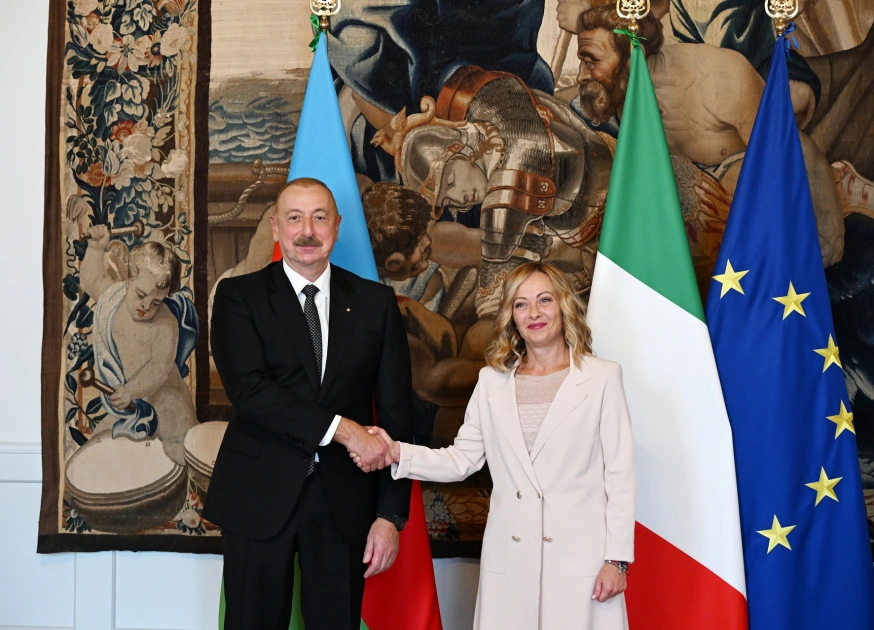
the upcoming visit of Italian Prime Minister Giorgia Meloni takes
on special significance, reflecting not just the stability of
bilateral relations, but their gradual transformation into a
multifaceted strategic partnership encompassing energy, transport,
investment, the digital economy, and the humanitarian sphere.
Energy cooperation remains the foundation of bilateral
relations, setting the pace for all other areas. Azerbaijani gas
supplies to Italy via the Trans-Adriatic Pipeline (TAP) reached 9.5
billion cubic meters in 2025, accounting for about 16 percent of
Italy's total gas imports. Since TAP was commissioned, total
supplies have exceeded 42 billion cubic meters, demonstrating
Azerbaijan's high degree of integration into Europe's energy
architecture. Furthermore, total Azerbaijani gas exports to the
European Union in 2025 reached 12.5 billion cubic meters, a 53.8
percent increase compared to 2021, reflecting Europe's accelerated
adaptation to new energy balance conditions.
The memorandum on strategic energy cooperation between the EU
and Azerbaijan, signed in Baku in July 2022 with the participation
of Ursula von der Leyen, played a key role in institutionalizing
this partnership. The document established the goal of doubling gas
supplies to Europe to 20 billion cubic meters annually by 2027.
Practical implementation is already underway: the first stage of
the TAP expansion, commissioned in January 2026, provided an
additional 1.2 billion cubic meters of capacity, with 1 billion
directed to Italy. This qualitative shift strengthens Italy's role
as a key energy hub for Southern Europe.
The importance of Azerbaijani gas for Italy grows amid global
market instability. Rome's negotiations with suppliers like the US,
Azerbaijan, and Algeria following the suspension of supplies from
Qatar demonstrate a drive for diversification. Azerbaijan is
perceived as one of the most reliable partners capable of ensuring
uninterrupted supplies. It is no coincidence that the Italian side
emphasizes the strategic nature of TAP as infrastructure directly
linking the Caspian region to European markets.
Expansion of energy cooperation is acquiring pan-European
significance. In January 2026, Azerbaijani gas supplies to Austria
and Germany began via Italy, confirming Italy's role as a transit
hub. Simultaneously, the dialogue is shifting toward a "green"
agenda. Italian expertise in renewable energy is in demand in
Azerbaijan, which is implementing a strategy to diversify its
energy balance. CESI SpA's involvement in feasibility studies for
the "Caspian–Black Sea–Europe" and "Central Asia–Azerbaijan" green
corridors points toward a new energy geography.
The investment dimension also shows qualitative changes. The
State Oil Fund of Azerbaijan (SOFAZ) has entered projects in Italy,
including a 49 percent stake in Enfinity Global’s solar portfolio,
reflecting a move toward a model of mutual investment. Investments
in the transport company Italo – Nuovo Trasporto Viaggiatori S.p.A
further highlight deepening economic interdependence.
This naturally extends to transport and logistics, centered on
the Middle Corridor. If Italy is Azerbaijan's "gateway to Europe,"
Azerbaijan is Rome's strategic entry point to Central Asia. Italy's
interest in this route reflects a broader European trend toward
diversifying transport paths between Europe and Asia. Furthermore,
Italy’s support for the normalization of relations between
Azerbaijan and Armenia highlights the link between regional
security and economic prosperity.
Economic indicators confirm this upward trend. In 2025, trade
turnover reached $11.86 billion, a 4.1 percent increase. Italy
remains Azerbaijan's largest export destination. Italian direct
investment in Azerbaijan has more than tripled, while Azerbaijani
investments in Italy reached $125.1 million. Cooperation is also
expanding into fintech and the digital economy through discussions
between the Central Bank of Azerbaijan and Italian companies like
Numia and Bancomat.
Finally, the humanitarian dimension adds depth to the
relationship. Cooperation with the Vatican, initiated in 2012, has
expanded to include the restoration of the Catacombs of Saints
Marcellinus and Peter and the Catacombs of Saint Sebastian. The
Heydar Aliyev Foundation has collaborated with the Pontifical
Commission for Sacred Archaeology on restoration projects, the
digitization of manuscripts with the Vatican Apostolic Library, and
works within the Vatican Museums and St. Peter's Basilica.
Thus, Giorgia Meloni's visit takes place as bilateral relations
reach a new level of maturity. While energy remains the core, the
combination of energy, transport, investment, and humanitarian ties
makes this partnership truly multifaceted, contributing to the
broader goal of building sustainable links between Europe and
Asia.