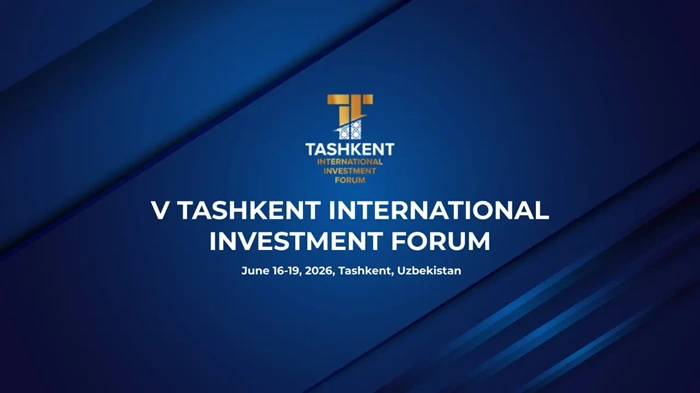
BAKU, Azerbaijan, April 21. The 5th anniversary
of the Tashkent International Investment Forum (TIIF), scheduled to
take place in Uzbekistan’s capital from June 16-19, 2026, is poised
to exceed the expectations typically associated with a conventional
business event.
For a landlocked nation like Uzbekistan, which is heavily
reliant on transit routes, external capital serves not only as a
financial resource but also as a vital means of overcoming
geographical limitations. Through strategic investments, Tashkent
is simultaneously addressing multiple structural challenges:
mitigating logistical isolation, enhancing export capacities, and
fostering the development of an interconnected economic
framework.
Consequently, the investment agenda focuses primarily on sectors
such as transport corridors, energy, and digital infrastructure.
The goal extends beyond simply constructing roads or power plants
to encompass the creation of a comprehensive, interconnected
economy that is seamlessly integrated into both regional and global
value chains.
The magnitude of these transformative efforts is underscored by
the figures: by the end of 2025, foreign investment inflows reached
a record $43.1 billion. Of this total, $30.5 billion was directly
tied to agreements and contracts finalized during the forum itself.
This underscores the TIIF’s role not merely as a forum for dialogue
but as a highly effective mechanism for attracting tangible capital
investment.
For comparison, Kazakhstan attracted $14.9 billion in foreign
direct investment during the first nine months of 2025. While this
may suggest a competitive landscape, it is more of an indicator
that Uzbekistan is emerging as one of Central Asia’s most dynamic
investment destinations.
However, the most significant shift lies not merely in the
volume of investments but in their structural orientation. Capital
is increasingly directed toward long-term sectors such as energy,
industry, transport, urban development, and the digital economy.
This trend signals a strategic repositioning, where investors are
beginning to view Uzbekistan not as a transient opportunity but as
a long-term platform for establishing a sustained economic
presence.
Ali Malik, Senior Investment Specialist at the Asian Development
Bank, highlighted several key factors driving international
investment into Uzbekistan: regulatory stability, the availability
of banking instruments for transactions, and risk mitigation
mechanisms, such as partial credit guarantees and blended finance.
These elements collectively reinforce the country's appeal to
global investors.
In this context, external evaluations play a crucial role.
According to Boston Consulting Group, Uzbekistan is currently
positioned with a strategic "window of opportunity" over the next
5-10 years, which could serve as a pivotal period for accelerating
its economic growth. The reforms that have already been
implemented, including currency liberalization, tax simplification,
and efforts to foster private sector development, are starting to
produce cumulative effects that are likely to further strengthen
the country’s investment appeal.
The energy agenda deserves special attention, as it has become
one of the main drivers of investor interest. Uzbekistan has set an
ambitious target to increase the share of renewable energy in
electricity generation to 54% by 2030. Solar and wind power plants
with a combined capacity exceeding 4 GW are already operational,
while the overall project pipeline surpasses 19 GW.
At the same time, the public-private partnership (PPP) market is
taking shape. As of early 2025, PPP projects worth around $28
billion have been signed. For investors, this means clear rules of
the game: standardized power purchase agreements (PPAs), long-term
guarantees, and transparent return mechanisms.
Energy, however, is only part of a broader picture. Transport
corridors linking Central Asia with China, the Middle East, and
Europe are also developing активно. Uzbekistan is positioning
itself as a transit hub, including through projects within the
Trans-Caspian corridor and southern routes via Afghanistan.
Additional momentum comes from digitalization and urban
development. Investments are flowing into data centers, fintech,
e-commerce, and smart infrastructure, forming a new layer of the
economy that is less dependent on raw materials.
The forum itself is evolving into a multi-level platform. In
2025, it brought together more than 3,000 participants from over
100 countries. In 2026, an even broader geography is expected, with
business forums planned with the United States, South Korea,
Turkey, and European countries, as well as an investment dialogue
between China and SCO members.
At the same time, TIIF has moved beyond being a purely
image-building event. Its effectiveness is measured not by the
number of memorandums signed, but by how many projects reach
implementation. In this sense, the forum has become an integral
part of the country’s investment policy.
The fifth forum takes place at a moment when several factors
converge: ongoing reforms, improving sovereign ratings, discussions
on launching an international financial center, and the
introduction of new instruments such as alternative investment
funds. This combination creates a rare window of opportunity for
investors willing to engage in fast-growing markets.
The key question now is whether Uzbekistan can convert strong
interest into a sustained inflow of capital and long-term projects,
or whether some agreements will remain on paper.
If current momentum is maintained, Tashkent has the potential to
establish itself not just as a regional investment platform but as
one of the emerging economic centers of Eurasia. The answer will
largely depend on the outcomes of TIIF-2026.