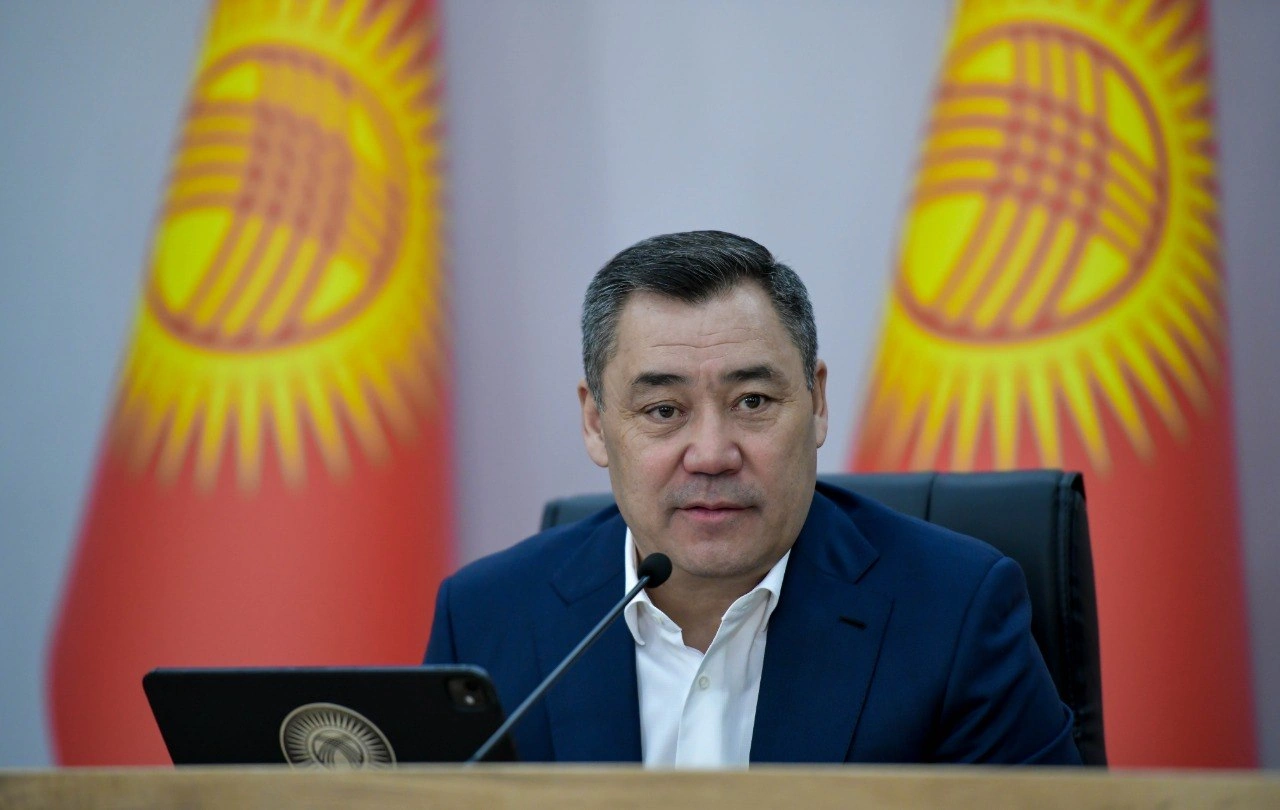
BAKU, Azerbaijan, April 18. President Sadyr
Japarov of Kyrgyzstan, during his recent working visits to various
regions, has undertaken a comprehensive review of large-scale
infrastructure and socio-economic projects across multiple sectors.
These regional visits reflect a cohesive approach to development,
positioning projects such as roads, schools, hospitals, and local
economic initiatives as interconnected components of a unified
regional development program, rather than isolated efforts.
The implementation of these projects is largely carried out
within the framework of initiatives promoted by the president,
aimed at accelerating the development of regions and modernizing
the country's key infrastructure.
In the course of his visits to districts in the Osh region,
including Naryn-Kulja, Uzgen, and Kara-Kulja, significant emphasis
has been placed on improving fundamental infrastructure,
specifically in the areas of transportation, water supply,
irrigation, and energy. Notably, over the past five years, more
than 120 kilometers of roads have been asphalted, with an
additional 90 kilometers slated for completion. Concurrently,
projects aimed at enhancing the availability of drinking water are
underway, with several settlements already connected to water
supply systems, while others remain under development.
Another crucial aspect of the regional development agenda is the
improvement of social infrastructure. Simultaneous initiatives are
underway across various districts to construct schools,
kindergartens, medical centers, and primary healthcare facilities.
Noteworthy developments include the establishment of a 100-bed
hospital, a 40-bed medical facility, and a substantial 350-bed
medical center. These healthcare projects are part of a broader
strategy to alleviate pressure on the existing healthcare system by
expanding regional capacity and improving access to essential
services.
Simultaneously, the investment dimension of the regional
development policy is being reinforced. In several districts, new
enterprises are either under construction or in the planning
stages, spanning a range of sectors from agricultural processing to
the production of construction materials and light industry.
Additionally, the development of municipal markets, logistics
facilities, and agricultural packaging enterprises is being
prioritized, thereby enhancing the role of local administrations in
fostering economic growth.
The energy sector is emerging as a significant focus of
development efforts. In parallel with the modernization of existing
energy infrastructure, small hydropower plants, with capacities
ranging from several hundred kilowatts to nearly 8 MW, are being
established in various regions. These energy projects are
accompanied by the renovation and upgrading of irrigation systems
and canals, directly aligning with the agricultural specialization
of these areas.
Housing and public infrastructure projects also form an integral
part of the ongoing regional development. State-supported mortgage
programs are facilitating the construction of multi-apartment
residential complexes, while efforts to rejuvenate public spaces
such as parks, stadiums, and recreational areas are underway. Some
of these initiatives involve large-scale urban planning projects,
including the construction of up to 16 residential blocks and
nearly one thousand apartments within a single housing development.
This reflects a holistic approach to urban and suburban
development, which seeks to address both housing needs and the
broader quality of life for local populations.
Overall, this policy reflects a systemic commitment to improving
the quality of life of the population and strengthening the
economic resilience of the regions, thanks to the President of
Kyrgyzstan.
The overall logic of the current regional development model is
based on synchronizing three key areas: infrastructure, social
services, and the local economy. Within this framework,
infrastructure projects provide the foundation, social facilities
ensure internal demand and stability, while municipal enterprises
and investment initiatives create potential growth points for
employment.
In terms of possible dynamics, several scenarios can be
identified. In the baseline scenario, gradual alignment of
infrastructure conditions between regions will continue, with a
high share of state financing remaining. In an accelerated
scenario, the development of municipal enterprises and local
investment projects could lead to the emergence of more independent
economic centers within districts, particularly in agricultural and
border areas.
However, there remains a risk of uneven project implementation,
where development pace depends on the administrative efficiency of
specific regions, the quality of project management, and the
sustainability of budget financing. An additional factor is the
ability of new facilities - from medical centers to industrial
enterprises- to integrate into a long-term economic model rather
than remaining isolated projects.
Overall, the current regional policy of Kyrgyzstan demonstrates
a shift from isolated infrastructure construction toward an attempt
to build an interconnected development system at the district
level, where infrastructure, social services, and the economy are
treated as a single management framework.