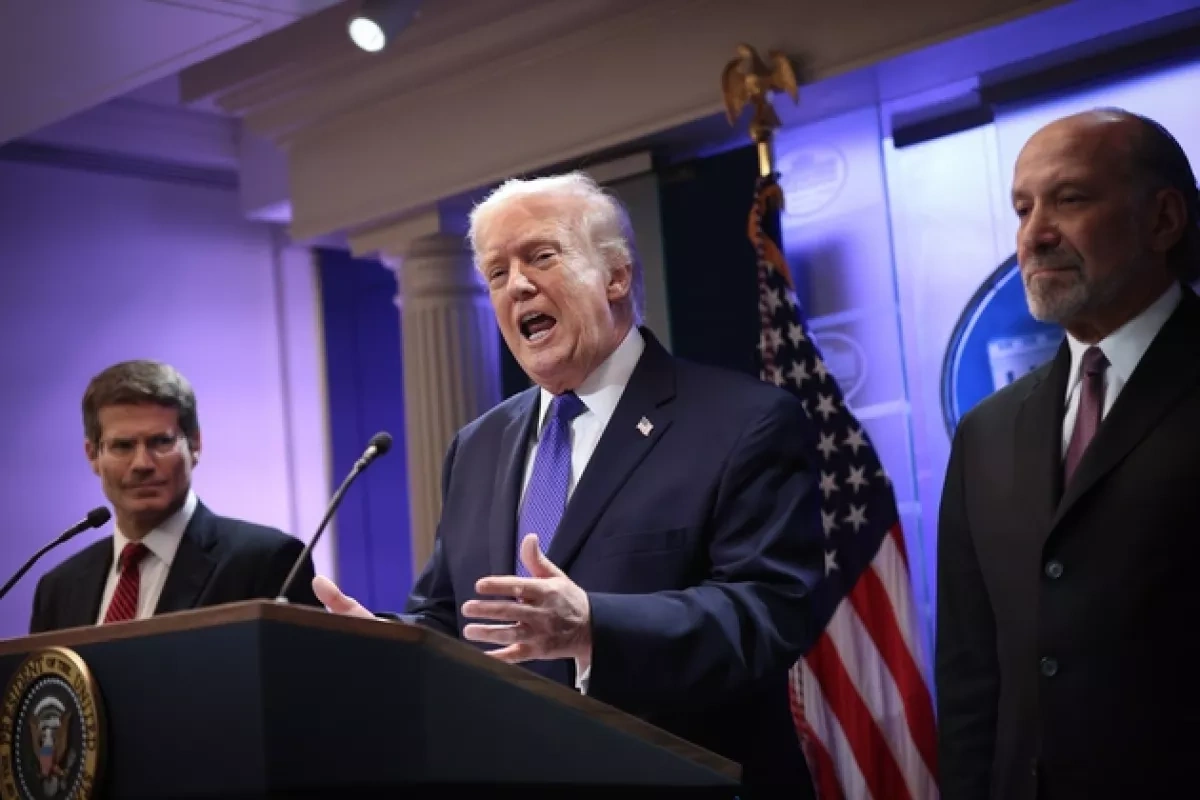
A federal trade court on Friday (April 10) raised doubts over the legality of President Donald Trump’s 10% global tariff imposed in February, following a Supreme Court ruling that struck down his earlier tariff programme.
A three-judge panel of the U.S. Court of International Trade appeared uncertain whether the administration correctly relied on a 1974 trade law to justify the new duties, which are temporary and set to expire after 150 days unless extended by Congress, Politico reports.
The case follows the Supreme Court’s decision earlier this year invalidating Trump’s broader “Liberation Day” tariffs, which had been imposed under emergency powers on dozens of countries.
The administration has since turned to Section 122 of the Trade Act of 1974, which allows temporary global tariffs of up to 15% in response to a “large and serious” balance-of-payments deficit.
During nearly three hours of hearings, judges and lawyers debated whether the statute, written in the era of fixed exchange rates, can be applied to today’s trade system.
“We’re not quite sure how to translate 1974 into 2026,” Judge Timothy Stanceu said.
Opponents, including small businesses and Democratic-led states, argued the law was intended for narrow foreign exchange or monetary crises, not persistent trade deficits.
“We think that in the use of the term ‘balance of payments’ as it was there, as it was understood in the 1970s … it does not exist today,” said Brian Marshall of the Oregon Attorney General’s Office.
A Justice Department lawyer defended the administration, saying trade deficits remain part of broader balance-of-payments concerns.
“A trade deficit was a large driver of a balance of payments deficit in 1974 as it is today,” DOJ lawyer Brett Shumate said. “We’re not on the gold standard any more. We don’t have a fixed currency, but we can still have balance-of-payment problems.”
Opponents also urged the court to apply the “major questions doctrine”, arguing Congress had not clearly authorised such broad executive power.
“So, the ‘major questions doctrine’ would say, ‘Well, this needs to be a clear statement from Congress,’” said Jeffrey Schwab of the Liberty Justice Center.
By Aghakazim Guliyev