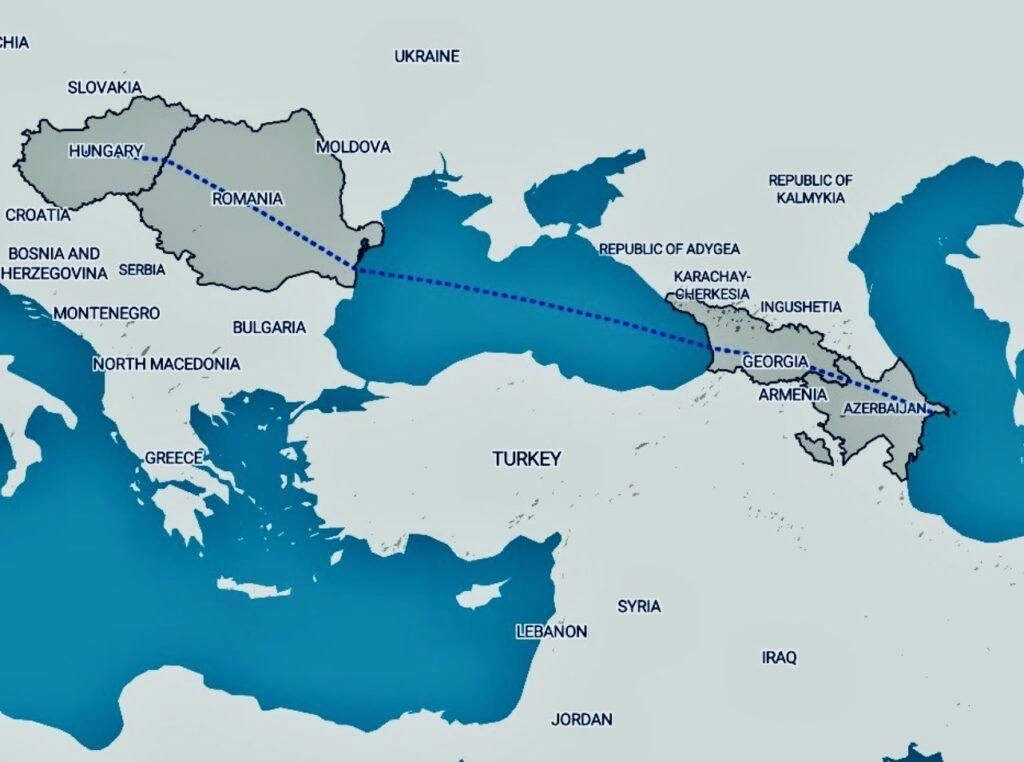
BAKU, Azerbaijan, February 7. Black Sea Cable
Project, which envisages green energy transportation from
Azerbaijan and Georgia to Europe is a major strategic step in
connecting energy markets, Trend reports citing the EU-funded meta-study.
“A major strategic step in connecting the energy markets is the
planned subsea power cable from Georgia to Romania, which was
included in the 2nd list of Projects of Common Interest and Project
of Mutual Interest (PCI/PMI list) in December 2025, and which will
support the balancing of both power systems and the integration of
more renewable energy on both sides. The project is expected early
in the 2030s. Crucially, to make most use of this link, domestic
networks must be reinforced, notably with stronger 400 kV lines in
Romania and Bulgaria (e.g., in Dobrogea and across the Danube). To
physically realise these market interconnections, the region is
also developing the necessary logistical backbone to deploy
large-scale energy infrastructure,” reads the study.
Analysts note that in Georgia, the modernisation of the Batumi
and Poti ports, alongside the revival of the Anaklia deep-sea port,
is strategically aligned to handle the heavy equipment required for
the subsea cable and renewable generation projects.
“This logistical readiness is mirrored on the European shore of
the Black Sea, where Bulgaria and Romania are upgrading the ports
of Constanța and Varna. By equipping these hubs with heavy-lift
quays and specialized storage for offshore wind components, these
nations are establishing a synchronized industrial ecosystem
essential for constructing the physical corridors that will link
these energy markets,” the study says.
On December 17, 2022, Azerbaijan, Georgia, Romania, and Hungary
signed a strategic partnership agreement, which includes plans for
the construction of a 1,000 MW submarine energy cable under the
Black Sea, spanning 1,195 kilometers. This cable will transmit
green electricity generated in Azerbaijan and Georgia to Romania,
with further transport to Hungary and the rest of Europe, enhancing
Europe’s access to renewable energy from the Caucasus region.
Bulgaria has also expressed interest in joining the project.
In September 2024, Romanian transmission system operator
Transelectrica, Georgian transmission system operator Georgian
State Electrosystem, Azerbaijan’s power utility AzerEnerji, and
Hungary’s power utility MVM established a joint firm to install a
submarine cable under the Black Sea.