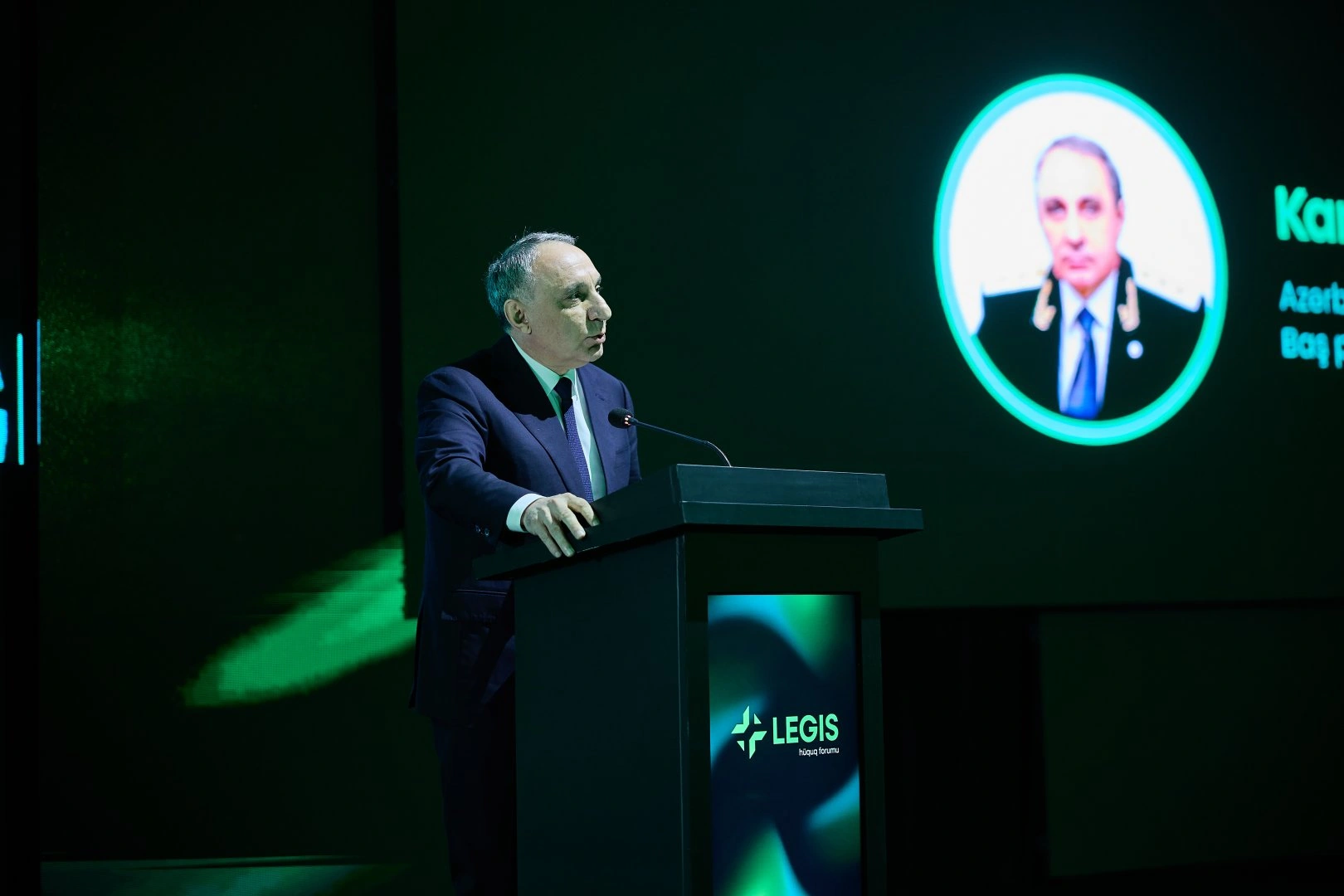
BAKU, Azerbaijan, February 5. Azerbaijan is
making significant progress in sending criminal cases to courts
electronically, with technical challenges largely resolved,
Prosecutor General Kamran Aliyev stated during his speech at the
"LEGIS" International Legal Forum in Baku, Trend reports.
Aliyev noted that a draft law prepared by the Prosecutor
General’s Office on legislative amendments, currently under review
in the Azerbaijani Parliament, also addresses other digital
matters, including electronic evidence collection, preservation,
and issues previously lacking legal regulation.
Aliyev emphasized that artificial intelligence (AI) technologies
have begun to be used in prosecutorial processes. "Since the end of
last year, AI has been applied to determine the appropriate
recipient for incoming applications and to propose which official
should review a document. AI is also being tested to assist in
criminal investigations and to help manage citizen inquiries
received by the Prosecutor’s Office under staff supervision," he
explained.
He stressed that AI does not replace humans but serves as a tool
to support legal decision-making, making it more objective and
efficient. However, Aliyev warned that the use of AI carries risks,
particularly in areas lacking legal regulation, and that clear
rules are needed to ensure ethical and responsible
implementation.
"The core challenge lies in the absence of a clear legal
framework governing the use of AI technologies. In particular,
there is ongoing debate over liability; should responsibility for
any incorrect decision, advice, or action lie with the AI
manufacturer or the user?
I believe that to ensure AI is used ethically and responsibly, a
comprehensive regulatory framework with clear rules and standards
must be established.
It is also important to highlight the strong commitment of the
country’s political leadership to AI development. This is reflected
in key initiatives, including the Presidential Order approving the
'Artificial Intelligence Strategy of the Republic of Azerbaijan for
2025-2028,' signed on March 19, 2025. One of the strategy’s primary
goals is to embed AI into national legislation by establishing its
foundational norms and defining ethical principles and guidelines
for its use.
Looking ahead, one of the main risks is excessive reliance on
AI, which could erode individuals’ independent thinking, analytical
skills, and decision-making abilities. This dependence is
particularly concerning for young people, as it may foster
intellectual passivity," he noted.
Aliyev cautioned that overreliance on AI could weaken
independent thinking and analytical skills, especially among youth,
potentially diminishing the human factor in decision-making.
"Ultimately, if unchecked, the human factor could be
overshadowed by technology, allowing systems to dominate
decision-making processes. Legal regulation is essential to
maintain the proper balance, and in some cases, restrictions on AI
use may be necessary. For instance, several countries have already
limited AI applications within higher education institutions to
safeguard human oversight and critical thinking," he concluded.
Stay up-to-date with more news on Trend News
Agency's WhatsApp channel