BAKU, Azerbaijan, January 6. The beginning of
2026 allows us to view our victory in Karabakh not in terms of
emotions or the current political situation, but in the context of
historical outcomes. This is not simply a matter of military
success or the restoration of territorial integrity, but a rare
case of absolute and complete victory, brought to a political,
diplomatic, and internationally recognized conclusion.
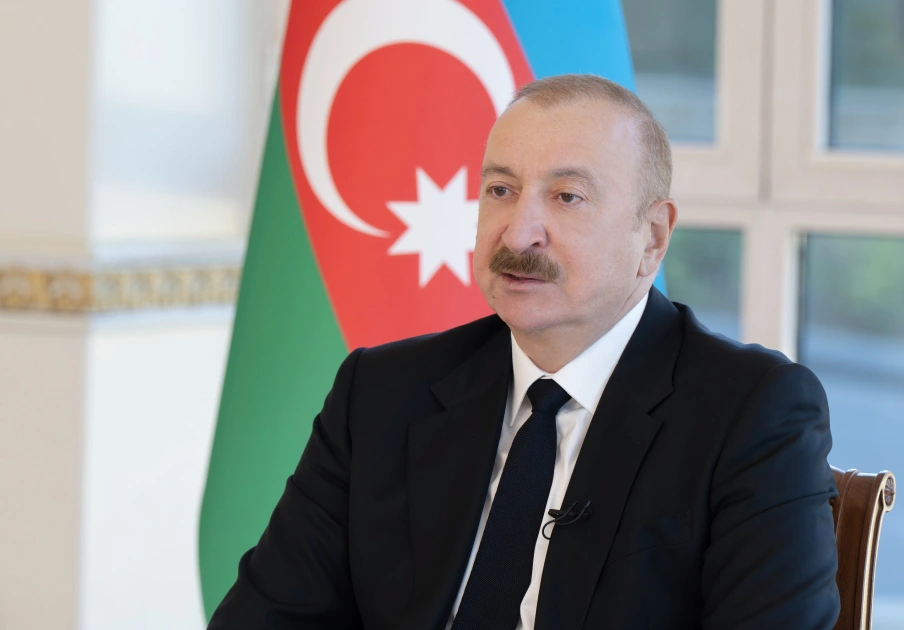
President Ilham Aliyev addressed this directly in an interview
with Azerbaijani television channels on January 5. Reflecting on
the events of 2025, he highlighted that, from a political
perspective, the war between Armenia and Azerbaijan was
conclusively brought to an end last year.
“We have been living in peace for several months now. We are
learning what it is like to live in peace since after gaining
independence, and even before that, the people and the state of
Azerbaijan lived in a state of war,” the head of state said.
What is crucial here is not merely the fact of a ceasefire, but
the completeness of the outcome. The Second Karabakh War, the
subsequent anti-terrorist operation, and the political decisions of
2025 form a single, logically completed chain. The victory achieved
on the battlefield was consolidated in the political sphere, as the
head of state underlined, “in the number one office in the world,”
which became one of the most significant events in the entire
history of independent Azerbaijan.
The thoroughness of the outcome sets the Karabakh case apart
from most conflicts of the late 20th and early 21st centuries.
Since World War II, the international system has repeatedly
encountered situations in which military superiority and actual
territorial control failed to secure international recognition of a
conflict’s results. The Korean War, for instance, concluded not
with a peace treaty but with an armistice, freezing the peninsula’s
division and creating one of the world’s most volatile lines of
tension. In Cyprus, the conflict produced a de facto reality that
has remained unrecognized under international law for decades,
fostering chronic instability in the Eastern Mediterranean.
Likewise, the Palestinian-Israeli confrontation, despite multiple
military and political phases, has never reached a final
settlement, becoming a persistent source of regional crises.
Numerous similar examples exist across modern history, from the
Balkans to Africa.
A defining feature of these conflicts has been their
incompleteness: either the military victory was not recognized, the
political solution failed to reflect the real balance of power, or
external actors deliberately maintained “managed uncertainty”
instead of securing a final resolution. The result was frozen
conflicts, competing claims of legitimacy, constant risks of
escalation, and, ultimately, prolonged suffering for entire
populations.
In contrast, the victory in Karabakh stands out as a rare
exception. Azerbaijan not only reestablished control over its
territories but also achieved full recognition of the new reality
by the international community, including leading states and major
international institutions. Today, Azerbaijan’s sovereignty over
the liberated territories is unambiguously acknowledged by key
global powers, the United States, the European Union and its major
members, Russia, China, as well as influential regional actors.
This broad international consensus is critically important, as it
decisively distinguishes Azerbaijan’s Karabakh victory from most
post-war conflicts, where battlefield gains often remained
contested or ignored.
As President Ilham Aliyev recalled in the same interview, during
the period of activity of the Organization for Security and
Cooperation in Europe (OSCE) Minsk Group, Azerbaijan was
persistently urged to “accept the realities on the ground,” while
resolutions of the United Nations Security Council and norms of
international law were ignored.
“And all my arguments about Security Council resolutions,
international law, and violations of international law were met
again with a kind of wall of silence. So, realities on the ground.
I said, okay, we will change the realities on the ground. So we did
it, and now the whole world recognizes it,” the head of state
noted.
A particularly striking aspect of this story is the reassessment
of the role of international law. In the interview, President Ilham
Aliyev described the existing system as outdated and ill-equipped
to address modern challenges. For decades, international
resolutions, principles, and declarations offered little support to
Azerbaijan, while appeals to territorial integrity and United
Nations Security Council decisions, in his words, repeatedly struck
a “wall of silence.” Meanwhile, the principle of
“self-determination” was often misused to justify aggressive
separatism, in direct contradiction to fundamental norms of
international law.
It was in this context that the formula of “realities on the
ground” acquired a fundamentally different meaning for Azerbaijan.
What had previously been imposed on Baku as an argument against its
legitimate demands was transformed into an instrument for restoring
justice.
Through decisive action, President Ilham Aliyev changed the
reality on the ground and, in doing so, compelled the world to
recognize it.
This serves as a powerful example of how a state, even without
superpower status but armed with political will, military
capability, and economic resources, can actively shape the
international environment rather than remain a passive
observer.
Equally significant are the domestic effects of this achieved
peace. According to the head of state, even the first months of
life without war have already yielded tangible results: stronger
confidence in stability and security, a positive shift in public
sentiment, and expanding economic opportunities. This highlights a
crucial distinction between a complete victory and a
“semi-victory”: here, peace is not merely declarative; it is
practical, working to strengthen the state and improve the lives of
society.
Ultimately, the victory in Karabakh is an example of how peace
is only possible for the strong, and that it is precisely strength,
exercised responsibly and translated into political results, that
can put an end to protracted conflicts. In a world where so many
wars have remained unfinished since World War II, Azerbaijan's
experience stands out as a rare but telling precedent. This is
precisely the historical significance of the victory achieved by
President Ilham Aliyev—not only for Azerbaijan, but for the entire
system of modern international relations.
Stay up-to-date with more news on Trend News
Agency's WhatsApp channel