ASHGABAT, Turkmenistan, October 21.
Turkmenistan’s cooperation with the UN and international partners
in the area of methane emission reduction is aimed at integrating
satellite monitoring, emission reduction technologies, and policy
development, which could help attract international investment in
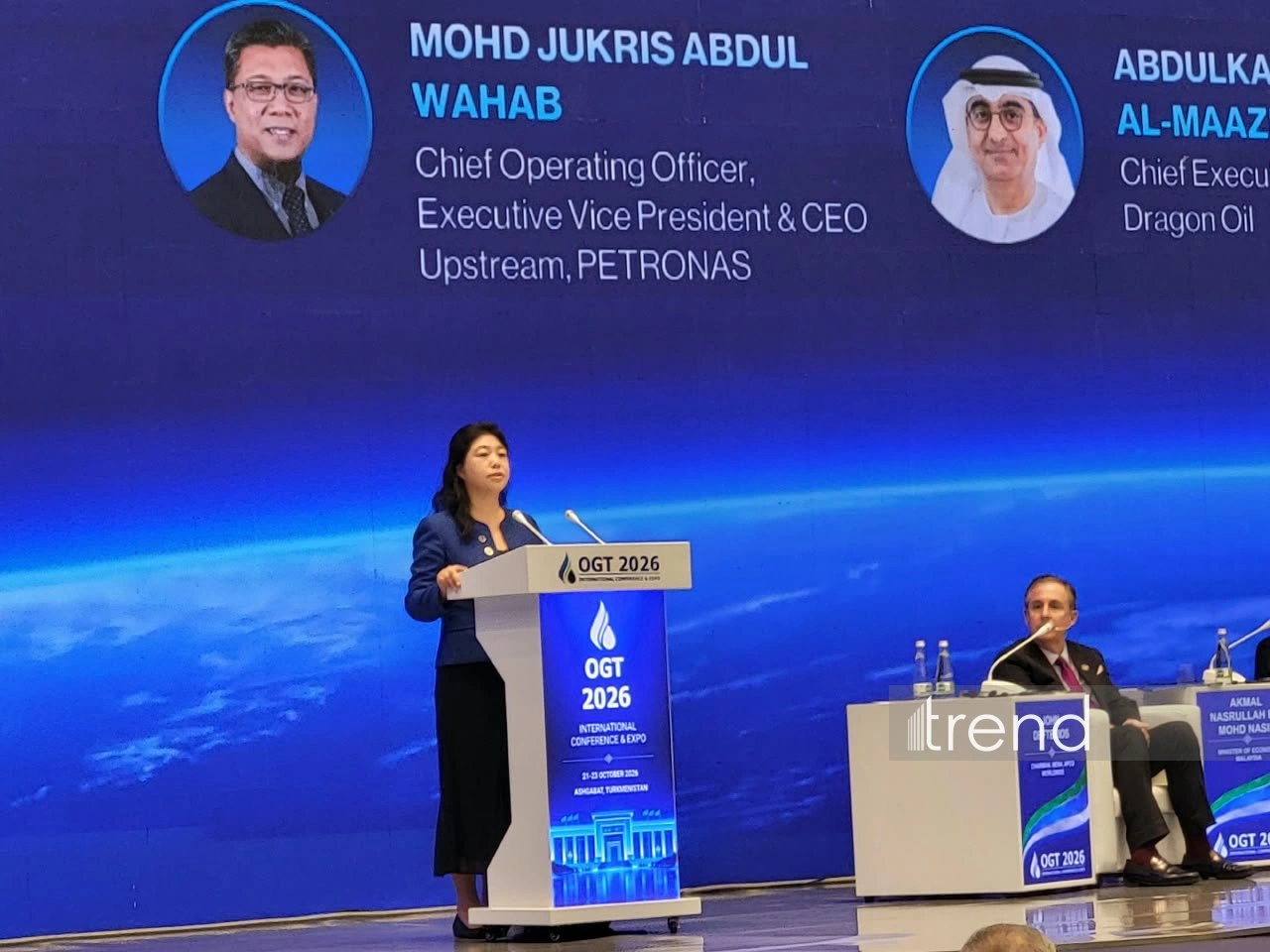
sustainable development, the UN Resident Coordinator in
Turkmenistan, Xiaojun Grace Wang, said at the international
conference and exhibition “Oil and Gas of Turkmenistan – 2026” (OGT
2026) in Ashgabat, Trend's special correspondent reports.
According to her, the United Nations Environment Programme
(UNEP) noted Turkmenistan’s progress in reducing methane emissions
in a recent global report. The satellite-based methane emission
early warning and response system has identified eight major
measures taken by the country to reduce these emissions.
“This lays a solid foundation for us to achieve even more
together,” Wang noted.
She noted that the UN, in collaboration with international
partners and national authorities, is promoting a joint program to
reduce methane emissions that integrates factual data, policy
decisions, emission-reduction technologies, satellite monitoring,
and reporting.
According to the UN representative, the value of this initiative
extends beyond individual projects: it serves as an open platform
that brings together the necessary elements, with the country
itself playing a leading role. This approach, she noted, lays the
groundwork for mobilizing international investment in a sustainable
future.
Grace Wang also highlighted technological innovation and
regional energy cooperation as other areas of collaboration between
the UN and Turkmenistan.
She highlighted the potential of the regional climate technology
center for Central Asia in Ashgabat, proposed by Turkmenistan.
According to her, under the auspices of the UN, the center will be
able to facilitate technology exchange and align supply and demand
in the areas of climate solutions and energy.
In addition, the UN representative highlighted the importance of
the UN General Assembly resolution on the key role of reliable and
stable energy interconnectivity for sustainable development,
adopted in December 2025. The UN report prepared in its wake
contains factual data and recommendations on energy
interconnectivity, innovation, investment, and regional
cooperation.
“The future of energy lies not in how much we produce, but in
how intelligently we produce, consume, distribute, and connect,”
Wang emphasized.