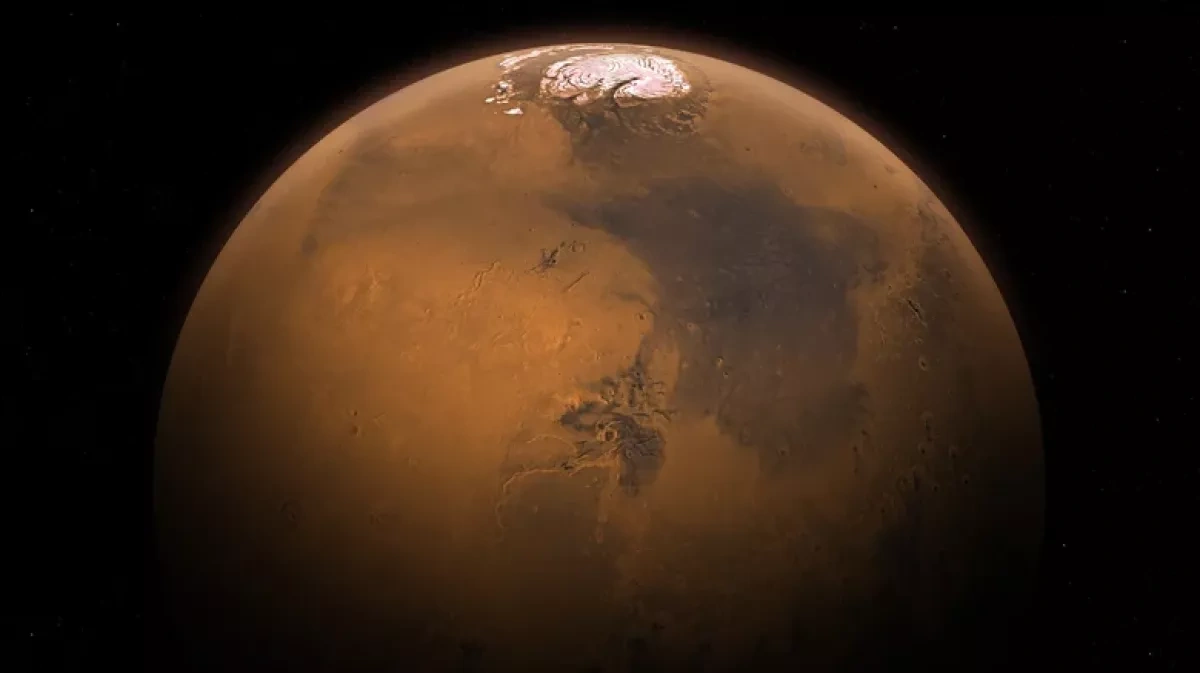
Mars may have more natural protection from the Sun than scientists previously thought, but a surprising atmospheric discovery does little to change the daunting challenges facing any future human settlement on the Red Planet.
According to BGR, scientists have detected an unexpected atmospheric phenomenon on Mars known as the Zwan-Wolf effect, a pattern generally associated with planets such as Earth that possess strong magnetic fields. Such fields help protect planetary atmospheres by deflecting harmful solar wind.
The effect was detected in Mars’ ionosphere, roughly 80 miles above the surface, during NASA’s Mars Atmosphere and Volatile Evolution (MAVEN) mission. Researchers observed it during a coronal mass ejection that struck Mars in December 2023. The powerful solar event appears to have enhanced the phenomenon enough for scientists to detect it.
The finding was unexpected because Mars does not have a strong global magnetic field.
MAVEN launched in November 2013 and spent more than a decade studying Mars’ upper atmosphere before losing contact with Earth. Data collected by the spacecraft played a central role in identifying the atmospheric effect.
As BGR notes, the discovery indicates that Mars does possess some degree of protection against space weather. However, that protection was apparently never strong enough to prevent solar winds from gradually stripping away much of the planet’s atmosphere over billions of years.
Could Mars be terraformed?
The discovery also raises an intriguing question: could Mars eventually be transformed into a more Earth-like world?
Terraforming Mars has long been discussed as a potential way to make the planet more hospitable to humans, including by introducing carbon dioxide into the atmosphere to trap heat and increase atmospheric pressure.
Mars, however, remains an extremely hostile environment. Temperatures can fall as low as –225 degrees Fahrenheit, while its atmosphere is far thinner than Earth’s and contains very little oxygen.
Even if humans succeeded in engineering a thicker atmosphere, the lack of a sufficiently powerful protective magnetic effect would remain a major problem. Solar activity could continue eroding the atmosphere over time, while solar flares and other space-weather events could expose settlers to dangerous radiation.
Other obstacles include toxic perchlorates found in Martian rocks and the planet’s gravity, which is only about one-third that of Earth. Prolonged exposure to such weak gravity could cause serious bone and muscle problems for humans.
A 2024 scientific paper examined the possibility of using nanoparticles to produce a powerful greenhouse effect on Mars, suggesting that some aspects of terraforming might be technically conceivable. But significant challenges remain.
A more realistic alternative?
BGR also highlights paraterraforming as a potentially more practical approach.
Instead of attempting to transform the entire planet, humans could build interconnected, enclosed and pressurised habitats. Such settlements could use Martian resources, including carbon dioxide, to produce fuel and support plant life.
Underground structures could provide an additional layer of protection from radiation, with the Martian crust shielding inhabitants from dangerous solar particles.
In theory, sufficiently large enclosed settlements could eventually include farms, parks, forests and even lakes, creating pockets of Earth-like environments without requiring Mars itself to become fully habitable.
A 2023 study cited by BGR even explored the possibility that a Mars colony could initially be established with as few as 22 people, assuming the enormous technical and environmental challenges could be overcome.
For now, the Zwan-Wolf effect offers an intriguing glimpse into Mars’ atmospheric behaviour — but it does not provide the missing shield that would make turning the Red Planet into a second Earth feasible.
By Sabina Mammadli