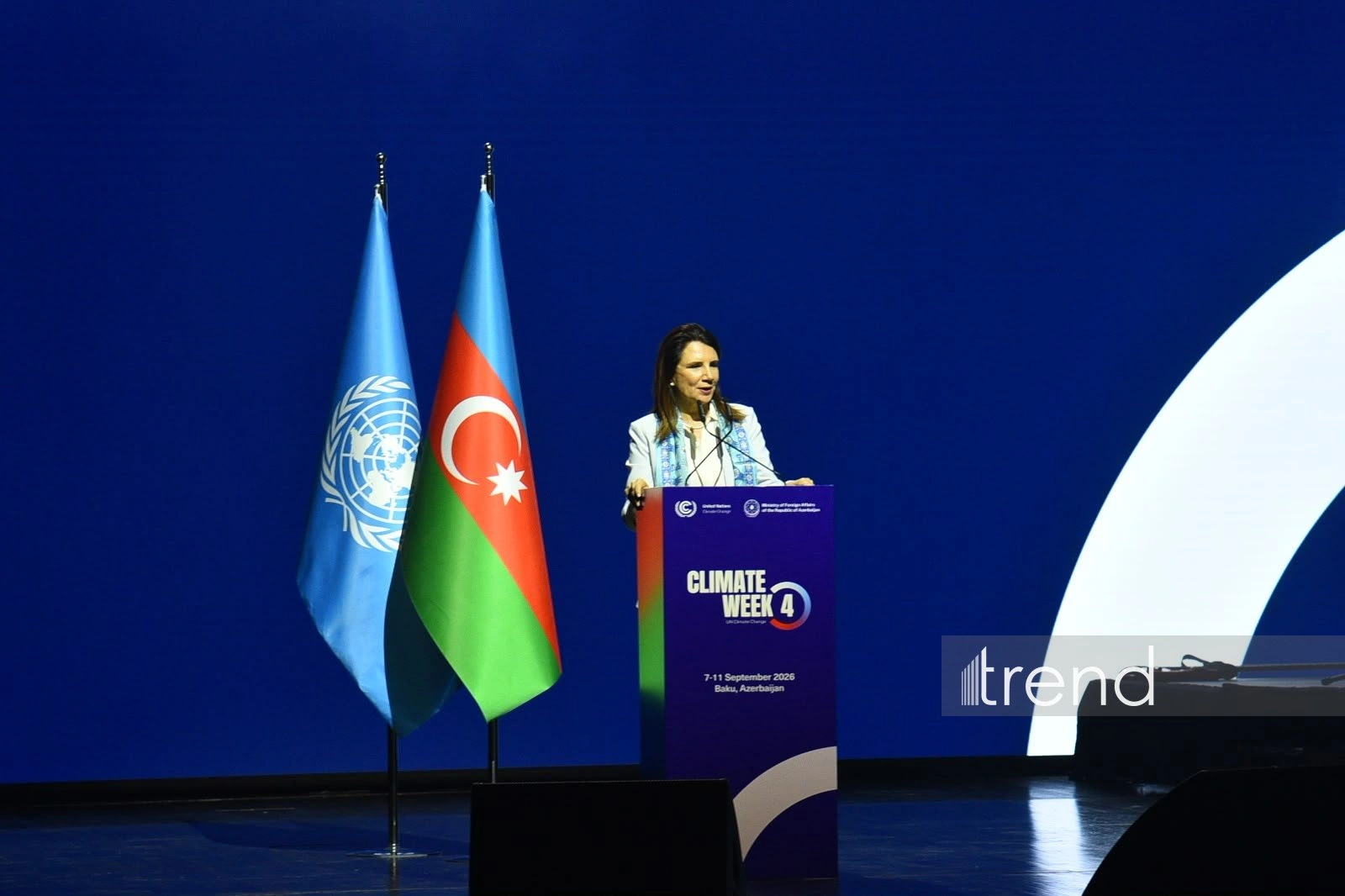
BAKU, Azerbaijan, September 9. Baku Climate
Week is crucial in accelerating the transition from climate
commitments to concrete solutions, from solutions to
implementation, and from implementation to measurable results, the
CEO of COP30 and Brazil's National Secretary for Climate Change,
Ana Toni, said at the official opening ceremony of the 4th Climate
Week in Baku, Trend's correspondent reports from the event.
According to her, Baku Climate Week is not just another event,
but also an important milestone in the climate implementation
process.
"This week is really important. We have started a decade of
implementation. The climate action agenda held in Baku will take us
one step further in the implementation process because we are
closer to the implementers in this region and in this country. This
is exactly what climate weeks are important for," she said.
Toni noted that within the framework of COP30, the Climate
Leaders team, together with COP29, COP31, and the UN Framework
Convention on Climate Change (UNFCCC), tried to reorganize the
climate agenda and increase the contribution of climate weeks to
this process.
"We cannot continue to move from COP to COP, changing the topics
that everyone considers a priority. That is why we agreed on a
5-year plan in 6 areas that we are working on together, and now we
have very strong plans to accelerate implementation," the COP30 CEO
emphasized.
She noted that an important part of the multilateral climate
process is the consensus decisions taken within the UNFCCC, and
that great work has been done in the last 10 years to shape the
framework of the Paris Agreement.
"The main thing we need now is to accelerate implementation.
That is why the 5-year plan agreed at COP30 and linked to the
Global Stocktake is so important," said Toni.
According to him, the climate week in Baku allows bringing
global processes closer to the regions, sectors, and actors where
they are implemented.
Toni pointed out that the implementation labs held within the
framework of the event will focus on solving specific problems.
"The implementation laboratories won't only abstractly discuss
implementation. They will consider specific problems, for example,
opening up financing opportunities for agriculture, food security,
and electrification. They will also look at the decarbonization of
construction materials and public procurement for heavy industry,"
she also said.
The COP30 CEO added that the main goal is to ensure the
transition from commitments to solutions, from solutions to
implementation, and from implementation to measurable results.
Toni also noted that the work done after COP30 was evaluated in
cooperation with the COP presidency, climate champions and the
UNFCCC.
"Where implementation is lagging, we need to find the cause and
identify what we can do together to address some of the
challenges," she explained.
She welcomed COP31's adoption of the six-pronged framework
developed at COP30, and its priorities, urgency and pragmatism for
advancing implementation.
Toni said that the priorities set for COP31, such as
electrification, zero waste, bridges and food security, are key
themes in accelerating the implementation of climate action.
According to her, it is also planned to open pavilions at COP31
to support the climate action agenda.
"As Brazil, we will open our pavilion to welcome climate action
agenda events from any country so that we can go one step further,"
Toni noted.
She stressed that Baku is not just another stop before
COP31.
"This is a crucial milestone in the implementation process.
Let's use these two days to look very concretely at the solutions,
barriers, opportunities and funding we need to accelerate
implementation," Toni added.