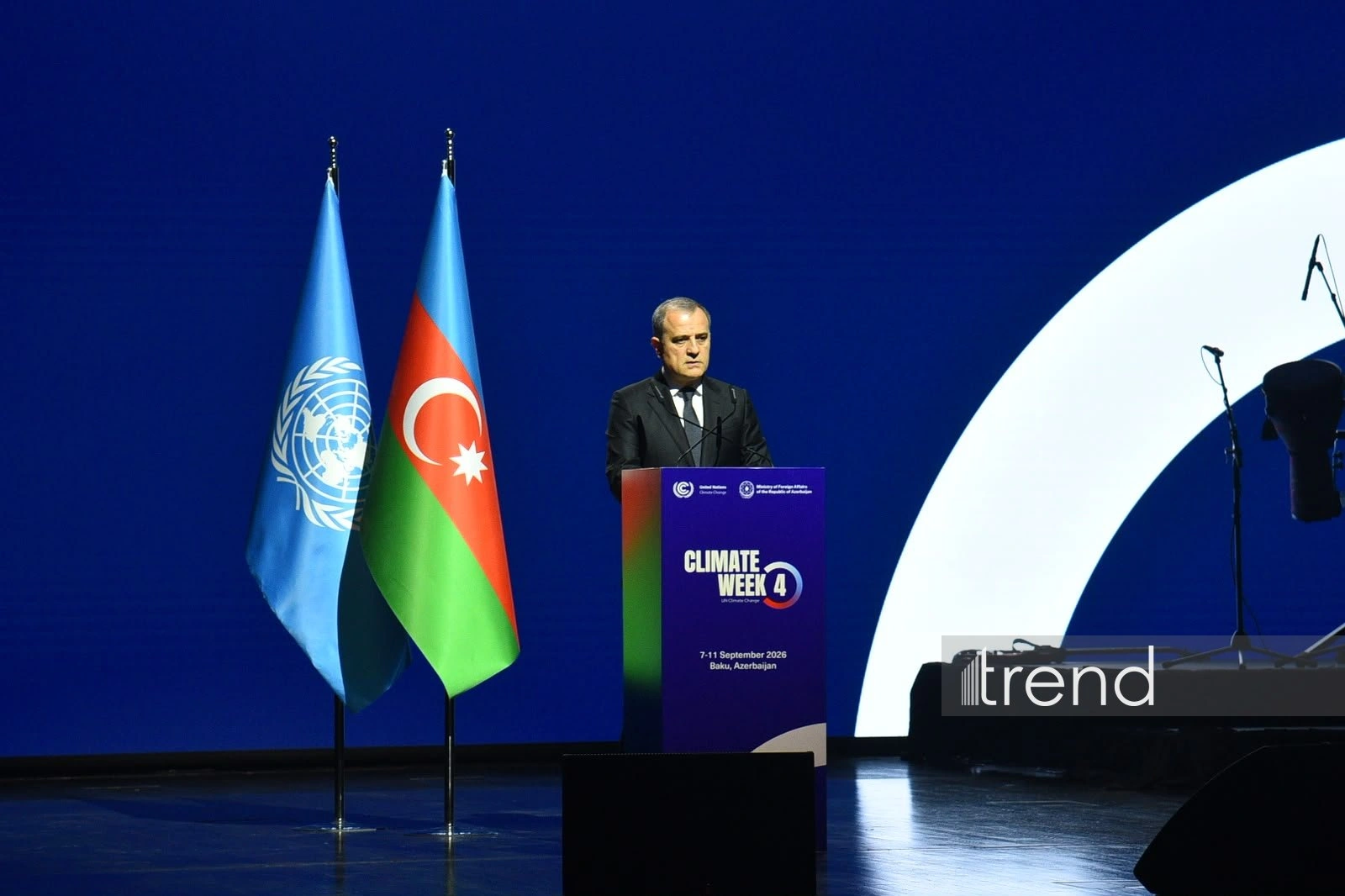
BAKU, Azerbaijan, September 9. Azerbaijan is
clearly observing the effects of climate change, including the
significant retreat of the Caspian Sea in recent years, Foreign
Minister Jeyhun Bayramov said at the official opening ceremony of
the 4th Climate Week in Baku, Trend's correspondent reports from the event.
The minister noted that the planet is undergoing rapid
ecological changes, and the realities of climate change are no
longer just assumptions.
"The realities of climate change are no longer just assumptions.
They are clearly visible all over the world, including in
Azerbaijan. An example of this is the Caspian Sea: it has
significantly retreated in the past two years. The coastline that
you see today along the Caspian coast, around the beautiful Baku
Boulevard, is not the coastline of just a few decades ago,"
Bayramov emphasized.
According to him, the growing impacts of climate change are
creating additional financial pressure on national economies and
public finances.
"Global instability, conflicts, and market fluctuations are
further increasing these pressures. These processes make economic
diversification and energy sustainability even more important for
national security, economic stability, and long-term
sustainability," the minister pointed out.
Bayramov also noted that historic decisions were made on climate
finance, carbon markets, and other areas of the Paris Agreement
within the framework of COP29 held in Baku.
"These decisions serve to accelerate climate action and support
countries that want to fulfill their commitments but lack
resources. The Baku financial goal must be implemented in good
faith and provided as a basis for trust among partners," he
said.
The minister added that this goal should go beyond the $300
billion outlined in the Baku to Belem Roadmap.
"This document shows that climate finance can be mobilized on a
scale exceeding $1 trillion," Bayramov explained.
The minister highlighted that Azerbaijan has aligned its
international leadership on the climate agenda with decisive steps
taken domestically.
"Azerbaijan has submitted its updated Nationally Determined
Contributions (NDCs) in accordance with the results of the Global
Stocktake," he noted.
According to Bayramov, Azerbaijan is increasing its renewable
energy capacity by commissioning large solar and wind projects,
expanding hydroelectric power, and developing clean energy projects
with international partners.
"If we look at 2030, our areas designated as green zones provide
approximately 6 gigawatts of additional solar and wind energy
capacity. With these plans, Azerbaijan is preparing to exceed the
targets of the first Global Stocktake, which called for a threefold
increase in global renewable energy capacity by 2030," the minister
said.
He stressed that Azerbaijan is determined to demonstrate that
traditional energy producers can be pioneers of a green and
sustainable future.
"All these elements are based on the long-term strategic vision
of the President of the Republic of Azerbaijan Ilham Aliyev," said
Bayramov.
The minister expressed Azerbaijan's commitment to playing an
active role in the development of climate diplomacy and related
areas at the international level.
"Our activities have continued even after the end of our COP
presidency. In May, Baku hosted the 13th Global Forum, advancing
global discussions on climate-resilient cities, sustainable urban
development and housing. Its results contributed to the high-level
meeting on the mid-term review of the UN New Urban Agenda in July,"
he said.
Bayramov noted that in June, Baku hosted the UN World
Environment Day, further strengthening Azerbaijan's role in global
environmental action.