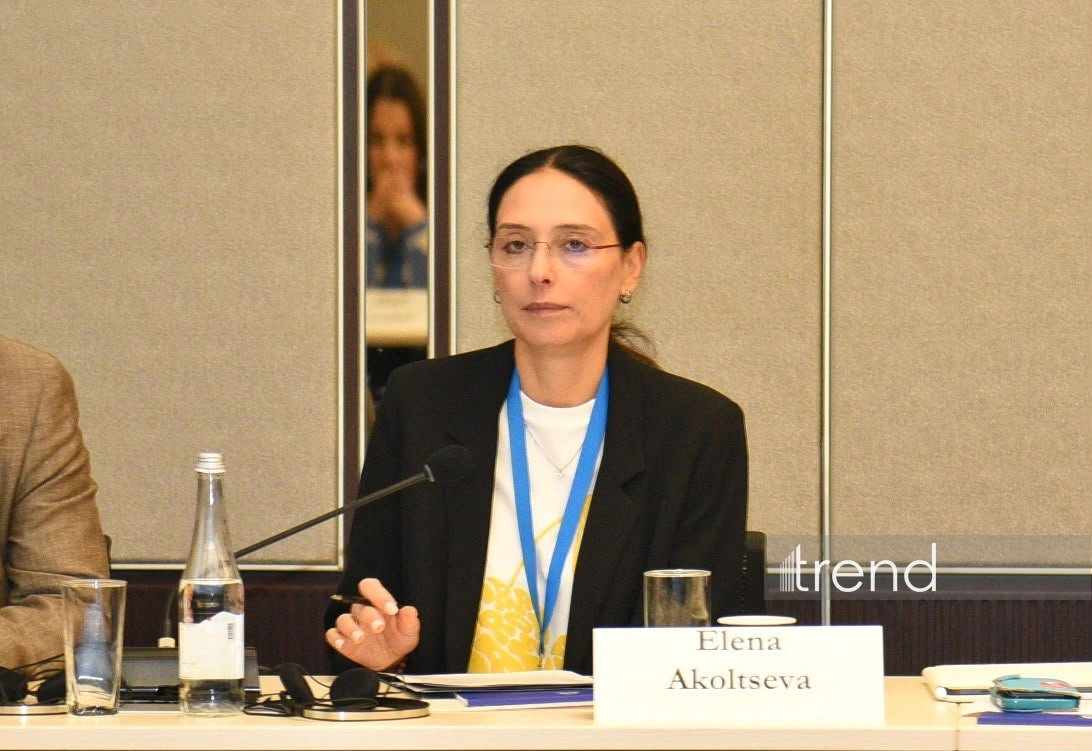
BAKU, Azerbaijan, September 9. As global energy
demand rises, a key task of climate leadership is to balance energy
security, affordability, industrial competitiveness and emissions
reductions, Yelena Akoltseva, vice president for Europe and the CIS
at Baker Hughes, said, Trend’s correspondent reports from the event.
She made the remarks during Baku Climate Action Week 2026 (BCAW
2026).
She said the development of digital infrastructure, artificial
intelligence and data centers, population growth and rapid
technological advances were driving energy demand faster than
previously projected. “When we start the discussion about climate
leadership, we first need to focus on how we can meet growing
energy demand with high reliability, affordability and lower
emissions,” Akoltseva said.
According to her, creating sustainable economies, developed
communities and food security worldwide requires greater
capabilities from industry. “This is the implementation issue that
many of you have mentioned today. That is why industry needs to
respond with innovative technological solutions, large-scale
processes and continuous improvements,” she emphasized.
Akoltseva noted that both conventional and emerging energy
sources would be used to meet growing energy demand. “Natural gas
will remain one of the key sources of scalable and flexible power
generation for many years. But we need to ensure that it is used as
efficiently as possible,” the vice president said.
She added that demand for oil would also remain amid high energy
demand. “Our responsibility is to ensure that these energy sources
are produced as efficiently as possible and with lower carbon
emissions. The key issue for climate leadership is to focus on how
emissions can be reduced across the energy value chain,” Akoltseva
said.
According to her, ahead of COP31, the focus should not only be
on setting new targets but also on creating the conditions needed
to achieve emissions reductions at scale. “The priority should be
to create the conditions that enable emissions reductions to be
implemented at scale. This requires investment, technology
deployment, modern infrastructure, reliable data and policies that
incentivize low-carbon outcomes,” she said.
Akoltseva emphasized that progress on climate issues depends not
on choosing between economic growth and decarbonization, but on
aligning the two. “Climate progress will not be achieved by
choosing between growth and decarbonization. It will come from
bringing together energy security, affordability, industrial
competitiveness and emissions reductions. This is where sustainable
progress is achieved, and this is what the next stage of climate
leadership should focus on,” she added.
The Baker Hughes executive also said Azerbaijan was an important
example in this regard. “During COP29, in Azerbaijan, we signed
several agreements with SOCAR on emissions reduction and geothermal
energy development. This is a key element of the implementation
issue I mentioned today,” Akoltseva said.
The third day of Baku Climate Action Week 2026 (BCAW 2026) is
underway.
The third day’s program focuses on such issues as moving from
climate commitments to concrete action, climate finance, youth
participation in climate processes, artificial intelligence and
climate technologies, energy efficiency, methane emissions
reduction, water resource management and the protection of cultural
heritage.
Representatives of governments and state institutions from
various countries, international organizations, experts, financial
institutions, the private sector and civil society are
participating in the events.
Baku Climate Action Week is being held for the third time and,
for the first time this year, is taking place in parallel with the
UNFCCC Climate Week. A series of sessions, panel discussions and
other events on climate change, climate finance, sustainable
development and accelerating climate action will be held as part of
the Fourth Climate Week and Baku Climate Action Week.
Baku Climate Action Week 2026 will continue through Sept.
11.