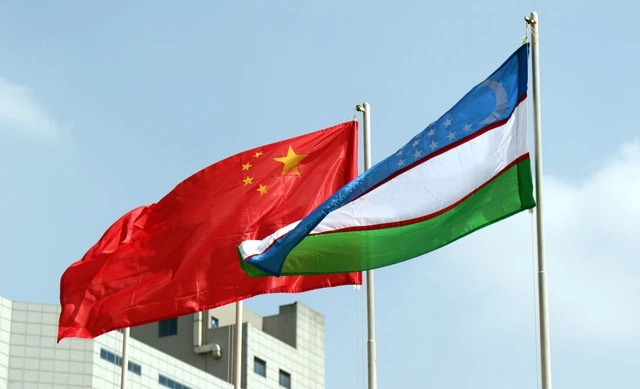
BAKU, Azerbaijan, August 24. China accounted
for nearly 30% of all enterprises with foreign investment operating
in Uzbekistan as of August 1, 2026, making it the country's largest
source of foreign-invested businesses amid rapidly expanding
economic ties between the two countries.
This was reflected in data published by Uzbekistan's National
Statistics Committee.
A total of 20,973 enterprises with foreign investment were
operating in Uzbekistan as of August 1, including 6,241 with
Chinese participation. Of the overall total, 4,685 were joint
ventures and 16,288 were foreign-owned enterprises.
Russia ranked second with 3,512 enterprises, followed by Türkiye
with 2,327. Kazakhstan accounted for 1,321 enterprises, South Korea
for 730 and Afghanistan for 706. Azerbaijan ranked seventh with 492
enterprises.
Kazakhstan accounted for 1,321 enterprises, South Korea for 730
and Afghanistan for 706. Azerbaijan ranked seventh with 492
enterprises, followed by Tajikistan with 467, the UAE with 453 and
India with 439.
Trend's analysis
shows that Uzbekistan's foreign-invested enterprise base remains
concentrated among its largest economic partners. China, Russia and
Turkey together accounted for 12,080 enterprises, or about 57.6% of
the total.
China alone represented approximately 29.8% of all
foreign-invested enterprises in Uzbekistan, meaning that nearly
three out of every 10 such companies had Chinese participation.
The scale of Chinese business activity reflects the broader
acceleration in economic ties between the two countries. Bilateral
trade reached $17.8 billion in 2025, up 34% year on year, while
Chinese direct investment in Uzbekistan increased fivefold to $17
billion, according to Uzbekistan's Ministry of Investment, Industry and
Trade. More than 6,000 enterprises with Chinese capital were
operating in the country as of July 2026.
Trend's calculations show that the 6,241 Chinese-invested
enterprises recorded by the National Statistics Committee account
for about 29.8% of Uzbekistan's entire foreign-invested enterprise
base. The figure is also substantially higher than the 4,731
Chinese-invested enterprises reported as of November 2025,
indicating continued rapid expansion of Chinese business
presence.
The growth extends beyond the number of companies. According to
the Eurasian Development Bank, China's FDI stock in Uzbekistan rose
from just $284 million in 2016 to $10.7 billion in the first half
of 2025. Energy accounted for about 51% of that stock, while
manufacturing represented another 31%, pointing to a growing focus
on industrial and energy projects rather than purely trade-related
activity.
The structure of Chinese investment is particularly relevant to
Uzbekistan's industrial development. The concentration of Chinese
capital in energy and manufacturing links the bilateral
relationship directly to the country's efforts to expand production
capacity, modernize infrastructure and develop new industrial value
chains.
Recent cooperation has also broadened into green energy,
agriculture, technology, logistics and export-oriented
manufacturing. At a July 2026 Uzbekistan-China business forum in Tashkent, companies
discussed projects in mining, green energy, agriculture, health
care, advanced technologies and industrial cooperation. Moreover,
the two countries have also been expanding cooperation in digital
infrastructure and irrigation modernization. Uzbek and Chinese
officials agreed in April to accelerate projects under the "Digital
Silk Road" and discussed Chinese financing for the modernization of
Uzbekistan's irrigation infrastructure.
Trend's assessment is that China's position as Uzbekistan's
largest source of foreign-invested enterprises is part of a much
broader transformation in bilateral economic relations. The
relationship has evolved from primarily trade-based ties toward
deeper investment cooperation spanning energy, manufacturing,
infrastructure, technology and agriculture.
For Uzbekistan, the growing Chinese presence provides access to
capital, technology and industrial partnerships, while the
diversification of projects could support the country's efforts to
expand its manufacturing base and integrate more deeply into
regional and global supply chains. At the same time, the
concentration of foreign-invested enterprises among a handful of
countries underscores the importance of continuing to diversify
Uzbekistan's investor base.