BAKU, Azerbaijan, August 10. Kazakhstan is
steadily expanding its transport infrastructure, seeking to turn
growing connectivity with the Caspian region, China, Russia and
Europe into a long-term driver of transit growth.
In 2025, 36.9 million tons of transit cargo passed through
Kazakhstan, up 6.6% from the previous year. In the first six months
of 2026, the rail network of Kazakhstan Temir Zholy (KTZ) carried
157.1 million tons of cargo, an increase of 3.5% year on year.
However, transit growth itself has yet to match the country's
ambitious targets: the government expects transit volumes to reach
55 million tons in 2026.
That is why Kazakhstan is now working on several fronts at once
— expanding its rail network, modernizing ports and highways,
increasing the capacity of border crossings and simultaneously
digitizing transport processes.
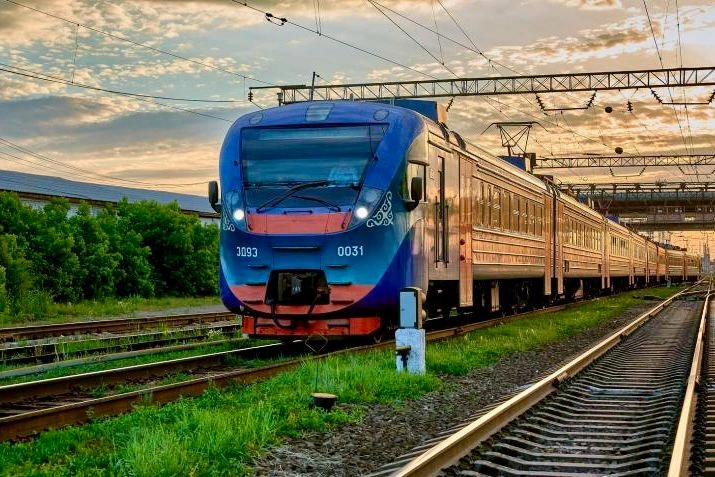
Rail infrastructure remains one of the country's flagship
priorities. The 836-kilometer second track on the Dostyk–Moyynty
route, completed in 2025, increased the capacity of the section
fivefold, from 12 to 60 train pairs per day. Construction of the
322-kilometer Moyynty–Kyzylzhar line is expected to shorten the
route to the Caspian by almost 150 kilometers and reduce travel
time by roughly one day.
Kazakhstan is also strengthening its road network. In 2025,
around 13,000 kilometers of roads were built or rehabilitated,
while revenues generated by the road freight sector reached 1.5
trillion tenge ($3.2 billion). Construction of the Aral–Caspian
highway began in August. Once completed, it is expected to shorten
the China–Caspian/Europe route by around 1,000 kilometers and two
to three days. Cargo volumes along the route are projected to reach
13.2 million tons annually by 2029.
The Middle Corridor occupies a particularly important place in
this system. Freight volumes along the Trans-Caspian International
Transport Route have increased roughly fivefold over seven years,
reaching about 4.1 million tons in 2025. Kazakhstan is focusing not
only on tonnage but also on containerization: around 77,000 TEUs
were transported along the route last year, with the country
targeting 300,000 TEUs by 2029.
Meanwhile, the modernization of the lifting and transfer bridges
at the Port of Kuryk was completed in August, reducing processing
times for rail ferries from 18 to 12 hours and for road ferries
from 10 to six hours. Rail ferry capacity increased from 40 to 48
wagons. In the first half of 2026, Kuryk handled 884,800 tons,
while throughput since the beginning of the year had exceeded 1.5
million tons by early August.
However, expanding physical infrastructure only creates the
basic conditions for transit growth. The next question is how
quickly Kazakhstan can reduce transport times along individual
sections of its routes.
IRU Permanent Representative for Eurasia Vadim Zakharenko told
Trend in an exclusive
interview that around 80% of overland freight shipments from China
pass through Kazakhstan. According to him, the country needs to
develop infrastructure while also introducing rules and procedures
that accelerate cargo flows and ensure operational
transparency.
“Therefore, it is crucial to develop physical infrastructure
while simultaneously implementing advanced rules, procedures, and
all aspects of so-called ‘soft measures’ that help accelerate the
flow of goods while ensuring an appropriate level of control and
transparency in the operations carried out,” Zakharenko said.
Against this backdrop, digitalization is emerging as a separate
pillar of Kazakhstan's transport policy. President Kassym-Jomart
Tokayev has proposed launching a pilot digital transport corridor
between Kazakhstan and Russia along one of the busiest routes.
“Based on existing digital platforms, we propose launching, on a
pilot basis, a Kazakhstan–Russia digital transport corridor along
one of the busiest routes,” Tokayev said.
According to him, digital integration should help boost both
bilateral trade and transit flows. In May, Kazakhstan and Russia
also launched their first pilot operation involving autonomous
freight trucks between the two countries. Tokayev described the
experiment as a sign that transport cooperation is entering a new
technological phase.
For Central Asia, digital interoperability is becoming
increasingly important as pressure on existing corridors grows.
Tatiana Rey-Bellet, IRU Director for TIR and Transit Systems, told
Trend that even
large-scale investments in physical infrastructure can have a
limited impact if they are not accompanied by digital connectivity
and harmonized procedures. “Effective transport is not limited to
infrastructure,” she said.
According to her, trucks may reach borders faster thanks to new
roads, but this brings little economic benefit if queues, repeated
inspections and uncoordinated customs procedures remain at border
crossings. IRU identifies electronic systems such as eTIR and eCMR
as tools to address these bottlenecks.
Kazakhstan is also seeking to expand the use of advanced
technologies along the Middle Corridor. Kazakhstan's Vice Minister
of Trade and Integration Asset Nusupov told Trend that Kazakhstan and
Azerbaijan could use artificial intelligence for predictive
management of cargo flows between KTZ and the Port of Baku.
According to him, AI could be used to optimize schedules, reduce
idle time, automate document processing and assess risks in
cross-border trade. “By synchronizing our AI systems in logistics,
we will ensure that the speed of goods movement along the route
increases, while unpredictability decreases. This benefits shippers
across the entire region,” Nusupov said.
International partners also view the Middle Corridor as a
long-term project. Secretary General of the TRACECA Permanent
Secretariat Jasurbek Choriev told Trend that international financial institutions are
prepared to continue investing in the route, viewing its
development as an integrated system spanning Central Asia, the
Caucasus and the Black Sea region.
At the same time, Kazakhstan's transport strategy extends beyond
overland routes. According to IATA, the number of scheduled air
routes in the country increased from 200 in 2015 to 295 in 2025,
while combined inbound, outbound and direct transit cargo volumes
rose by 149% in 2024 compared with 2019. “IATA applauds the
ambitions of President Tokayev for Kazakhstan to become an aviation
hub for passengers and cargo. Opportunities for growth certainly
exist,” IATA Regional Vice President for Europe Rafael Schwarzman
told Trend in an
exclusive interview.
The aviation sector, however, also highlights the gap between
infrastructure potential and actual utilization. According to IATA,
only 3% of passengers arriving in Kazakhstan continue their journey
in transit to another country. Schwarzman noted that further
development of air connectivity will be a key factor in
strengthening Kazakhstan's position on international routes.
At the same time, Kazakhstan still needs to address the
competitiveness of its aviation hub. According to IATA, airport
operating costs remain a factor, including fuel prices, which are
still higher than at major hubs such as Dubai. This shows that even
with the necessary infrastructure in place, Kazakhstan needs to
create commercial conditions capable of attracting new carriers and
transit flows.
Overall, Kazakhstan is entering the next stage of transport
development with a significantly larger infrastructure base. The
second Dostyk–Moyynty track has increased rail capacity, new lines
are bringing cargo flows closer to the Caspian, the modernization
of Kuryk is accelerating the maritime leg, and the Aral–Caspian
highway is expected to provide an additional road connection.
Transit volumes are expected to grow gradually as these projects
are completed and bottlenecks are removed. Physical infrastructure
will be complemented by digital integration among Kazakhstan,
Azerbaijan, China, Russia and other countries along the routes,
helping accelerate cargo processing and strengthen the
competitiveness of the Middle Corridor.
There is, however, a key constraint: infrastructure can expand
faster than actual cargo flows. For Kazakhstan, therefore, success
will be measured not only by new kilometers of railways and
highways, but also by its ability to ensure that these assets are
supported by stable transit demand.
This is where the next stage of Kazakhstan's strategy will
differ from the previous one. The country is already building
greater transport capacity; it now needs to ensure that railways,
ports, roads, border crossings and digital systems operate as a
single, integrated mechanism. If it succeeds, Kazakhstan will be
better positioned to become one of the key logistics hubs linking
China, Central Asia, the Caspian region and Europe.