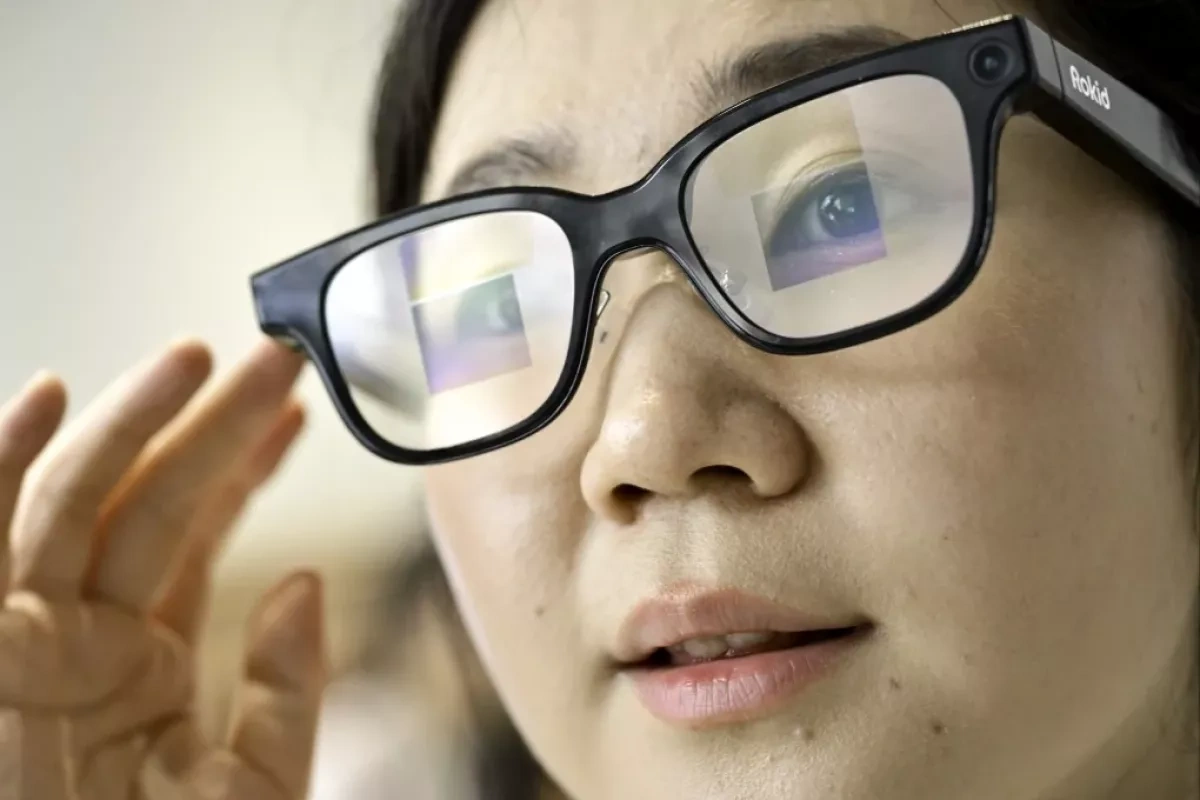
The growing availability of artificial intelligence-powered smart glasses is raising concerns among educators across Asia, where intense academic competition has made examinations a crucial gateway to university admissions, employment opportunities and social mobility.
Recent cases in South Korea and Taiwan have highlighted how AI-enabled wearable devices are being used to gain an unfair advantage in exams, prompting authorities to strengthen anti-cheating measures and reconsider how students are assessed, US media reports.
Last month, two test-takers in South Korea were caught using smart glasses during an English-language proficiency exam commonly used by employers in hiring decisions. In Taiwan, a student taking an entrance examination for a prestigious medical school was found wearing smart glasses after exam supervisors became suspicious of unusual eye movements and detected heat coming from the frame.
The incidents come as AI-powered wearable technology becomes increasingly sophisticated, affordable and difficult to detect. Authorities in China, where more than 10 million students sit the country's annual college entrance examination each year, required inspections of all glasses during this month's exams. Britain’s exams regulator has also warned that AI glasses and hidden earpieces could increase the risk of cheating.
South Korea's college entrance exam administrator said it is discussing additional measures with education authorities to prevent cheating involving AI glasses, which are already prohibited along with other electronic devices in examination halls.
Experts say the reported cases may represent only a fraction of the problem.
“If we’re seeing a few cases being reported, we’re seeing a lot more cases not being reported,” said Thomas Corbin, a lecturer at Deakin University in Australia who researches AI-powered wearable technology and academic assessment.
The concerns coincide with the rapid expansion of the AI eyewear market. U.S. technology company Meta introduced its first AI-enabled smart glasses with Ray-Ban in 2023 and has since released additional versions. More than seven million pairs were sold last year.
“Wearable AI is as much of a challenge to exams as ChatGPT was to essays in 2022 and I just don’t think there is any real way that we can reliably have exam practices moving forward,” Corbin said.
Researchers in Hong Kong have also tested the capabilities of commercial AI glasses in academic settings.
Meng Zili, an assistant professor at the Hong Kong University of Science and Technology (HKUST), said an experiment conducted using commercially available AI glasses during an undergraduate electrical engineering examination demonstrated the technology's effectiveness.
By scanning exam questions, the glasses transmitted the information to an AI large language model, which generated responses and displayed them on the lenses. The AI-assisted performance ranked among the top five students in a class of more than 100 and significantly exceeded the class average score.
The findings suggest that educators may need to reconsider traditional approaches to testing, Meng said.
“After conducting the experiment, it really raises the question of how much knowledge students actually need to memorize for exams, versus whether we should allow them to use AI during assessment, given what AI is now capable of,” Meng said.
Zhang Jun, an electrical engineering professor at HKUST who co-led the research, said educational institutions are struggling to keep pace with advances in AI technology.
“The real question is how quickly we can rethink and adapt our education system — how we change the way we teach, and how we evaluate students,” he said.
While AI poses significant challenges for traditional examinations, some educators argue that the technology should be integrated into learning rather than banned outright.
“We should use technology. We should use AI. We should not just say avoid it, stop using it… The bottom line is: don’t outsource your thinking capability,” said Kong Siu Cheung, director of the AI and Digital Competence Education Center at the Education University of Hong Kong.
The emergence of AI-enabled smart glasses is intensifying debate among educators over whether existing examination systems remain fit for purpose in an era when artificial intelligence can provide real-time assistance that is increasingly difficult to detect.
By Aghakazim Guliyev