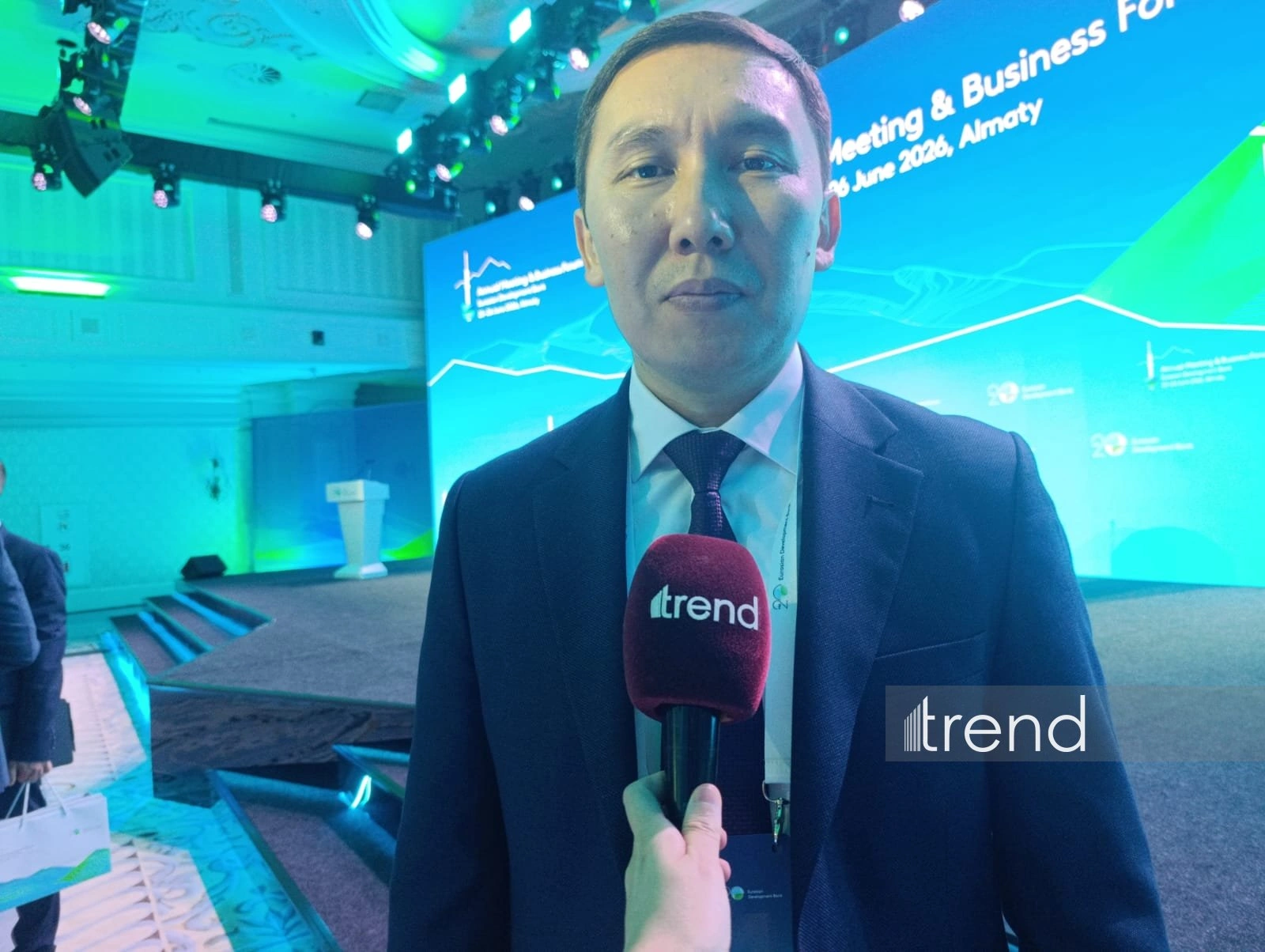
ALMATY, Kazakhstan, June 27. Around 57% of
public-private partnership (PPP) agreements in Kazakhstan are
related to the education sector, Aidos Kobetov, First Deputy
Chairman of the Management Board and Board Member of the Kazakhstan
Public-Private Partnership Center JSC told Trend.
He made the remark on the sidelines of the Annual Meeting and
Business Forum of the Eurasian Development Bank (EDB) in
Almaty.
“As of today, around 1,300 PPP agreements have been concluded.
About 57% of them are in the education sector, including
kindergartens, schools and other areas. The healthcare sector ranks
second, accounting for 18%. At the same time, specifically in
healthcare, 6.7 million people have already received services at
healthcare facilities created through PPP projects,” he said.
Kobetov noted that public-private partnerships have been
developing in Kazakhstan for around 20 years. According to him, the
starting point was the adoption of the Concessions Law in 2006.
“Compared with other Central Asian countries and Russian
regions, the PPP mechanism in Kazakhstan is quite well developed.
As I noted during the session, on the one hand, we are very
interested in studying the experience of other countries, while on
the other hand, we take a very cautious approach to introducing new
contracts that involve significant government obligations,” he
said.
According to Kobetov, the Kazakhstan Public-Private Partnership
Center is improving the legislative framework while maintaining a
cautious approach to taking on new state commitments.
He also noted that since last year the center has been
systematically expanding cooperation with international financial
institutions.
“Previously, we mainly had individual projects. For example, the
Big Almaty Ring Road (BAKAD) project, projects implemented jointly
with the International Finance Corporation (IFC), part of the World
Bank Group, as well as the Karaganda hospital project, which was
launched with support from the Asian Development Bank. Now we have
taken a more systematic approach. Since last year, we have
developed a project pipeline,” he said.
According to Kobetov, the pipeline currently includes seven
projects, each of which has been assigned to a specific
international financial institution.
“Each of these projects is supported by a specific international
financial institution. For example, the Asian Development Bank is
supporting five projects: four in the higher education and
healthcare sectors and one in the road sector. The International
Finance Corporation (IFC) is supporting a project in Western
Kazakhstan involving the construction of a desalination plant.
Another project is being implemented jointly with the European Bank
for Reconstruction and Development — a university clinic in
Almaty,” Kobetov said.