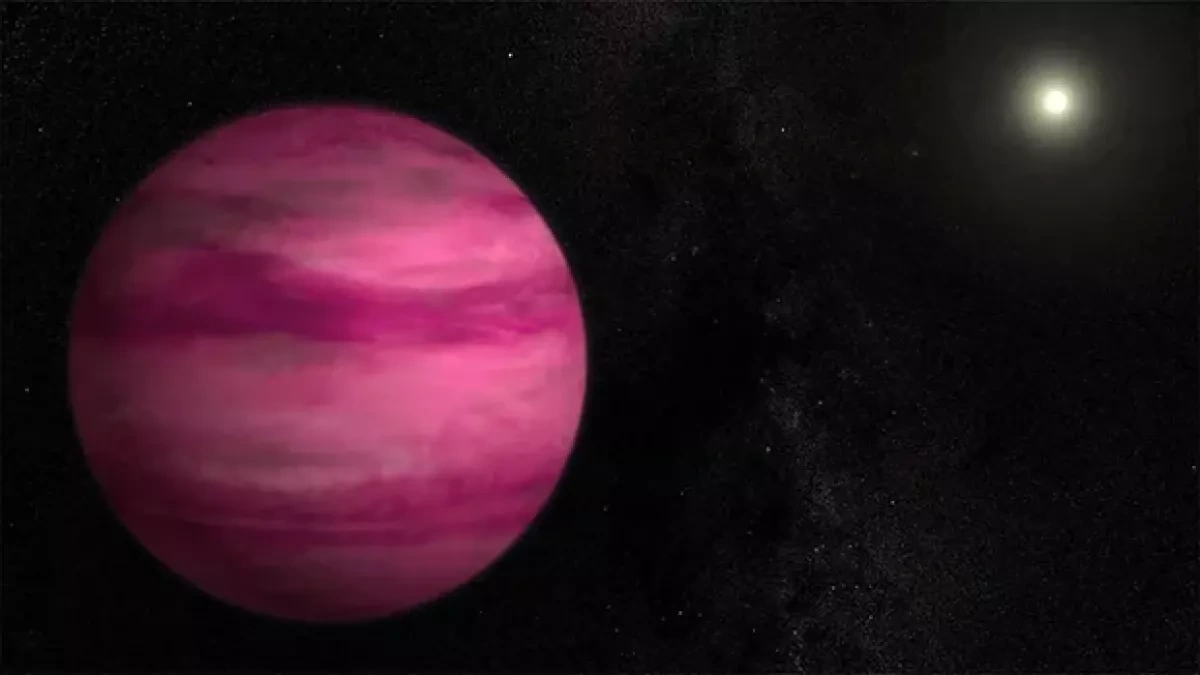
Astronomers using the James Webb Space Telescope have discovered an unexpected feature in the atmosphere of a distant object known as the “Pink Planet”: clouds made of salt.
The findings, led by researchers at Northwestern University, were published in The Astronomical Journal and suggest the presence of a previously unseen type of cloud formation in a planetary atmosphere, CBS News writes.
The object, formally known as GJ504b, was discovered in 2013 and is classified as a “planetary-mass companion” — meaning it may be either a giant exoplanet or a small brown dwarf orbiting a star, according to Northwestern University. It lies about 57 light-years from Earth.
It orbits a sun-like star and has an estimated temperature of around 550 degrees Fahrenheit (about 290 degrees Celsius), which is cooler than most known giant exoplanets, which typically range between 1,000 and 2,000 degrees Fahrenheit.
“We were very surprised, because people have theorized that salt clouds might exist in the atmospheres of companions at these temperatures of, say, 500 to 700 degrees Fahrenheit, but people in general just don't observe any kind of signatures of clouds in such temperatures, so we were very surprised,” said Aneesh Baburaj, the study’s lead author, speaking to CBS News.
Baburaj, a postdoctoral associate at Northwestern’s Center for Interdisciplinary Exploration and Research in Astrophysics, said the object is estimated to be around 25 times the mass of Jupiter and between 2.5 billion and 4 billion years old, which helps explain its relatively low temperature as giant planets cool over time.
The object’s faint and distant nature has made it difficult to observe from Earth, with previous attempts by multiple teams failing to capture usable data. However, Baburaj said the James Webb Space Telescope was able to complete a successful observation in just two hours.
The telescope captures infrared light and produces spectral data that reveals the chemical composition of distant atmospheres. Using this method, researchers identified water vapor, methane, carbon dioxide, ammonia, and other molecules.
The team found that the data could only be properly explained when salt clouds were included in their atmospheric models, suggesting these clouds influence how light is absorbed and transmitted.
“We were really, really amazed by how easy it was to detect with James Webb, as opposed to like it had been close to impossible from the ground,” Baburaj told CBS News.
He said salt clouds may represent a transitional type of atmospheric feature, forming in conditions where water or ammonia clouds cannot exist, but silicate clouds are also not yet possible.
Baburaj added that the Webb telescope will allow astronomers to study even colder and more distant objects in future research, potentially revealing new types of atmospheric chemistry.
“We will be able to detect colder and colder objects, and a lot of these objects might have these higher metal-to-hydrogen ratios compared to our sun,” he said.
By Sabina Mammadli