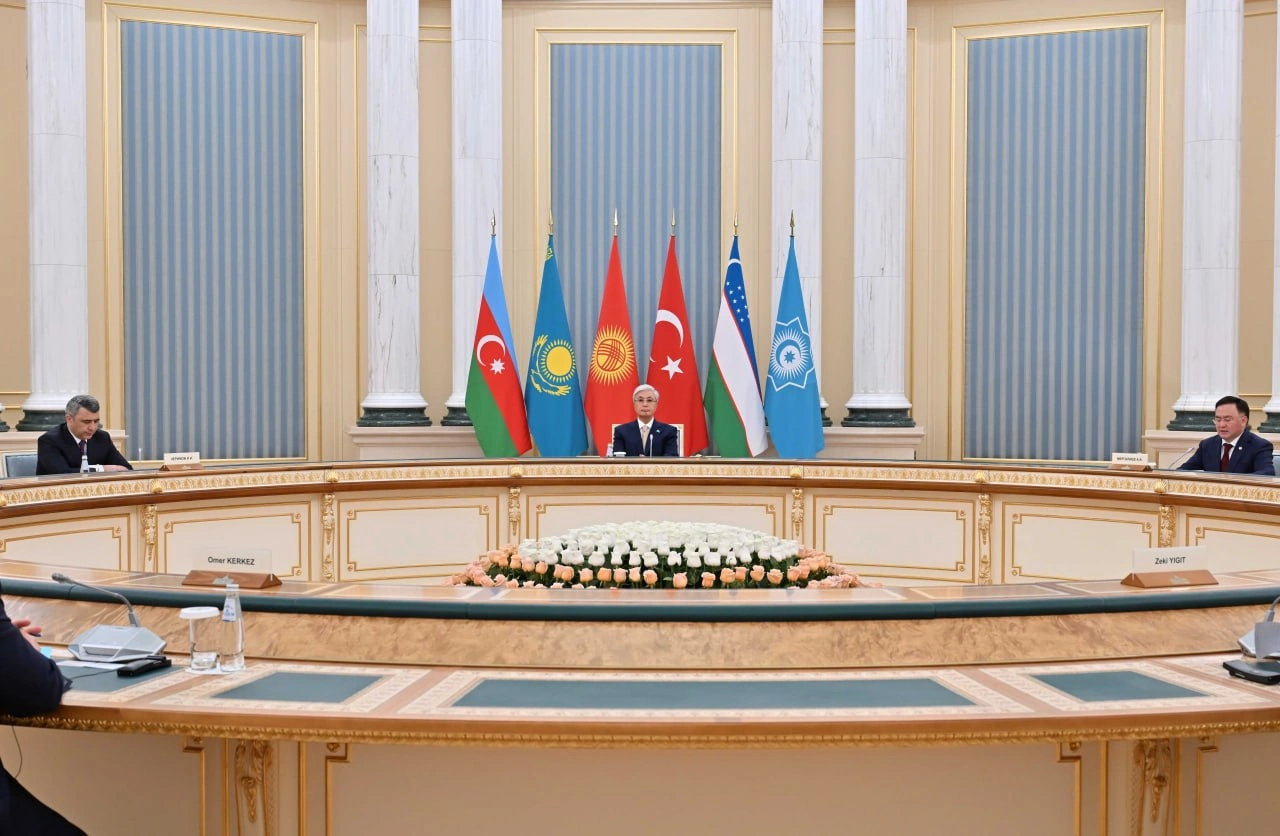
BAKU, Azerbaijan, June 18. President of
Kazakhstan Kassym-Jomart Tokayev has received the heads of the
supreme judicial bodies of the member states of the Organization of
Turkic States (OTS).
This is reflected in the statement by the press service of
Kazakh president.
The delegation arrived in the country to participate in the
second conference of the supreme courts of the OTS member states,
scheduled to take place in Turkestan.
"The judicial system is of vast importance for the progress and
prosperity of any civilized country. Therefore, deepening ties
between supreme courts fully meets the common interests of our
brotherly nations," President Tokayev stated during the
meeting.
According to the official press service, the meeting was
attended by Inam Karimov (Chairman of the Supreme Court of
Azerbaijan), Mederbek Satyev (Chairman of the Supreme Court of
Kyrgyzstan), Ömer Kerkez (President of the Court of Cassation of
Türkiye), Zeki Yiğit (President of the Court of Council of State of
Türkiye), and Alisher Usmanov (First Deputy Chairman of the Supreme
Court of Uzbekistan). The head of state emphasized that the
interaction between the OTS member states in the judicial and law
enforcement spheres is steadily strengthening, providing a crucial
foundation for regional cooperation.
During the talks, the President noted that the upcoming judicial
forum would address critical modern legal challenges faced by
developing economies in the wake of rapid technological shifts.
"On tomorrow's conference in Turkestan, issues of digitalization
of the judicial sphere, protection of investors' rights and other
important topics will be comprehensively discussed," Tokayev
highlighted, adding that the exchange of views on these matters
will significantly boost the development and authority of the
organization.
The President also briefed the visiting legal officials on
Kazakhstan's extensive domestic state reforms, noting that the
country's updated Constitution is set to enter into force on July
1. The legal overhauls include specific new provisions guaranteeing
the protection of citizens' personal data in the digital space,
alongside five new constitutional laws and amendments to over 70
codes and statutes aimed at fully modernizing the country's public
administration and law enforcement structures.