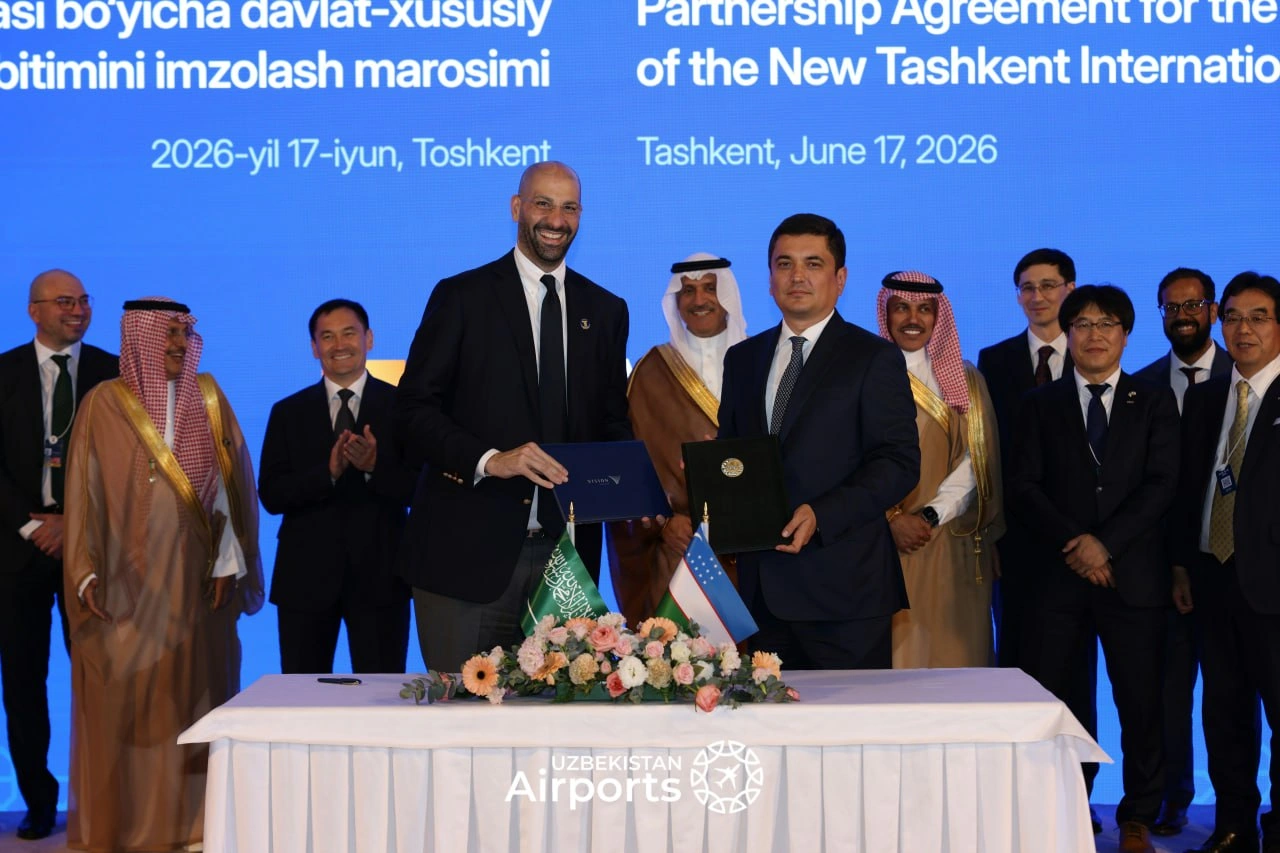
BAKU, Azerbaijan, June 17. Uzbekistan Airports
and an international consortium led by Saudi Arabia's Vision Invest
have signed a public-private partnership (PPP) agreement for the
construction and subsequent operation of a new Tashkent
International Airport.
This is reflected in the official statement of Uzbekistan
Airports.
According to the release, the signing took place on the
sidelines of the 5th anniversary Tashkent International Investment
Forum (TIIF-2026), currently underway in the capital of
Uzbekistan.
"The new Tashkent International Airport will become a modern,
high-tech aviation hub capable of meeting the growing needs of
passenger and cargo transportation for decades to come," Uzbekistan
Airports Chairman of the Management Board Zhavlonbek Umarkhodjaev
stated.
According to the head of the national airport management
company, the consortium of private partners also includes Japan's
Sojitz Corporation and the Republic of Korea's Incheon
International Airport Corporation. Umarkhodjaev noted that through
this partnership, Uzbekistan receives not only direct investments
but also unique global expertise in designing, building, and
managing large-scale airport complexes. Under the signed framework,
the private consortium will handle the construction and future
operation of the passenger terminal and the station square, while
the state partner retains responsibility for building and operating
the airfield complex.
"Thanks to the partnership with leading international companies,
we receive not only investments but also unique experience in the
design, construction and management of the world’s largest airport
complexes using the latest technologies," Umarkhodjaev emphasized,
adding that the project marks a new phase for Uzbekistan's aviation
industry.
The new capital airport, legally established under Presidential
Decree No. 353 dated November 25, 2025, will span 1,310 hectares
across the Urtachirchik and Kuyichirchik districts of the Tashkent
region. The initial phase of the mega-project outlines the
construction of two 4-kilometer runways, a 208,000-square-meter
passenger terminal, 98 aircraft parking stands, an advanced fuel
refueling complex, and a modern air traffic control tower. Upon its
scheduled commissioning at the end of 2030, the hub will be capable
of handling up to 20 million passengers and up to 300,000 tons of
cargo annually. Comprehensive engineering network relocations and
land preparation works are scheduled to begin this June.