BAKU, Azerbaijan, June 17. Major infrastructure
projects require joint efforts of international financial
institutions, development banks, and export credit agencies to
secure financing and drive regional integration successfully,
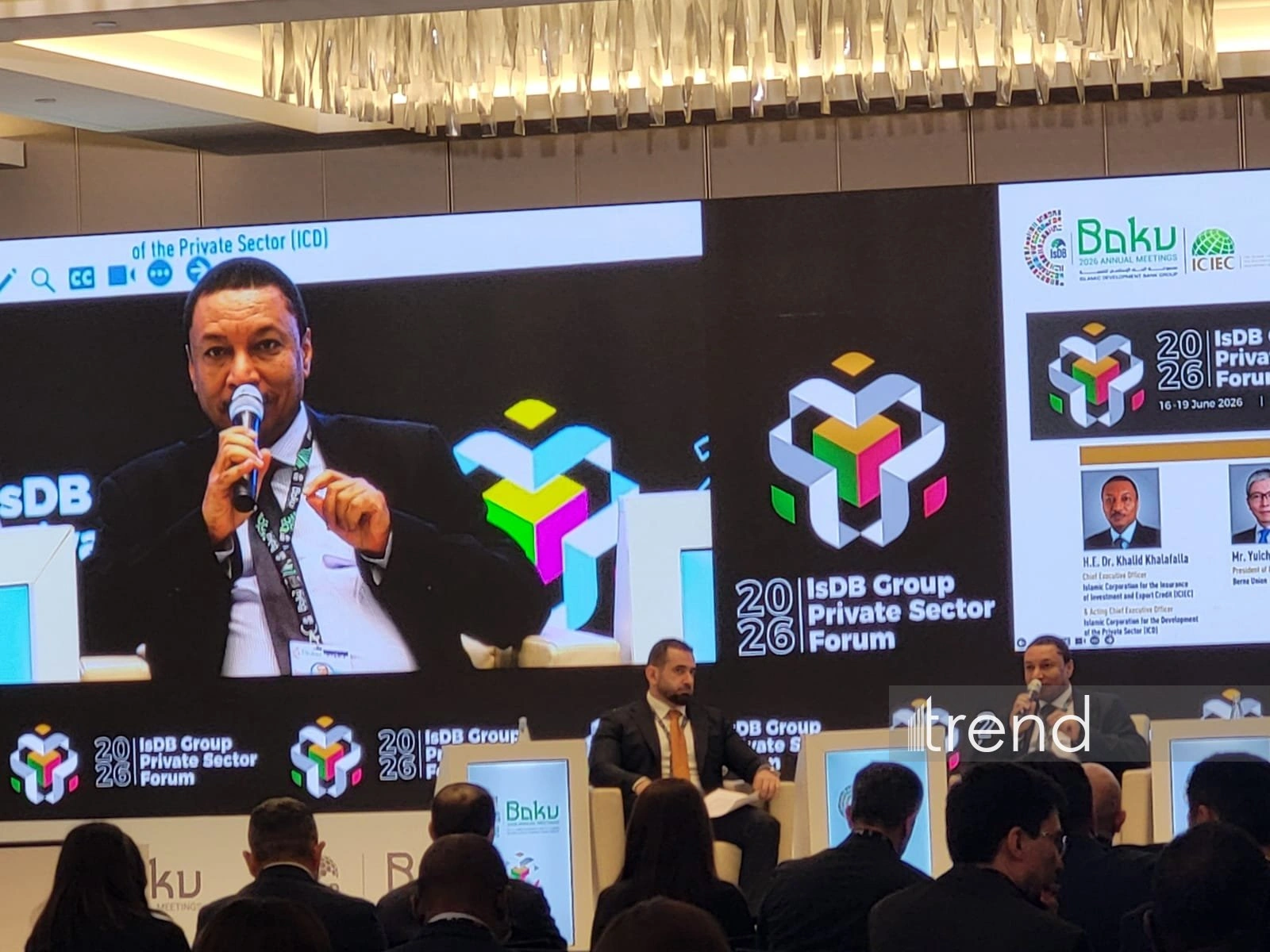
Khalid Khalafalla, CEO of the Islamic Corporation for the Insurance
of Investment and Export Credit (ICIEC), said at a panel session
during the 14th Private Sector Forum of the Islamic Development
Bank (IsDB) Group, Trend's correspondent reports from the event.
"Neither ICIEC nor other multilateral institutions are capable
of meeting the demand on their own. The only way forward for us is
to work jointly as part of a syndicate of financiers and insurers,"
he said.
According to Khalafalla, since its inception, ICIEC has provided
insurance coverage for trade and investment transactions worth $139
billion, of which nearly $57 billion accounted for projects within
the Organisation of Islamic Cooperation (OIC) member countries.
"Our mandate is to support intra-OIC trade and investment. This
is precisely why we report annually on the volume of operations
directed toward fostering regional integration," the head of the
corporation noted.
He emphasized that ICIEC actively interacts with national export
credit agencies and international financial institutions.
"In Central Asia, we work closely with NEXI, jointly expanding
our support for critically important infrastructure projects. We
recently renewed and expanded our memorandum of understanding to
implement more projects, especially in the renewable energy
sector," Khalafalla said.
As one of the successful examples of such cooperation, he
pointed out the delivery of locomotives from Kazakhstan to
Azerbaijan, executed with ICIEC support.
According to the head of the corporation, the organization pays
special attention to transport and energy projects, as these form
the very foundation of regional integration.
"As a rule, these are projects with very large financing
volumes, and no single lender or insurer is capable of providing
the necessary coverage independently," he stressed.
Khalafalla also noted the advantages of Islamic finance in
implementing such projects.
"When a deal is structured according to the principles of
Islamic finance, ICIEC can provide full insurance coverage for both
the principal amount and the profit. This is why we always strive
to structure transactions under the Islamic model," he said.
In conclusion, the head of ICIEC emphasized that the potential
for further cooperation remains very high.
"For us, there is no limit to the possibilities of supporting
such projects. We will continue to work together with financial
institutions, export credit agencies, and multilateral development
banks to realize new initiatives," Khalafalla declared.