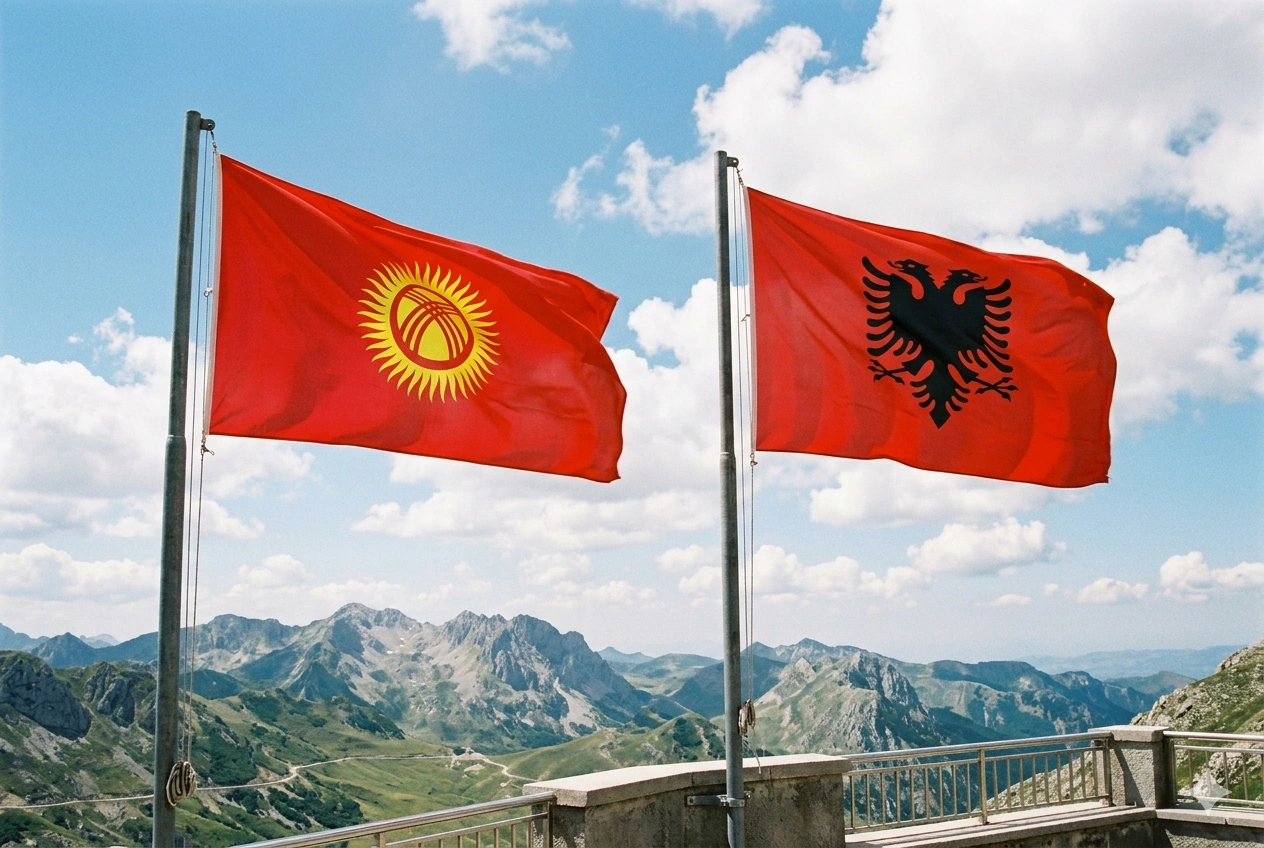
BAKU, Azerbaijan, June 17. President of Albania
Bajram Begaj will pay an official visit to Kyrgyzstan on June
17–19, 2026. This visit immediately follows his talks in
Uzbekistan, which concluded on June 16. To date, economic ties
between Albania and Kyrgyzstan are in their initial stages, with
official statistics recording minimal figures. The parties intend
to use this diplomatic round to establish real mechanisms for
interaction, as previous contacts were predominantly introductory
in nature.
The current state of trade between Albania and Kyrgyzstan is
characterized by low intensity. According to the UN Comtrade
database and the National Statistical Committee of the Kyrgyz
Republic, the annual trade turnover between the countries typically
does not exceed $50,000–$100,000. In certain periods, this figure
drops to minimal levels, which is typical for states that
previously lacked close economic ties. The dynamics of the past
three years clearly demonstrate the need to develop new approaches
to stimulate the business communities of both countries.
In 2023, a certain post-pandemic revival in trade was recorded,
with turnover amounting to approximately $50,000 to $80,000, driven
mainly by supplies of Albanian goods to the Kyrgyz Republic. In
2024, the figures adjusted downward, and Albania's exports to
Kyrgyzstan totaled $49,760. The main share of supplies at that time
consisted of mineral fuels, oils, and products of their
distillation, while Kyrgyz exports to Albania were virtually
unregistered. In 2025 and early 2026, the situation remained at a
stably low level, and the emerging activation of diplomatic
agencies is currently only preparing the ground for the commercial
sector. Albania, which possesses a developed light industry and
experience working with European brands, periodically supplies
ready-made garments, footwear, textiles, pharmaceutical products,
and medicinal herbs to Kyrgyzstan. Shipments in the opposite
direction, which included Kyrgyz dried fruits, walnuts, and small
metal products, have been sporadic over the past two years.
Investment cooperation between the states is also in its
formative stage. According to the Ministry of Economy and Commerce
of the Kyrgyz Republic and UNCTAD reports, no active joint ventures
with Albanian capital are currently registered in Kyrgyzstan.
Foreign direct investment from Albania was not recorded during the
period from 2023 to the first half of 2026.
The main reason for the restrained activity of commercial
entities lies in the absence of basic interstate agreements. To
date, the foundational documents on the avoidance of double
taxation, as well as on the mutual protection and promotion of
investments, have not been signed between the countries. Another
round of substantive negotiations to establish this regulatory
framework took place in April 2026 between the Minister of Economy
of Kyrgyzstan Bakyt Sydykov and the Ambassador of Albania, and the
upcoming visit of the head of state is intended to accelerate the
coordination of these documents at the highest level.
For Tirana and Bishkek, this visit holds strategic
significance. Albania is currently actively seeking access to the
promising markets of Central Asia, as evidenced by its leader's
visit to Uzbekistan on June 16. For Kyrgyzstan, Albania could
become an additional "gateway" to the Balkans and the Adriatic Sea
via the Port of Durrës, which fully aligns with Bishkek's state
concept of diversifying logistics routes and searching for new
transport corridors. Although the parties are beginning
negotiations from a minimal baseline, it is precisely the
unrealized potential of the Durrës port infrastructure and the
pursuit of diversification that could transform this visit into a
starting point for creating a new transit vector between the Balkan
region and Central Asia.