BAKU, Azerbaijan, May 22. Creating a
high-quality ecological environment and green energy zone operates
as one of Azerbaijan's five core strategic targets, which requires
integrating Strategic Environmental Assessments (SEA) directly into
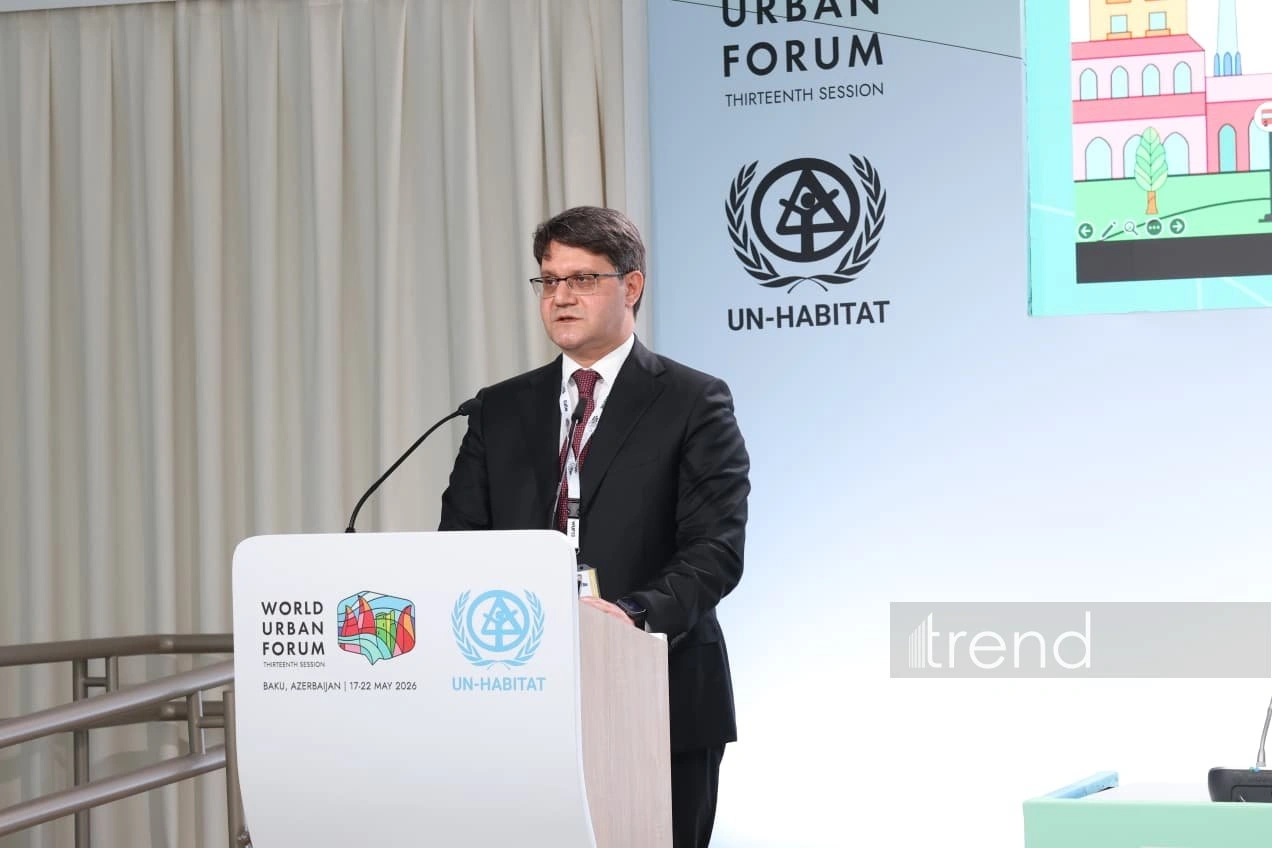
the master planning of cities, Minister of Ecology and Natural
Resources Rashad Ismayilov said, Trend reports.
He made the remarks during a specialized event titled "Strategic
Environmental Assessment as a tool for achieving climate targets in
urban planning," held within the framework of the 13th session of
the United Nations World Urban Forum (WUF13) in Baku.
"The long-term future of urban areas depends directly on
strategic development decisions, master plans, and state programs
regulating the utilization of land and other natural resources,
infrastructure deployment, and residential growth," the minister
explained.
Ismayilov reminded the delegation that the framework document
"Azerbaijan 2030: National Priorities for Socio-Economic
Development" explicitly defines green growth as a primary
structural driver of national economic expansion.
According to him, utilizing an SEA framework enables regulatory
bodies to monitor the execution of national climate commitments and
sustainable goals during the initial drafting and planning phases,
specifically aligning with UN Sustainable Development Goal 11
(Sustainable Cities and Communities) and SDG 13 (Climate
Action).
"Under the landmark Paris Agreement, our updated national
targets undergo formal documentation within the Third Nationally
Determined Contributions (NDC3) submission. Azerbaijan has
voluntarily committed to a structural 40% reduction in greenhouse
gas (GHG) emissions by the year 2035," Ismayilov noted.
The ecology minister emphasized that the successful execution of
an SEA demands absolute alignment with all existing macro-strategic
state documents during the municipal planning process.
"By adopting this proactive approach, we can systematically map
out the carbon footprint and detect potential ecological risks of
future economic operations well in advance. This methodology allows
planners to evaluate alternative development scenarios based on
rigorous, data-driven scientific analysis, while maximizing the
efficient utilization of our resource base," he concluded.
Today marks the final day of the 13th session of the World Urban
Forum (WUF13).
The first day included a ministerial meeting dedicated to the
New Urban Agenda, a ministerial roundtable, assemblies for women
and civil society, business sessions, and discussions on urban
prosperity. An official ceremony marking the raising of the UN and
Azerbaijani flags also took place.
The second day stood out for the inaugural Leaders' Summit,
featuring high-level discussions on the global housing crisis,
urbanization policy, and urban resilience. Concurrently, the
opening of the Mexico City pavilion took place, serving as a
significant platform for expanding cooperation with the Latin
American region and preparing for WUF14.
The third day of WUF13 featured a comprehensive program of
events covering the global housing crisis, the formation of safe
and inclusive cities, climate resilience, artificial intelligence
and urban governance, green urbanization, social equity, and
sustainable transport.
One of the highlights of the third day was the signing of a
sister-city memorandum between the Azerbaijani city of Shusha and
the Turkish city of Trabzon.
The fourth day of WUF13 featured a broad program of events
dedicated to urbanization, climate change, inclusive urban
development, housing policy, and sustainable governance.
The fifth day of WUF13 continued discussions on the global
housing crisis, the creation of safe and inclusive cities, climate
resilience, the use of artificial intelligence in urban management,
green urbanization, and social equality.
One of the important events of the UN Special Program for the
Economies of Central Asia (SPECA) Cities Forum, held on the fourth
day, was the announcement of Almaty’s official accession to the
“Declaration of Intent on the Establishment of the SPECA Smart
Climate-Resilient Cities Forum.”
Also, for the first time in WUF history and at Azerbaijan’s
initiative, the “WUF13 NGO Forum: Global Partnership and
Decision-Making” was held.
WUF13, which has attracted more than 40,000 registered
participants from 182 countries, will continue until May 22. Held
under the theme “Housing the world: Safe and resilient cities and
communities,” the forum brings together governments, international
organizations, experts, and representatives of civil society to
strengthen global cooperation in the field of sustainable urban
development.