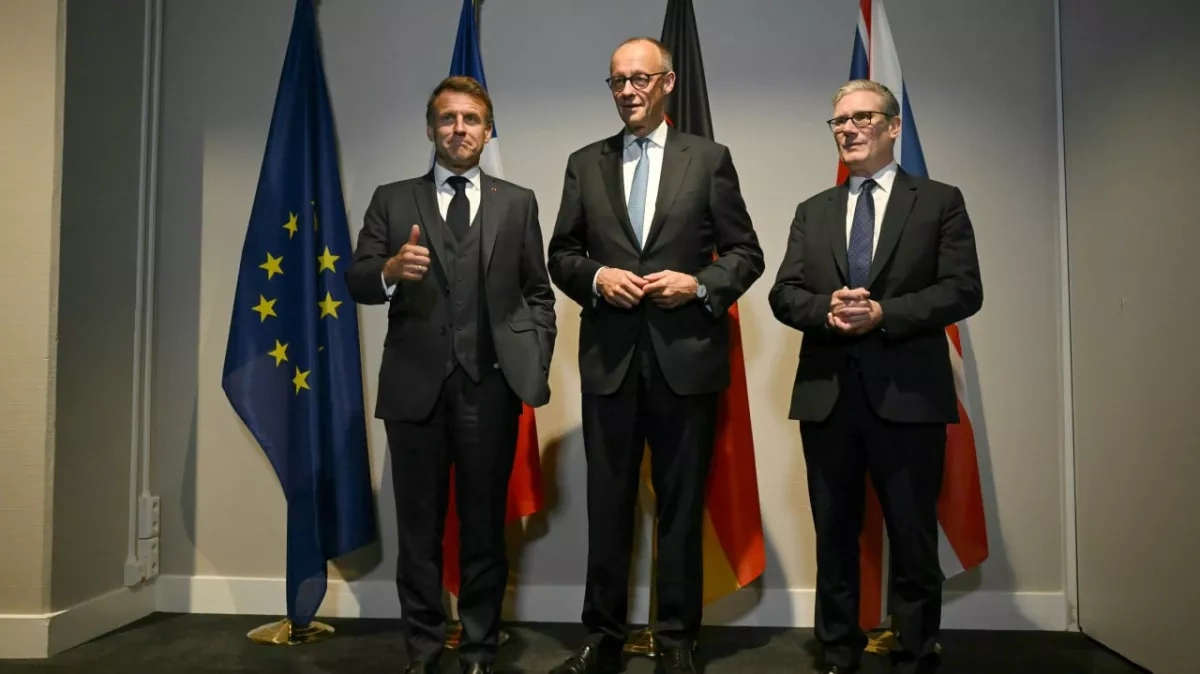
France is seeking to join a joint German-British programme to develop new long-range missiles as Europe accelerates efforts to strengthen its ability to conduct deep precision strikes without relying on the United States, Financial Times reports.
Paris has declared its interest in joining Berlin and London’s programme, according to five people familiar with the discussions, amid broader Franco-German defence coordination. The three countries are expected to hold trilateral talks in early June.
The initiative, announced by the United Kingdom and Germany in 2024 under their Trinity House defence agreement, aims to develop a family of ground-launched missiles with ranges exceeding 2,000 kilometres, capable of striking military targets inside Russia.
The programme has gained renewed urgency following US policy changes. “The European plan has gained new urgency after Donald Trump cancelled a plan to deploy a battalion equipped with Tomahawk missiles and other long-range weapons to a US base in western Germany,” according to the report.
European countries currently possess conventional missiles with ranges of roughly 300 kilometres or more, but these are largely air- or sea-launched, requiring aircraft or naval platforms to enter contested areas to reach distant targets.
Russia’s extensive use of ground-launched missile systems in Ukraine, as well as deployments in Kaliningrad, has intensified European efforts to develop comparable capabilities aimed at deterring potential aggression.
French interest in the programme also reflects President Emmanuel Macron’s growing emphasis on strengthening conventional strike capabilities alongside France’s nuclear deterrent. Officials in Paris argue participation could help “narrow the gap” between conventional and nuclear deterrence.
France had initially been involved in early discussions but later paused engagement amid internal debates over nuclear doctrine. In a March speech, Macron said France could extend implicit nuclear protection to European partners and stressed the importance of long-range strike systems “before the nuclear threshold is crossed”.
The UK-German programme, part of the wider ELSA framework, remains in the conceptual phase but envisages stealth cruise missiles and hypersonic weapons. Companies involved include MBDA and Hypersonica, while France proposes ArianeGroup as a potential contributor of rocket booster technology.
German Defence Minister Boris Pistorius recently said: “Now the French want to join us — and to do so as quickly as possible.” Berlin supports French participation, though some in London have expressed concern about industrial balance and governance of the project.
Despite past Franco-German defence setbacks, including tensions over the FCAS fighter programme, officials note successful cooperation on the Storm Shadow/SCALP missile. The three powers remain central to Europe’s evolving security architecture.
By Vafa Guliyeva