BAKU, Azerbaijan, May 22. Reconstruction should
not be limited to restoring the standards that existed in the past,
but should also use the advanced solutions, Special Representative
of the President of Azerbaijan for the Aghdam, Fuzuli, and
Khojavand districts, Emin Huseynov, said, Trend reports.
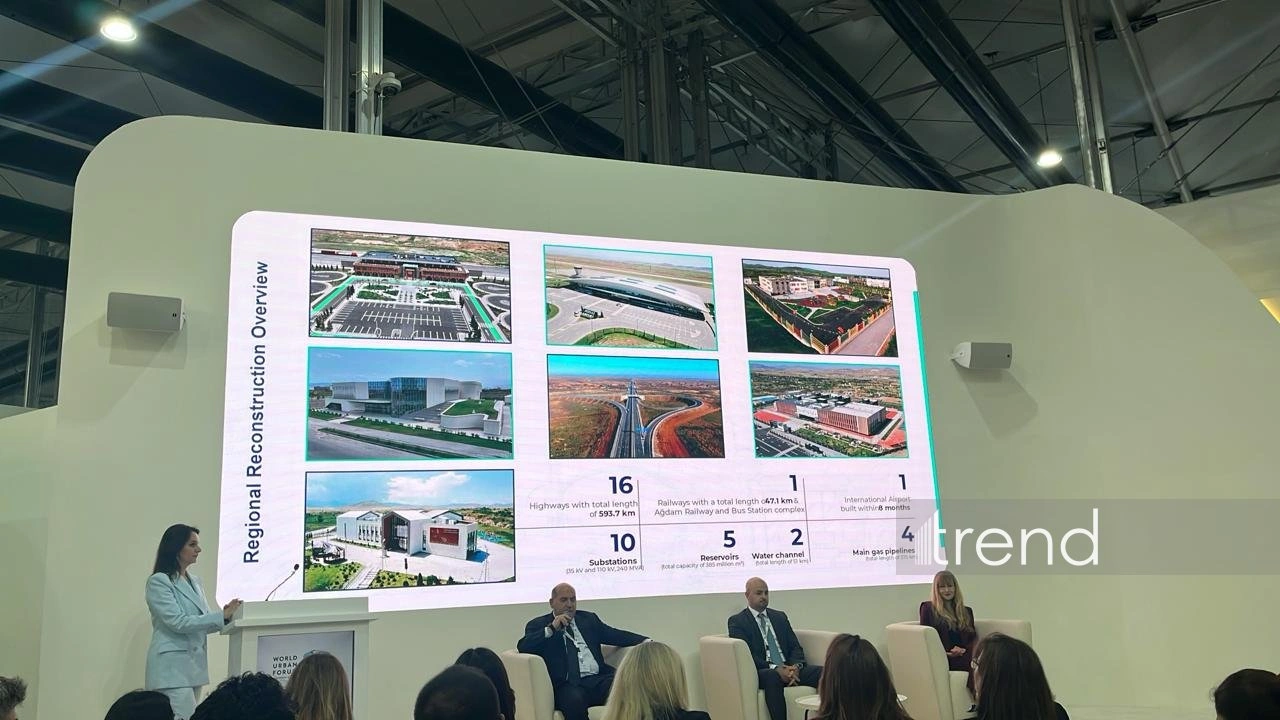
The official made the remark at the event "From Urbicide to
Revival: Sustainable Reconstruction, Resettlement, and Development
in Azerbaijan’s Liberated Territories" held within the framework of
WUF13.
According to him, it took a year to open a safe corridor of just
20 meters to supply electricity to Aghdam. Electricity is a
prerequisite for the implementation of all other projects.
Huseynov noted that the destruction in the areas was not limited
to above-ground structures.
"Vandalism also covered the underground infrastructure. All
pipes, communication lines, and engineering networks were
destroyed. Their reconstruction required a long time and large
resources," he stressed.
The special representative noted that one of the main principles
of Azerbaijan's recovery model is the application of modern
technologies.
"Reconstruction shouldn't be limited to restoring the standards
that existed in the past. The world is changing, technologies are
developing, and we must use the advanced solutions to achieve
better quality results in a shorter time," added Huseynov.
He also emphasized that the success of restoration and
reconstruction projects depends on the involvement of people in the
process. People must be heard, their opinions must be taken into
account, and they must become active participants in this process.
Only in this case can the created living spaces be sustainable and
long-lasting.
Today marks the final day of the 13th session of the World Urban
Forum (WUF13).
The first day included a ministerial meeting dedicated to the
New Urban Agenda, a ministerial roundtable, assemblies for women
and civil society, business sessions, and discussions on urban
prosperity. An official ceremony marking the raising of the UN and
Azerbaijani flags also took place.
The second day stood out for the inaugural Leaders' Summit,
featuring high-level discussions on the global housing crisis,
urbanization policy, and urban resilience. Concurrently, the
opening of the Mexico City pavilion took place, serving as a
significant platform for expanding cooperation with the Latin
American region and preparing for WUF14.
The third day of WUF13 featured a comprehensive program of
events covering the global housing crisis, the formation of safe
and inclusive cities, climate resilience, artificial intelligence
and urban governance, green urbanization, social equity, and
sustainable transport.
One of the highlights of the third day was the signing of a
sister-city memorandum between the Azerbaijani city of Shusha and
the Turkish city of Trabzon.
The fourth day of WUF13 featured a broad program of events
dedicated to urbanization, climate change, inclusive urban
development, housing policy, and sustainable governance.
The fifth day of WUF13 continued discussions on the global
housing crisis, the creation of safe and inclusive cities, climate
resilience, the use of artificial intelligence in urban management,
green urbanization, and social equality.
One of the important events of the UN Special Program for the
Economies of Central Asia (SPECA) Cities Forum, held on the fourth
day, was the announcement of Almaty’s official accession to the
“Declaration of Intent on the Establishment of the SPECA Smart
Climate-Resilient Cities Forum.”
Also, for the first time in WUF history and at Azerbaijan’s
initiative, the “WUF13 NGO Forum: Global Partnership and
Decision-Making” was held.
WUF13, which has attracted more than 40,000 registered
participants from 182 countries, will continue until May 22. Held
under the theme “Housing the world: Safe and resilient cities and
communities,” the forum brings together governments, international
organizations, experts, and representatives of civil society to
strengthen global cooperation in the field of sustainable urban
development.