BAKU, Azerbaijan, May 21. The main idea behind
Zangilan’s Master Plan was to ensure that trees, having grown and
matured over the past three decades, remain an integral part of the
urban environment, with development carefully integrated into
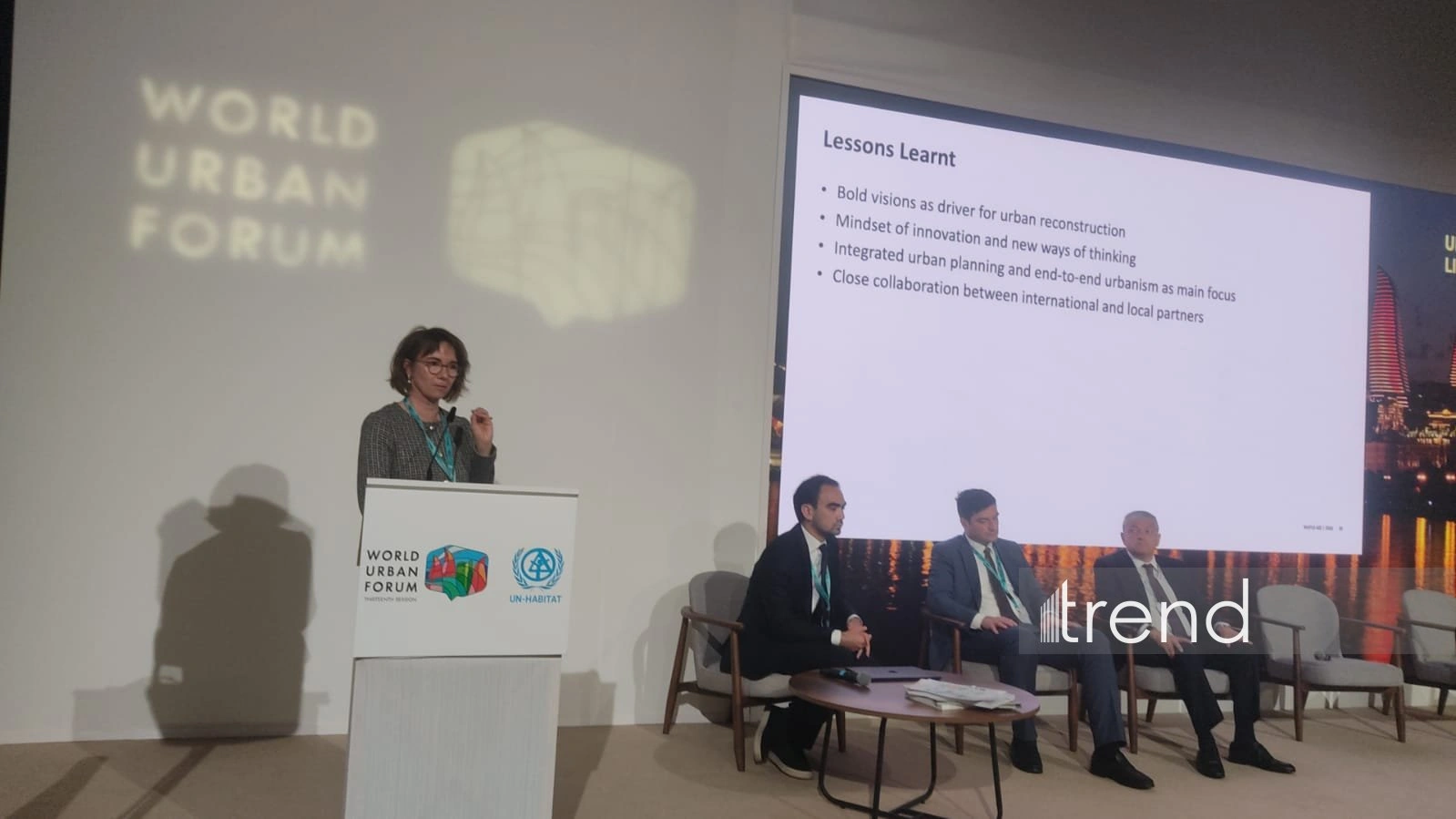
nature, Dunja Kovari, founding partner of the Urban Planning and
Planning Agency, made the remarks during a session titled
“Rebuilding Urbanism: How It Created an Innovation Laboratory for
Urban Transformation in Azerbaijan,” held within the framework of
the 13th session of the World Urban Forum (WUF13), Trend reports.
According to Kovari, this is why a large share of Zangilan’s
trees is being preserved.
“The city’s planning is based on ‘cool air corridors.’ We
continue building on this heritage through a contextual urban
regeneration approach,” she said.
Kovari noted that a large part of Karabakh and the East Zangazur
region is located in mountainous terrain, an environment in which
the Swiss agency feels particularly comfortable operating.
“That is why high-altitude planning became one of the key
directions of the reconstruction process,” she said.
She added that Kalbajar was known during the Soviet era for its
hot springs, and the current Master Plan builds on that strong and
long-standing tradition.
“We introduced a new typology — Alpine typology. What is
important, however, is that the Alpine residential model is
integrated in balance with nature and the mountains, together
creating a unified environment that, in our view, makes Kalbajar
unique,” Kovari said.
She also stressed that sustainable mobility solutions are
critically important for Baku’s transformation.
“Currently, the main focus is on transforming public spaces from
car-centered areas into open spaces designed for people — as you
can see here in Baku’s 28 May Square,” she said.
“No matter how often we say it, ultimately we are planning for
people. That is why Baku Central Park, as well as the planning and
development of green spaces across the city, are just as important
for the capital as they are for the territories undergoing
reconstruction,” Kovari added.
In the mean time, today marks the fifth day of WUF13 in
Baku.
The first day included a ministerial meeting dedicated to the
New Urban Agenda, a ministerial roundtable, assemblies for women
and civil society, business sessions, and discussions on urban
prosperity. An official ceremony marking the raising of the UN and
Azerbaijani flags also took place.
The second day stood out for the inaugural Leaders' Summit,
featuring high-level discussions on the global housing crisis,
urbanization policy, and urban resilience. Concurrently, the
opening of the Mexico City pavilion took place, serving as a
significant platform for expanding cooperation with the Latin
American region and preparing for WUF14.
The third day of WUF13 featured a comprehensive program of
events covering the global housing crisis, the formation of safe
and inclusive cities, climate resilience, artificial intelligence
and urban governance, green urbanization, social equity, and
sustainable transport.
One of the highlights of the third day was the signing of a
sister-city memorandum between the Azerbaijani city of Shusha and
the Turkish city of Trabzon.
The fourth day of WUF13 featured a broad program of events
dedicated to urbanization, climate change, inclusive urban
development, housing policy, and sustainable governance.
One of the important events of the UN Special Programme for the
Economies of Central Asia (SPECA) Cities Forum, held on the fourth
day, was the announcement of Almaty’s official accession to the
“Declaration of Intent on the Establishment of the SPECA Smart
Climate-Resilient Cities Forum.”
Also, for the first time in WUF history and at Azerbaijan’s
initiative, the “WUF13 NGO Forum: Global Partnership and
Decision-Making” was held.
WUF13, which has attracted more than 40,000 registered
participants from 182 countries, will continue until May 22. Held
under the theme “Housing the world: Safe and resilient cities and
communities,” the forum brings together governments, international
organizations, experts, and representatives of civil society to
strengthen global cooperation in the field of sustainable urban
development.