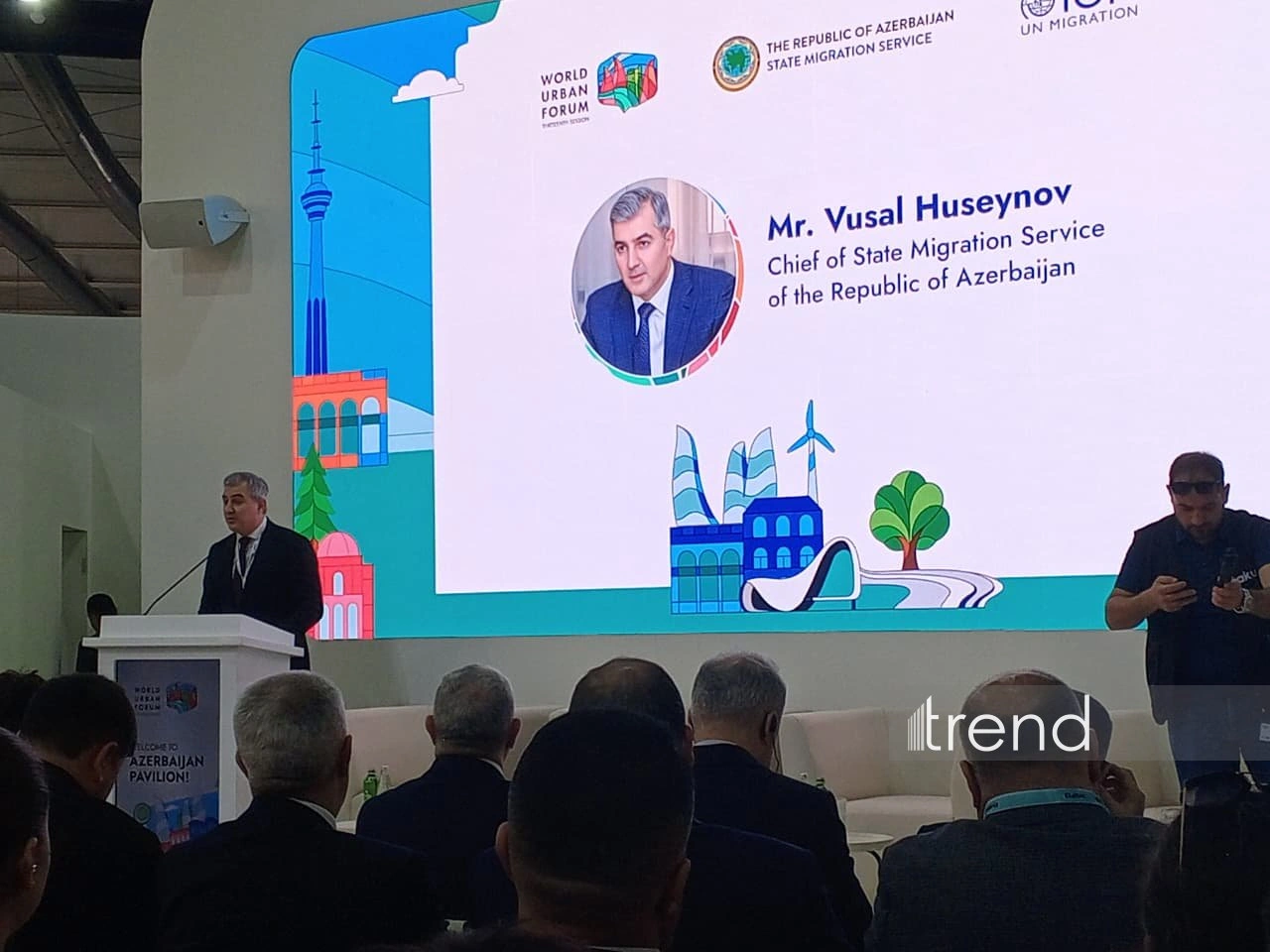
BAKU, Azerbaijan, May 20. Migration policy and
urban planning policy must complement each other, Head of the State
Migration Service Vusal Huseynov told reporters within the
framework of WUF13, Trend
reports.
"Our country has been hosting a global event for the past two
years. The World Urban Forum is being held in Baku, which is an
indicator of our country's growing international prestige,
diplomatic success, active contribution to global discussions, and
support for the sustainable development agenda," the official
explained.
He noted that the agenda of the World Urban Forum is quite
extensive, and various topics are discussed here.
"One of these issues is the topic of migration and cities.
Today, a high-level event was held on this topic. In fact, this
event is a continuation of the discussions that began two weeks ago
at the International Migration Review Forum held at the UN
Secretariat in New York.
According to the latest World Migration Report, released two
weeks ago, the number of international migrants has already reached
304 million. This figure includes only cross-border migration. If
we add internal migration indicators, these figures increase
several times," he said.
According to him, the fact that more than half of the world's
population lives in cities and that this figure is expected to
reach 70 percent by 2050 makes the connection between urban
planning and migration even more relevant.
"Of course, the settlement of people in new cities, access to
state and social services in the urbanization process, integrationб
and ensuring equal opportunities are important topics for
discussion.
The panel discussions specifically emphasized the importance of
urban planning policy and migration policy complementing each
other.
The goal is to shape sustainable and inclusive cities, while
also identifying the contributions that migration policy can make
to this process," he added.
He noted that migration processes are most pronounced in cities
and their positive effects can only be achieved through proper
urban management.
Huseynov also underscored that the event also focused on
Azerbaijan's Great Return Program and the reconstruction work
carried out in the liberated territories.
"The modern urban planning approaches implemented in the
liberated territories were also highlighted during the
discussions," he said.
The head of the State Migration Service added that this event is
planned to be continued in the future.
"We'll try to keep migration issues constantly in focus at
international urban planning platforms," Huseynov
highlighted.
Today marks the fourth day of WUF13 in Baku.
The first day included a ministerial meeting dedicated to the
New Urban Agenda, a ministerial roundtable, assemblies for women
and civil society, business sessions, and discussions on urban
prosperity. An official ceremony marking the raising of the UN and
Azerbaijani flags also took place.
The second day stood out for the inaugural Leaders' Summit,
featuring high-level discussions on the global housing crisis,
urbanization policy, and urban resilience. Concurrently, the
opening of the Mexico City pavilion took place, serving as a
significant platform for expanding cooperation with the Latin
American region and preparing for WUF14.
The third day of WUF13 featured a comprehensive program of
events covering the global housing crisis, the formation of safe
and inclusive cities, climate resilience, artificial intelligence
and urban governance, green urbanization, social equity, and
sustainable transport.
WUF13, which has attracted more than 40,000 registered
participants from 182 countries, will continue until May 22. Held
under the theme “Housing the world: Safe and resilient cities and
communities,” the forum brings together governments, international
organizations, experts, and representatives of civil society to
strengthen global cooperation in the field of sustainable urban
development.