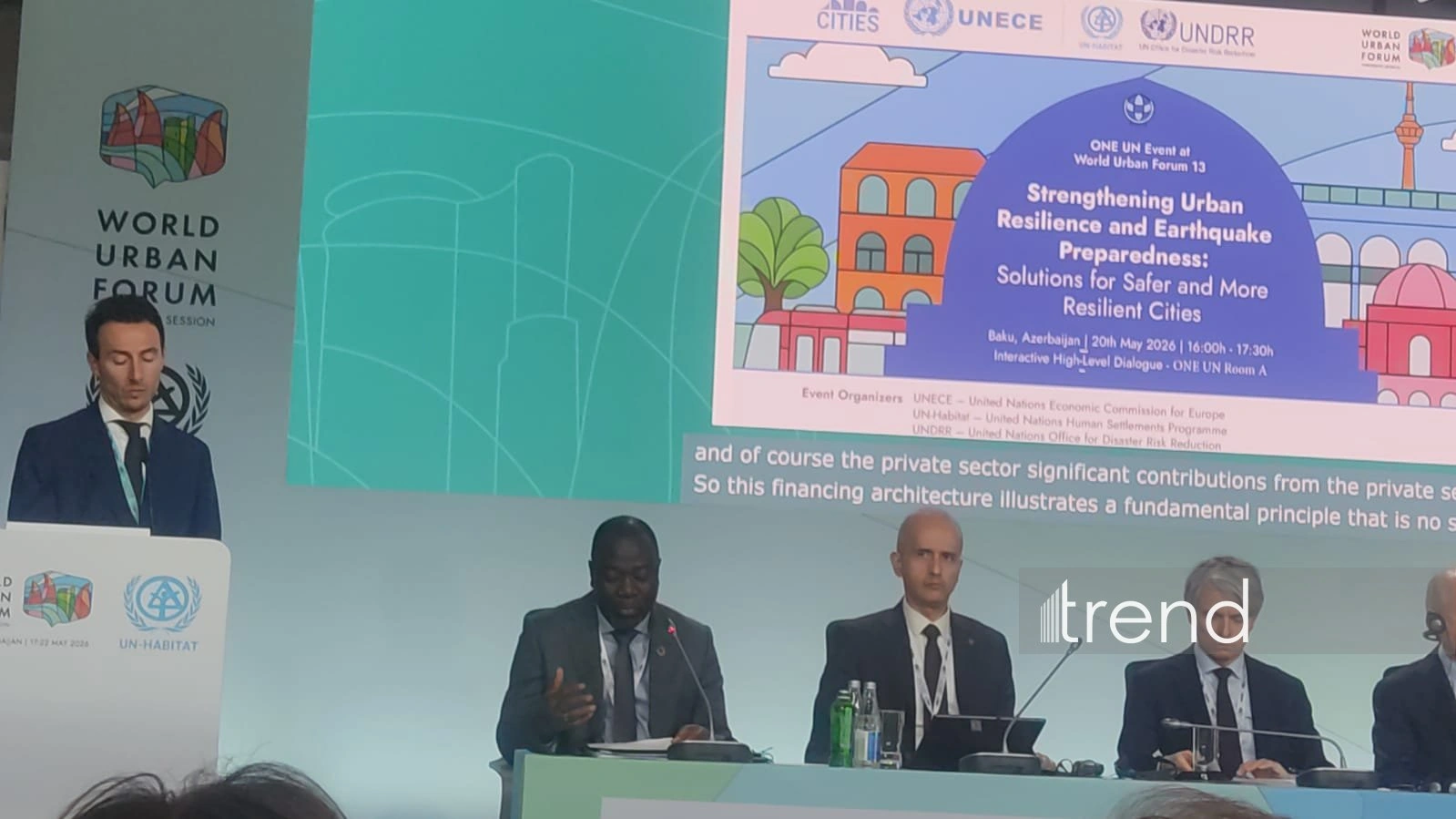
BAKU, Azerbaijan, May 20. The recent earthquake
in Türkiye has created tension in testing urban planning
approaches, UN resident coordinator in the country, Babatunde
Ahonsi, said during a conference titled "Strengthening Urban
Earthquake Preparedness ONE UN Solutions for Safer and More
Resilient Cities" held within the framework of the 13th session of
the World Urban Forum (WUF13) in Baku, Trend reports.
"The earthquake has created a deep, system-wide tension, testing
our development models, global health systems, and urban planning
approaches," he explained.
According to him, the recent earthquake in Turkey has revealed
the scale of physical vulnerability in cities.
"But within this great tragedy lies a significant opportunity.
It's an opportunity to transform the recovery process into a
forward-looking agenda towards resilience, sustainable development
and inclusion. This approach is crucial not only for protecting
people, assets and economic activity, but also for reducing
inequalities and exposure to various risks. This is why urban
resilience must be at the heart of both national recovery
strategies and global processes such as COP31.
Experience shows that urban resilience is not an expense. On the
contrary, it is one of the most strategic and cost-effective
investments that can be made for sustainable development. Civil
society, academia, the private sector and, in particular, the
affected communities themselves must be involved as active
co-founders of the recovery process. Of course, the UN's integrated
approach also plays an important role here.
As a United Nations country team, we are also trying to
implement this approach in practical terms in the recovery efforts
by creating innovative coordination mechanisms in the affected
regions," he noted.
Today marks the fourth day of WUF13 in Baku.
The first day included a ministerial meeting dedicated to the
New Urban Agenda, a ministerial roundtable, assemblies for women
and civil society, business sessions, and discussions on urban
prosperity. An official ceremony marking the raising of the UN and
Azerbaijani flags also took place.
The second day stood out for the inaugural Leaders' Summit,
featuring high-level discussions on the global housing crisis,
urbanization policy, and urban resilience. Concurrently, the
opening of the Mexico City pavilion took place, serving as a
significant platform for expanding cooperation with the Latin
American region and preparing for WUF14.
The third day of WUF13 featured a comprehensive program of
events covering the global housing crisis, the formation of safe
and inclusive cities, climate resilience, artificial intelligence
and urban governance, green urbanization, social equity, and
sustainable transport.
WUF13, which has attracted more than 40,000 registered
participants from 182 countries, will continue until May 22. Held
under the theme “Housing the world: Safe and resilient cities and
communities,” the forum brings together governments, international
organizations, experts, and representatives of civil society to
strengthen global cooperation in the field of sustainable urban
development.