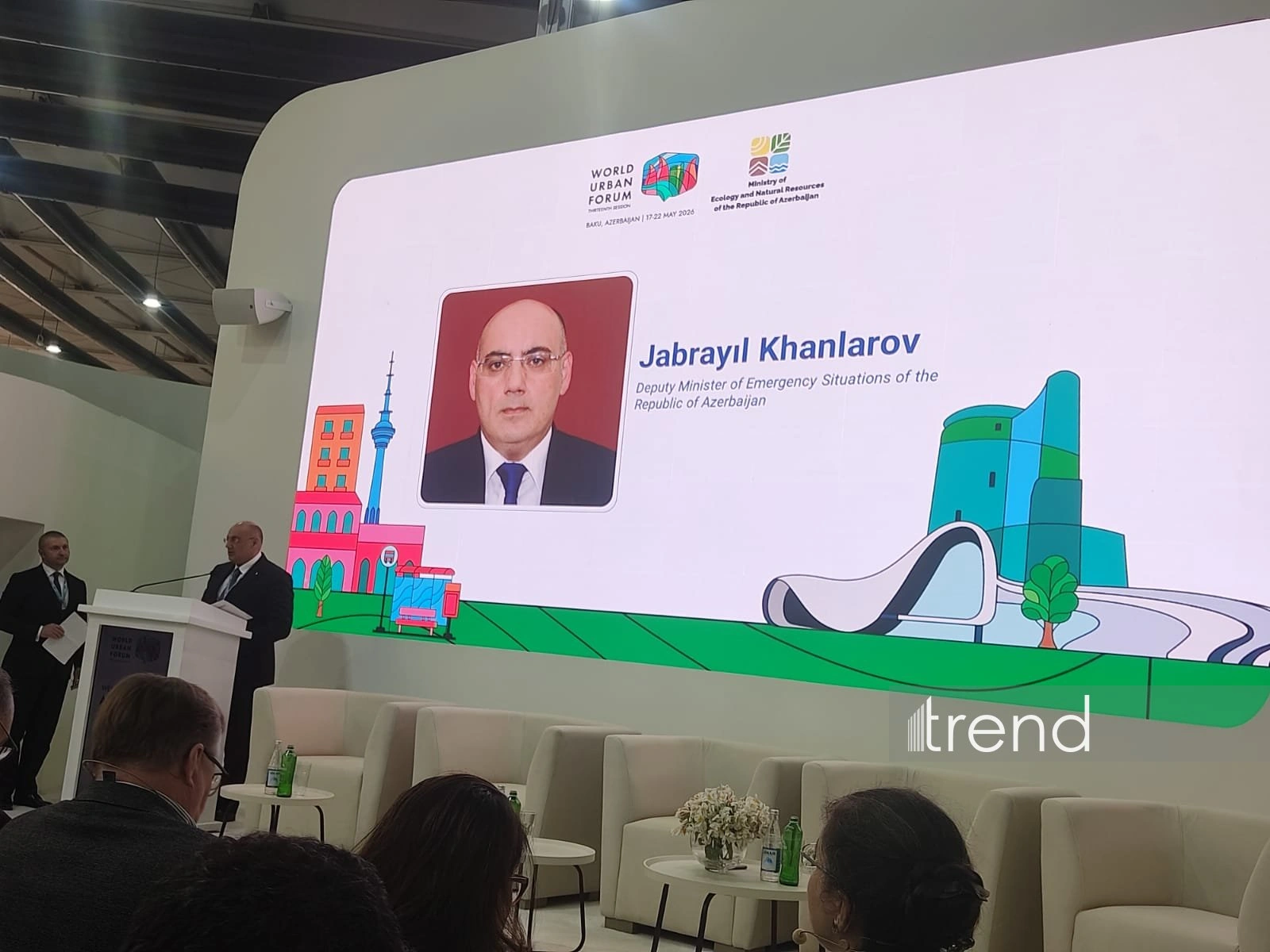
BAKU, Azerbaijan, May 19. The Ministry of
Emergency Situations supports large-scale early warning system
initiatives, Deputy Minister of Emergency Situations Jabrayil
Khanlarov said during an event titled "Early Warning Systems and
Climate-Resilient Cities" held within the framework of WUF13,
Trend reports.
According to him, public awareness, disaster risk planning and
implementation at the local level, as well as the organization of
communication systems, hold vital importance.
"The development of climate-resilient cities and the adaptation
of infrastructure to climate change are among the core priorities.
Key factors include the preparation of spatial planning documents,
optimization in engineering and design, and building urban
infrastructure in a climate-resilient manner. The impact of
environmental factors on urban infrastructure is taken into account
at every stage of construction and urban planning activity,"
Khanlarov noted.
He stressed that a number of critical measures must be
implemented to mitigate the impact of natural disasters and
increase the resilience of cities to ecological factors.
"The Ministry of Emergency Situations is carrying out serious
work toward utilizing energy-efficient lighting and heating
systems, developing water supply infrastructure, raising awareness
among construction specialists regarding climate change, utilizing
renewable energy sources, and increasing the climate resilience of
buildings and structures based on the 'smart city' concept.
Overall, the organization of early warning systems and joint
cooperation in urban climate resilience are essential," the deputy
minister added.
The third day of the 13th session of the World Urban Forum
(WUF13) is underway in Baku.
On the first day, a ministerial meeting dedicated to the New
Urban Agenda, a roundtable of ministers, assemblies of women and
civil society, business sessions, and discussions on urban
well-being were held. A ceremony for raising the flags of the
United Nations and Azerbaijan also took place within the framework
of the forum.
The second day of the forum drew attention with the first-ever
Leaders Summit. High-level discussions on the global housing
crisis, urbanization policy, and urban resilience were held that
day. At the same time, the Mexico City pavilion was inaugurated
within the framework of WUF13. The pavilion was presented as an
important platform for expanding cooperation with the Latin
American region and preparing for WUF14.
WUF13, which has attracted more than 40,000 registered
participants from 182 countries, will continue until May 22. Held
under the theme “Housing the world: Safe and resilient cities and
communities,” the forum brings together governments, international
organizations, experts, and representatives of civil society to
strengthen global cooperation in the field of sustainable urban
development.