BAKU, Azerbaijan, April 17. The “Trump Route
for International Peace and Prosperity” (TRIPP) could become a
strategic economic belt connecting Europe, the Middle East, and
South Asia, Ziya Mammadov, deputy head of the marketing division at
the Marketing and Tariff Policy Department of Azerbaijan Railways
(AZR), wrote on his social media account, Trend reports.
He noted that TRIPP can be viewed not only as a short-term trade
initiative but also as a long-term strategic logistics platform
with the potential to transform regional connectivity between
Europe, the Middle East, South Asia, and the broader Caspian
region.
"By connecting Türkiye, Iraq, Pakistan, Saudi Arabia, the United
Arab Emirates, Qatar, and Azerbaijan, as well as potentially
broader markets in the Gulf and Central Asia, the corridor could
form a diversified trade route that reduces dependence on a limited
number of traditional maritime bottlenecks and congested shipping
lanes.
In the coming years, global supply chains will increasingly
focus on sustainability, flexibility, and route diversification.
“In this context, TRIPP could become an important multimodal
network integrating land and sea routes, connecting production
centers, consumer markets, energy exporters, and transit hubs in
various regions,” the publication states.
Mammadov also highlighted the main long-term advantages of the
TRIPP corridor: Türkiye can serve as a gateway to Europe, the
Balkan markets, and the Mediterranean; Iraq possesses significant
geographical potential as a key land bridge between the Gulf
countries and Türkiye; Pakistan provides direct access to South
Asia and trade flows in the Arabian Sea; Saudi Arabia, the UAE, and
Qatar can boost cargo flows through their investment potential,
port infrastructure, and industrial demand; Azerbaijan can play a
strategic connecting role via the Port of Baku, East–West
infrastructure, and links to the Middle Corridor, Central Asia, and
the Caspian region; The integration of railways, highways, dry
ports, and logistics zones will enable the formation of a more
sustainable multimodal system; Diversifying routes will help
mitigate risks associated with geopolitical factors and maritime
“bottlenecks.”
According to the deputy head, the long-term sustainability of
the corridor will hinge on the harmonization of customs systems,
competitive transit tariffs, stable cross-border coordination,
digital cargo tracking platforms, ongoing investment in
infrastructure, and predictable trade policies.
"If implemented effectively, the TRIPP corridor could go beyond
a mere transport route and become a strategic economic belt,
uniting the capital of the Gulf countries, Türkiye’s industry,
Iraq’s transit potential, Azerbaijan’s logistics capabilities, and
access to Pakistan’s markets.
In the long term, the most successful corridors will not only
move cargo but also facilitate investment flows, promote industrial
development, and strengthen regional cooperation," he
concluded.
On August 8, 2025, following a trilateral meeting with U.S.
President Donald Trump in Washington, President of the Republic of
Azerbaijan Ilham Aliyev and Prime Minister Nikol Pashinyan signed a
joint declaration on ensuring peace between Baku and Yerevan and
establishing transport links between the main part of Azerbaijan
and Nakhchivan. This project was named the “Trump Route for
International Peace and Prosperity.”
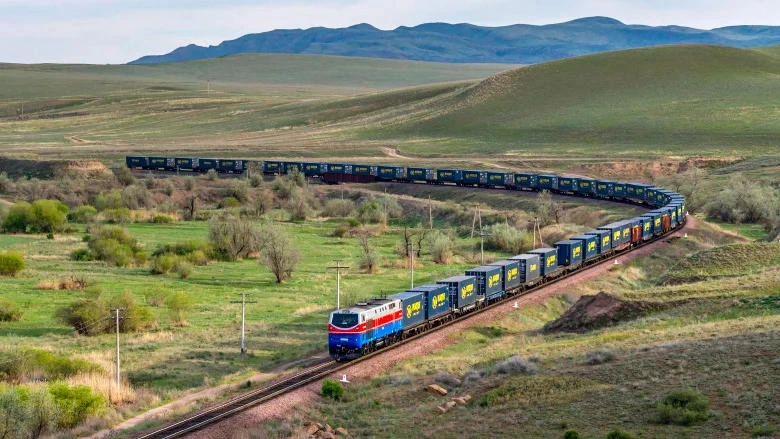
Meanwhile, the Middle Corridor is a transport and trade route
passing through a number of countries in the region and connecting
Asia with Europe. It serves as an alternative to the traditional
Northern and Southern Corridors.
The route begins in China and runs through the countries of
Central Asia. It then crosses the Caspian Sea, Azerbaijan, Georgia,
and Türkiye, before reaching Europe. The Middle Corridor is a land
route that bypasses longer sea routes, connecting the eastern
regions of Asia, including China, with Europe.