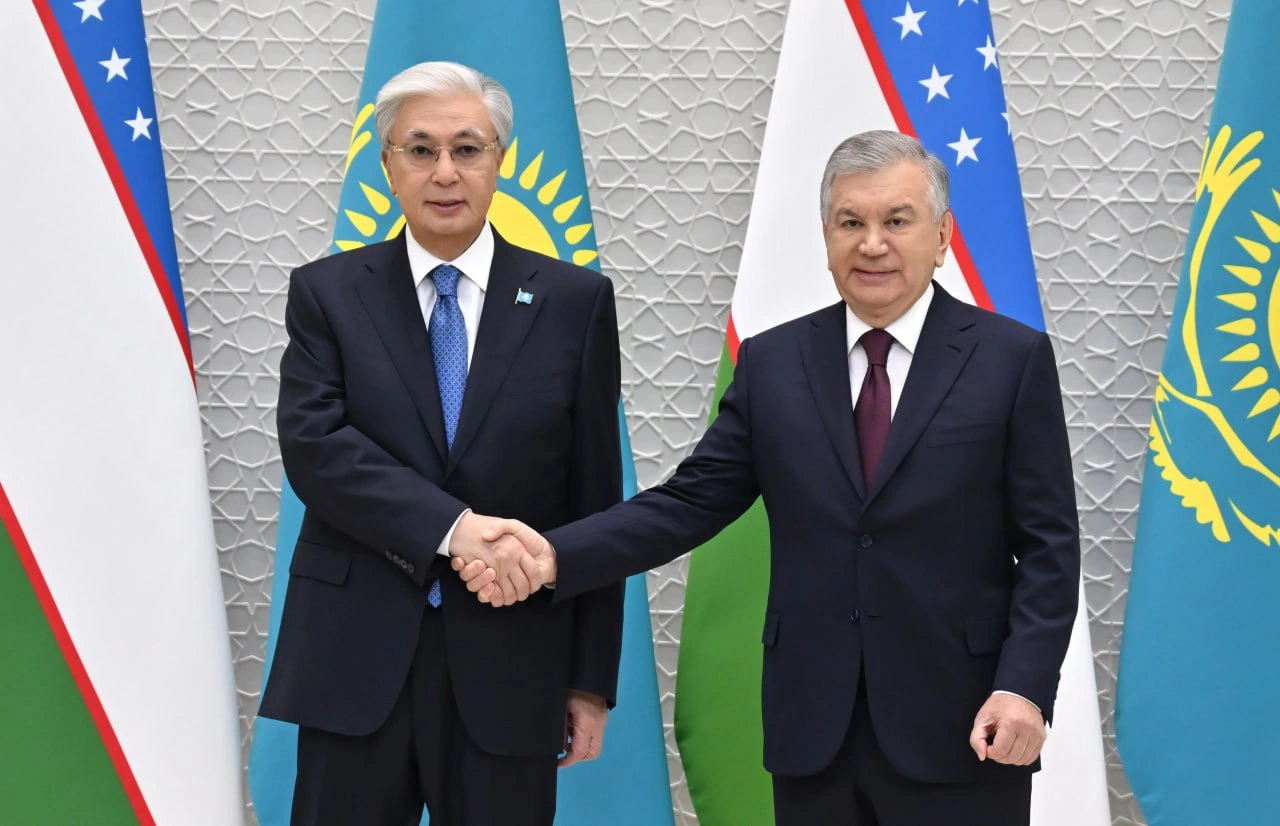
BAKU, Azerbaijan, April 11. President
Kassym-Jomart Tokayev of Kazakhstan is scheduled to undertake a
working visit to Uzbekistan on April 11, during which high-level
discussions and a series of bilateral events will take place in
Bukhara.
This visit is part of a broader trend of increasing Kazakh-Uzbek
interactions. On March 31, a Kazakh delegation, led by Foreign
Minister Yermek Kosherbayev, arrived in Uzbekistan, where a range
of bilateral meetings occurred, culminating in the signing of the
Programme of Cooperation between the foreign ministries for
2026-2027.
"Thanks to the political will of the heads of state,
Kazakh-Uzbek relations have been elevated to a qualitatively new
level, demonstrating robust development across all levels of
interaction," Kosherbayev remarked during the meetings.
Economic cooperation remains a key focus in the bilateral
relationship. The two nations are targeting a trade turnover of $10
billion, a goal that necessitates not only an increase in mutual
trade but also a deepening of industrial collaboration and the
localization of production.
According to Uzbekistan’s National Statistics Committee, trade
turnover between the two countries reached $837.5 million in
January-February 2026, reflecting a year-on-year increase of 26.8%.
Another key factor driving the strengthening of ties is the growing
investment footprint of Kazakhstan in Uzbekistan. As of early 2026,
there are 1,221 enterprises with Kazakh capital operating in the
country. In terms of industrial collaboration, the two nations are
currently engaged in 78 investment projects, with a combined
investment volume of $1.8 billion.
A central aspect of this cooperation is the integration of
transport and logistics systems. Both Kazakhstan and Uzbekistan are
enhancing their coordination in the development of railway routes
and border infrastructure, recognizing these efforts as essential
for expanding market access to the Middle East, South Asia, and
Europe.
In 2025, cargo transportation between the two countries reached
a record 32.3 million tons, marking a 16% increase and the highest
level in a decade. This growth not only underscores the expansion
of bilateral trade but also highlights the increasing strategic
significance of the region as a key transit hub within Eurasian
logistics.
A major project is the development of the International Center
for Industrial Cooperation “Central Asia” on the
Kazakhstan–Uzbekistan border. Its completion is planned for 2026.
The project is seen as an instrument to accelerate industrial
integration and reduce barriers for cross-border business. The
agreement regulating the center’s operations was signed in November
2023. The facility will be located near the Atameken (Kazakhstan)
and Gulistan (Uzbekistan) border checkpoints and will include
production sites, storage facilities for goods and equipment, and
transport infrastructure.
In addition, on April 3, 2026, an EPC contract was signed for
the first phase of the Multifunctional Modern Logistics Center
(MSLC) in the Tashkent region. The contract was concluded by the
joint venture Silkway CA, established in March 2025 with the
participation of Kazakhstan’s PTC Holding, JSC Uzbekistan Railways,
and China Railway Construction Engineering Group. It provides for a
turnkey implementation - from design and equipment supply to
railway infrastructure construction, a container terminal, and
commissioning of the facility. Investment in the first phase will
amount to $84 million.
Cooperation in water resources is also gaining importance, with
the countries moving toward a more formalized model of joint
management. The agreement on transboundary water bodies signed in
November 2025 establishes coordination mechanisms for
infrastructure operation, data exchange, and joint monitoring, as
well as measures to prevent accidents and climate-related
risks.
At the same time, the regional energy dimension is
strengthening. Hydropower projects are being discussed, including
the Kambarata HPP-1 with a capacity of 1,880 MW, which is being
developed with the participation of Kazakhstan and Uzbekistan on
the Naryn River in Kyrgyzstan. A broader framework of cooperation
in “green” energy is also taking shape.
On April 9, 2026, Kazakhstan ratified an agreement with
Azerbaijan and Uzbekistan on a strategic partnership in the
production and transmission of green energy, signed on the
sidelines of the COP29 World Climate Summit in November 2024. The
agreement provides for joint energy projects, interconnection of
the three countries’ power systems, and the laying of a submarine
cable across the Caspian Sea. The framework also envisions the
formation of an electricity export route integrated into the Black
Sea energy corridor.
The overall set of developments points to a gradual formation of
a denser economic and infrastructure linkage between Kazakhstan and
Uzbekistan. Cooperation is moving beyond a bilateral agenda and is
increasingly becoming a system-forming element for the entire
Central Asian region.
Against this backdrop, the upcoming visit to Bukhara marks a
stage in consolidating an already unfolding model of regional
integration, where trade, logistics, energy, and resource
management play a central role.