BAKU, Azerbaijan, April 6. When discussing
bilateral relations between states, it is customary to focus on
institutions, agreements, and mechanisms of cooperation. All of
this is undoubtedly important. But in the case of Azerbaijan and
Georgia, there is another factor that is no less significant - the
human one. More precisely, the factor of specific leaders whose
personal contacts, mutual trust, and alignment of strategic
priorities give these relations a dynamism that is difficult to
explain by the logic of mutual benefit alone.
The two countries are strategic partners and actively cooperate
both bilaterally and within international projects. That is true.
But for strategic partnership not to remain a mere declaration,
political will at the highest level is required. And this is
precisely where the role of Ilham Aliyev is hard to
overestimate.
Over more than twenty years, Aliyev has shaped Azerbaijan’s
foreign policy as a system of long-term priorities: transport
corridors, energy, and geopolitical neutrality that allows
cooperation with a wide range of partners. Within this framework,
Georgia occupies one of the central places - not by geographic
coincidence, but as a result of a deliberate choice. Joint oil and
gas projects form the basis of energy security for many countries,
and today Azerbaijan exports its natural gas to numerous countries
via transit through Georgia, with exports increasing every year -
as Ilham Aliyev himself stated after talks with the Georgian prime
minister in early 2025. Behind this statement lie years of
infrastructure investment, political agreements, and mutual
trust.
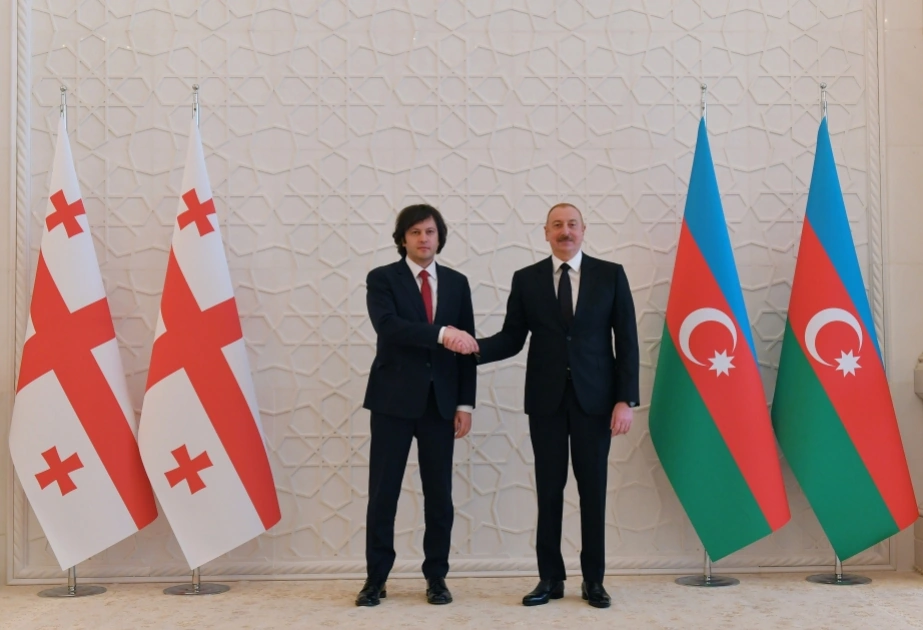
After the parliamentary elections in Georgia in autumn 2024,
when a new government was formed under Irakli Kobakhidze, the
dynamics of bilateral contacts noticeably accelerated. The
President of Azerbaijan congratulated Kobakhidze on the victory of
the “Georgian Dream” party, noting that the election results
demonstrated Georgian citizens’ support for stability, and invited
him to Baku. The invitation was accepted immediately: on January
17, 2025, Irakli Kobakhidze made his first post-election foreign
visit to Azerbaijan. The choice of the first destination after
reelection always speaks volumes about priorities. With this
choice, Tbilisi said a great deal.
At a joint press conference, Irakli Kobakhidze called Ilham
Aliyev “a special leader in the region and an example,” and also
noted that Georgia and Azerbaijan successfully play the role of a
bridge between Europe and Asia. In response, the Azerbaijani leader
stated that Azerbaijani–Georgian political relations could serve as
an example for all neighbors. Two leaders who see partnership in
the same way are a rarity - and one with very practical
significance.
The leadership factor is most clearly evident in major
infrastructure initiatives. Thanks in large part to Ilham Aliyev,
Azerbaijan has become a key hub of the Trans-Caspian International
Transport Route - the Middle Corridor - linking China with Europe
via the Caspian Sea, the Caucasus, and the Black Sea. Within this
project, Georgia, Azerbaijan, and Kazakhstan are forming a unified
railway company that will handle cargo flows from China on a
one-stop-shop basis. For such a structure to function, consistent
political leadership is required - and that is what these leaders
provide.
An even more telling example is the Black Sea Energy project - a
1,195-kilometer underwater electricity cable along the bed of the
Black Sea. In May 2024, energy operators from Azerbaijan, Romania,
Georgia, and Hungary signed a memorandum to establish the Green
Energy Corridor joint venture. At the initial stage, the cable is
designed to export 4 GW of “green” energy; construction is
estimated at €3.5 billion, and the European Commission plans to
allocate €2.3 billion to the project. In December 2025, the
European Commission officially granted the project PMI (Project of
Mutual Interest) status. Georgia is a full participant and
beneficiary in this structure. The fact that the project has
materialized now is largely explained by the presence of people on
both shores ready to promote it.
Following the 2024 parliamentary elections, President Ilham
Aliyev repeatedly received Georgian officials in Baku, including
Irakli Kobakhidze himself, President Mikheil Kavelashvili, and
members of the cabinet. Meetings also took place on the sidelines
of various international events abroad. Such intensity of contact
reflects practical necessity: too many joint projects are in an
active phase for communication to be limited to annual summits.
At recent meetings, the sides agreed to continue work on new
strategic projects and to take effective steps toward developing
the strategic infrastructure of both countries and enhancing
connectivity between them. Behind these formulations are specific
technical commissions, interagency groups, and investment
decisions. In January 2025, the 10th anniversary meeting of the
intergovernmental commission on economic cooperation took place,
and the very fact that this mechanism has functioned continuously
for ten years speaks to its real demand and effectiveness.
Ilham Aliyev consistently views Georgia as the western gateway
for Azerbaijan’s corridors to the Black Sea and to the broader
system of trade and energy links. Kobakhidze sees Azerbaijan as a
reliable and predictable partner in a region where predictability
is a scarce resource. Both leaders understand that their countries
cannot, on their own, realize the Middle Corridor, green energy
transit to Europe, or large-scale transport hubs. This shared
understanding is today the main driving force behind
Azerbaijani–Georgian relations.