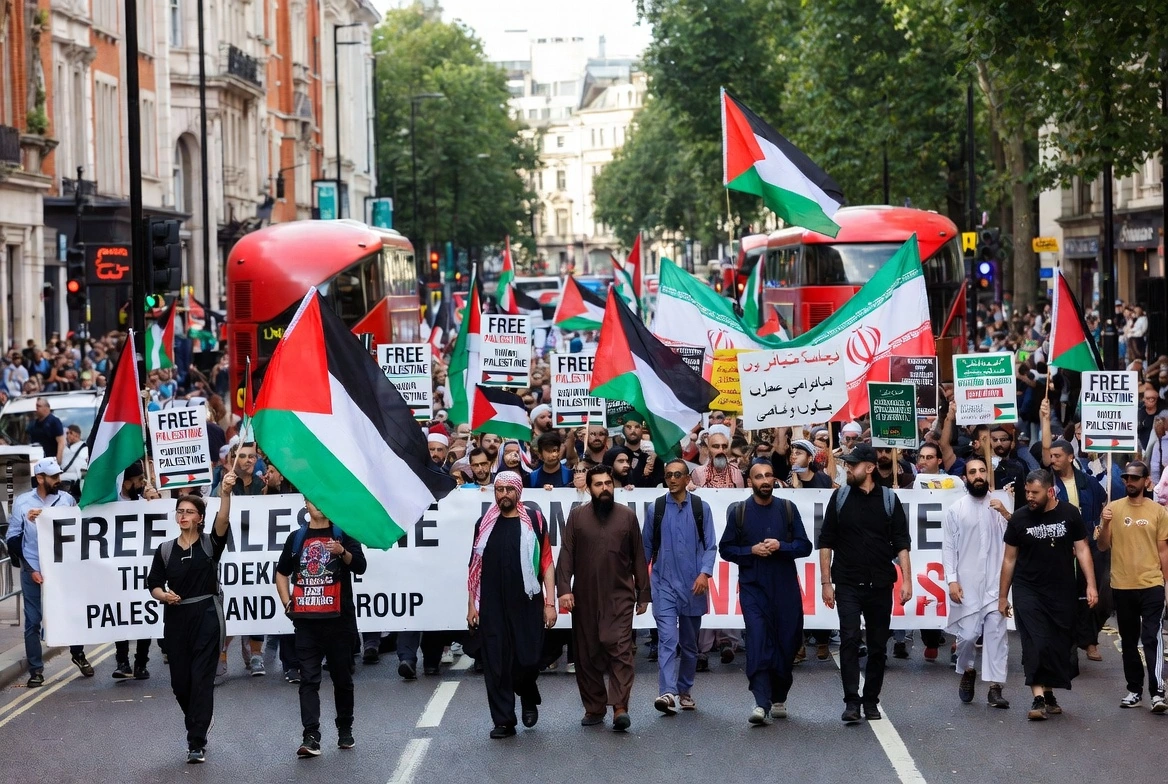
BAKU, Azerbaijan, March 11. British police have
banned a pro-Iran march that a group of public activists had
planned to hold in central London on Sunday, the statement of local
media says, Trend
reports.
The police linked the decision to the ongoing conflict in the
Middle East and tensions between opposing groups, warning that
opponents of Iran could also organize counter-protests during the
march, potentially leading to clashes.
According to reports, the pro-Iran demonstration had been
planned as part of the annual “Quds” march organized by the Islamic
Human Rights Commission (IHRC), which is said to have pro-Iranian
views.
“We have taken into account the potential impact of the unstable
situation in the Middle East on protest actions. The Iranian regime
is attacking Britain’s allies and military bases located abroad. We
must also consider the clear warnings from security services
regarding threats originating from the Iranian regime on the
territory of the United Kingdom,” the police said in a
statement.
Since no concrete agreement was reached in negotiations between
the United States (US) and Iran over the nuclear program, the US
and Israel began military airstrikes against Iran on February 28.
In response, Iran launched missile and drone attacks on Israel and
US military facilities located in countries across the region,
starting the same day.
On the first day of the air strikes against Iran, Iran’s Supreme
Leader Ayatollah Seyyed Ali Khamenei and several high-ranking
military officials were killed. On March 8, Iran’s Assembly of
Experts elected Seyyed Mojtaba Khamenei, the son of Ayatollah
Seyyed Ali Khamenei, as Iran’s third Supreme Leader by majority
vote.
Between March 1 and March 5, the confrontation expanded further,
affecting several countries across the Middle East.
According to reports, the US side suffered losses of 8 dead and
more than 140 wounded.
As a result of the conflict, the region’s energy infrastructure
and maritime transportation have also come under serious risk. Due
to heightened security tensions around the Strait of Hormuz, global
oil prices have surged sharply, and several countries have urged
their citizens to leave the region.
Stay up-to-date with more news on Trend News
Agency's WhatsApp channel