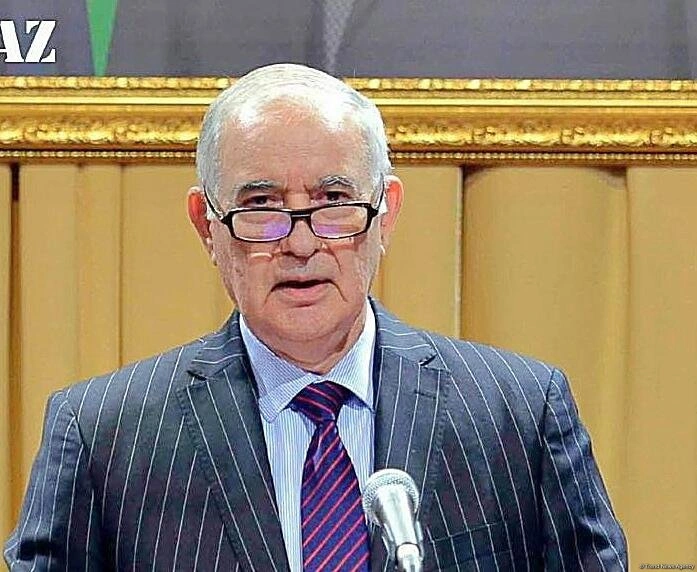
BAKU, Azerbaijan, January 24. President of
Azerbaijan Ilham Aliyev's visit to Davos once again demonstrated
the country's crucial role on the global agenda, political analyst
Azer Garayev told Trend.
According to him, the annual meeting of the World Economic Forum
held in Davos this January was not only another international
platform for Azerbaijan, but also an important milestone in terms
of demonstrating the new foreign policy line that the country has
formed in recent years. The visit was remembered for a number of
important messages in both political, economic and geopolitical
contexts. Within the framework of this visit, President Ilham
Aliyev's meeting with U.S. President Donald Trump, the signing of
the Board of Peace Charter, his speech at the panel session titled
"Defining Eurasia's Economic Identity" and his interview with
Euronews TV clearly revealed Azerbaijan's position in the new
global realities.
"The World Economic Forum has been considered one of the main
discussion platforms of the global political and economic elite for
many years. The opinions expressed there, the documents signed and
the meetings held directly affect not only the image of countries,
but also future geopolitical and geoeconomic processes. The Davos
meeting took place in 2026, at a time when the international system
is entering a period of transformation. As President Ilham Aliyev
emphasized in an interview with Euronews, today, international
relations are entering a new era, where it is not the rule of law,
but the rule of strength that is controlling the situation. Against
the background of this reality, Azerbaijan openly declares that it
bases its strategy on national interests, sovereignty and regional
stability. The discussions held in Davos have also become a
demonstration of the practical results of this approach," he
said.
According to the analyst, one of the main political events of
the visit was the signing of the Board of Peace Charter in Davos.
The goal of this organization, established under the chairmanship
of the U.S. President, is to resolve conflicts in the Middle East
and the world in general, and to institutionalize peace processes.
Azerbaijan's invitation to this organization as a founding member
demonstrates that the country is now playing an active role not
only in regional but also in global peace initiatives.
"The signing of this document by President Ilham Aliyev together
with other heads of state and government officials can be assessed
as a symbolic step that elevates Azerbaijan's image from the status
of a 'country which experienced conflict' to the status of a
'peace-making actor', especially considering that Azerbaijan itself
is a country that had emerged from more than 30 years of war and
today is already acting as a state that is experiencing the real
benefits of peace.
One of the most striking moments of the Davos visit was the
meeting of President Ilham Aliyev with U.S. President Donald Trump.
During the meeting, the parties expressed their satisfaction with
the development of U.S.-Azerbaijani relations in various fields,
and special emphasis was placed on Donald Trump's role in the
agreements reached between Azerbaijan and Armenia in Washington
last August. This meeting actually revealed two important political
lines. First, Azerbaijan-U.S. relations are entering a new
strategic phase. As President Ilham Aliyev also noted, Azerbaijan
is discussing a Strategic Partnership Charter with the U.S. Second,
the U.S. is already acting as one of the main global actors in the
peace process between Armenia and Azerbaijan. In this context, the
TRIPP project was also particularly emphasized. These projects are
not limited by regional transport routes, but are also presented as
one of the main pillars in the formation of a new geoeconomic map
of Eurasia," the analyst said.
Garayev noted that the main line in all of President Ilham
Aliyev's speeches and interviews in Davos was the
Armenian-Azerbaijani peace. This is no longer just diplomatic
rhetoric, but is presented as a process accompanied by concrete
economic and political realities.
"At the panel titled 'Defining Eurasia's Economic Identity ',
President Ilham Aliyev openly stated that there is already de facto
peace in the region, and the first real results of this peace are
reflected in economic cooperation. The export of oil products from
Azerbaijan to Armenia, the delivery of imported grain to Armenia
through Azerbaijan, the transportation of goods through the
territory of Georgia, and the opening of direct corridors in the
future are concrete indicators of this process. One of the most
notable moments was the statement of Armenian President Vahagn
Khachaturyan. He openly admitted that people in Armenia are already
filling their cars with Azerbaijani gasoline, and this is a reality
that could not have been imagined a few years ago. This fact proves
that peace is manifested not only in political documents, but also
at the level of everyday life," the analyst explained.
He underscored that one of the main topics of the Davos
discussions was the future role of Eurasia. In this context,
President Ilham Aliyev presented Azerbaijan's geographical position
as a strategic advantage. New transport corridors stretching from
the Caspian Sea to Türkiye and from there to Europe - in
particular, the TRIPP project - are turning the region into one of
the main nodes of the global trade system.
"Azerbaijan has already removed all restrictions on the
transportation of goods from Kazakhstan and Russia to Armenia. This
shows that Azerbaijan has become not only an energy center, but
also a logistics and transit center. This situation reflects the
main feature of a new stage in Azerbaijan's foreign policy: the
country presents itself as a global connectivity center. In
President Ilham Aliyev's interview with Euronews, the energy issue
also held a special place. He noted that Azerbaijan already
supplies natural gas to 16 countries, and 10 of them are members of
the European Union. Azerbaijan is number one in the world by the
geographical coverage of the supply of pipeline gas. This fact
shows that Azerbaijan has become one of the main players in
European energy security. The fact that Armenia is also importing
excess energy resources from Azerbaijan indicates that a new model
of economic dependence is being formed in the region: not security
built on conflict, but stability based on mutual economic
interests. The views expressed by President Ilham Aliyev regarding
the European Parliament were also noteworthy. 'We do not react' -
this sentence is a symbol of a new stage in Azerbaijan's relations
with European structures. The country presents itself not as a
constantly defensive party, but as an actor pursuing an independent
policy and not reacting emotionally to external criticism.
According to the head of state, the biased position of the European
Parliament is generated by special lobby groups, and these
criticisms are absurd, while Armenia itself appreciates the
relationship with Azerbaijan," he said.
Garayev pointed out that President Ilham Aliyev's visit to Davos
showed that Azerbaijan is no longer a subject of regional
conflicts, but an actor promoting peace, shaping economic and
transport links, and influencing the global agenda.
"The normalization of relations with Armenia, the deepening of
the strategic partnership with the U.S., and the formation of new
corridors in Eurasia indicate that Azerbaijan will become one of
the main political and economic centers of the region in the coming
years. In this regard, the Davos visit was a symbolic and real
confirmation of Azerbaijan's new status in the international system
- a state model that creates peace and acts as a coordinating
force," the analyst added.