ANKARA, Türkiye, December 18. Cooperation
within the Organization of Turkic States (OTS) at the level of
states, societies, and expert communities creates a solid basis for
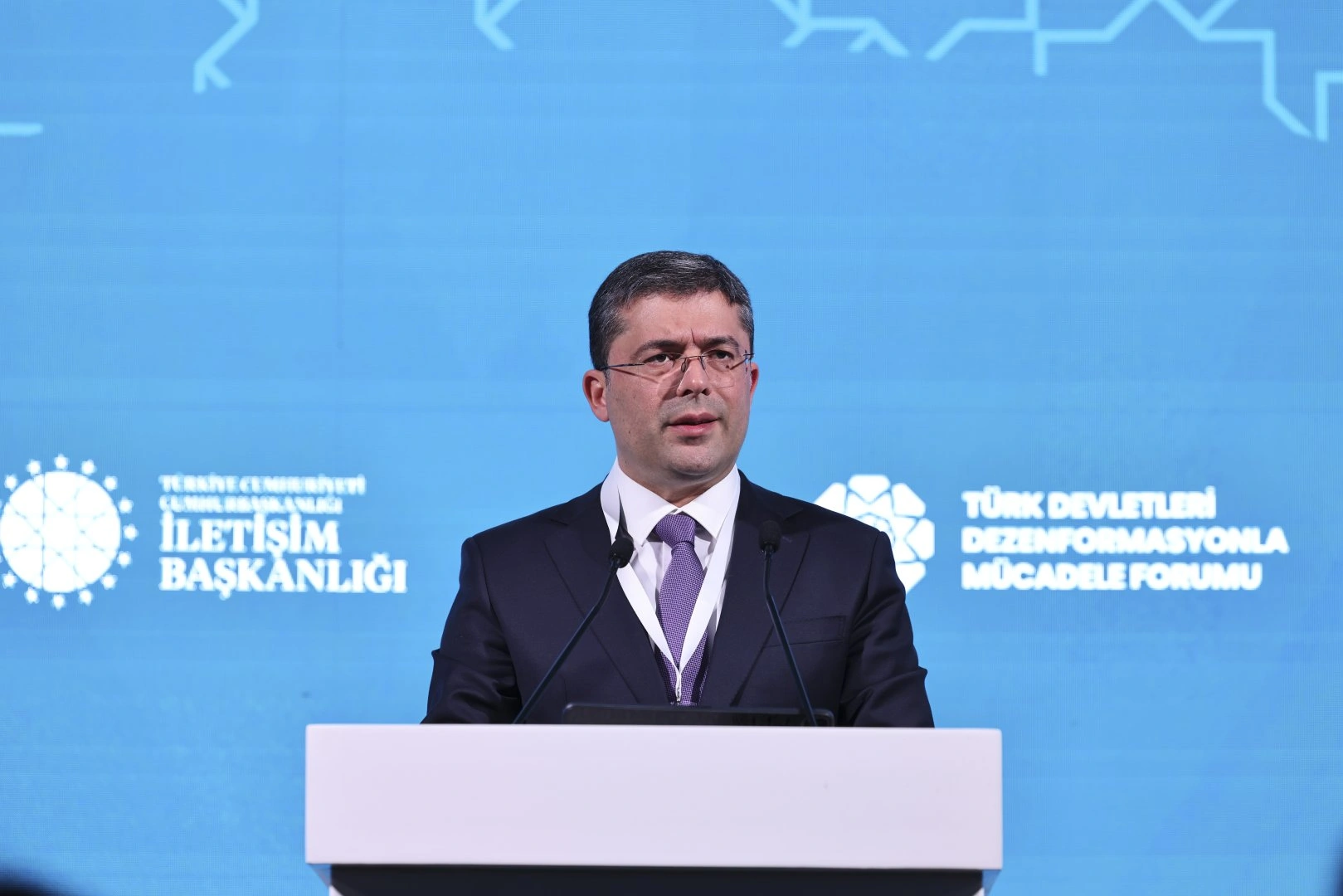
collective counteraction to disinformation, Executive Director of
Azerbaijan's Media Development Agency Ahmad Ismayilov said at the
Turkic States Forum on Combating Disinformation in Ankara, Trend's special
correspondent reports.
"Today, we are increasingly realizing that simply monitoring
social media is no longer a sufficient tool. We are faced with the
necessity of deeper analysis and more precise identification of
information. If previously information warfare was mostly limited
to political platforms, today the situation has radically changed.
What was previously characterized by localized occurrences and
sporadic events has evolved into a comprehensive and
multi-dimensional phenomenon.
Modern technologies, the development of digital platforms, media
environments, and tools of influence have made the spread of
manipulative content nearly a continuous process. In these
conditions, individual states, often without even realizing it,
become direct targets of disinformation operations. Turkic states,
in this context, are also in a zone of increased risk, facing
new-generation information and digital threats," Ismayilov
explained.
He pointed out that as fake news ramps up in complexity and
sophistication, the scale of disinformation campaigns also kicks
into high gear.
"The more falsifications are used, the wider their target
audience becomes. The only way to counter this is through public
education, protecting our people from intellectual disorientation,
and freeing them from imposed ignorance.
This serves as an indicator of the societal maturation process
and the operational efficacy of governmental frameworks.
The problem of disinformation in Azerbaijan is exacerbated by
the fact that information attacks are increasingly masked as
supposedly neutral or humanitarian narratives. Especially during
periods when the country is implementing large-scale goals and
strategic projects, we observe the activation of various campaigns
aimed at distorting reality. These campaigns are based on creating
an atmosphere of uncertainty, distrust, and covert pressure, often
accompanied by attempts to impose false stories on society under
the guise of alternative viewpoints," he added.
As Ismayilov pointed out, Azerbaijani government representatives
had earlier issued alerts regarding the pervasive landscape of
global misinformation dynamics—fake news, deepfakes, algorithmic
manipulation, and the abuse of artificial intelligence—which will
increasingly be used as a double-edged sword for pressure and
intervention.
"These actions require not only national response measures but
also coordinated, collective defense mechanisms. The foundation of
such defense is societal awareness and a high level of trust
between states. The creation of educational and analytical
platforms, the development of media literacy, and the formation of
resilient critical thinking skills should be viewed as elements of
national security. This is directly related to the work of the
media, civil society, and intergovernmental cooperation.
We also observe that external trends are increasingly attempting
to influence public opinion through the media space. For each
state, it is crucial to have an independent, objective, and
professionally managed information ecosystem. This is a key issue
for our shared future," he emphasized.
According to Ismayilov, the new generation of journalists,
experts, and analysts must be protected from the distortion of
values and professional degradation.
"Training programs, specialization, professional expertise, and
ethical standards are the foundation of the future media landscape.
We are convinced that the fight against disinformation should not
be fragmented but based on constant dialogue, joint research, and
knowledge exchange. Only through open cooperation, timely threat
analysis, and the development of joint countermeasures can
sustainable results be achieved. In this context, the steps taken
by Türkiye, as well as joint initiatives by Türkiye and Azerbaijan
aimed at strengthening information security, are of crucial
importance. The consultations held, the involvement of relevant
specialists, the implementation of technological solutions, and the
development of rapid response mechanisms have become important
stages in this process," he said.
Ismayilov mentioned that all these measures contribute to the
formation of responsible behavior in society, keeping manipulations
at bay, and bolstering ethical norms in both the national and
international information arena.
"Finally, the cooperation between Türkiye and Azerbaijan, as
well as cooperation within the Turkic States Organization at the
level of governments, societies, and expert communities, creates a
strong foundation for collective counteraction to disinformation.
This direction should become one of the key items on the agenda of
joint platforms and coordination mechanisms," he added.
Today the Turkic States Forum on Combating Disinformation in
Ankara has started. The forum is attended by delegations from
Türkiye, Azerbaijan, Kazakhstan, Kyrgyzstan, Uzbekistan, Hungary,
Turkmenistan, and the Turkish Republic of Northern Cyprus.
The main objective of the forum is to establish a sustainable
and effective communication environment among Turkic states, as
well as to strengthen institutional cooperation in combating
disinformation threats.
Representatives of government bodies, leading media
organizations, and relevant experts are participating in the event.
The Azerbaijani side is represented by Executive Director of the
Media Development Agency Ahmad Ismayilov, Head of the Communication
Policy Sector of the Department for Cooperation with NGOs and
Communications of the Presidential Administration Javid Musayev,
Head of the Media Relations Sector of the same department Kamran
Hasanov, Chief Advisor of the Media Relations Sector Parvana
Ibrahimova, Deputy Executive Director of the Media Development
Agency Natig Mammadli, Deputy Director of Trend News Agency and
Head of Baku Network Elchin Alioghlu, Board Member of the Center
for Analysis of International Relations Javid Valiyev, and the Head
of the International Relations and Analytics Department of the APA
Information Agency Faig Mahmudov.
The forum will discuss the impact of disinformation on national
security, public opinion, and regional stability, as well as
practical mechanisms for joint actions in the modern information
environment. In line with the Information Action Plan of the OTS
for 2025, the forum will serve as a platform for the exchange of
knowledge and experience in the fields of media literacy,
information security, countering disinformation, responsible use of
digital technologies, international broadcasting, and the
development of the next generation of journalism.
Stay up-to-date with more news on Trend News
Agency's WhatsApp channel