BAKU, Azerbaijan, December 17. The TRACECA
Intergovernmental Commission and the United Nations Economic
Commission for Europe (UNECE) discussed the digital transformation
of multimodal transport in Baku, TRACECA's statement said, Trend reports via
TRACECA.
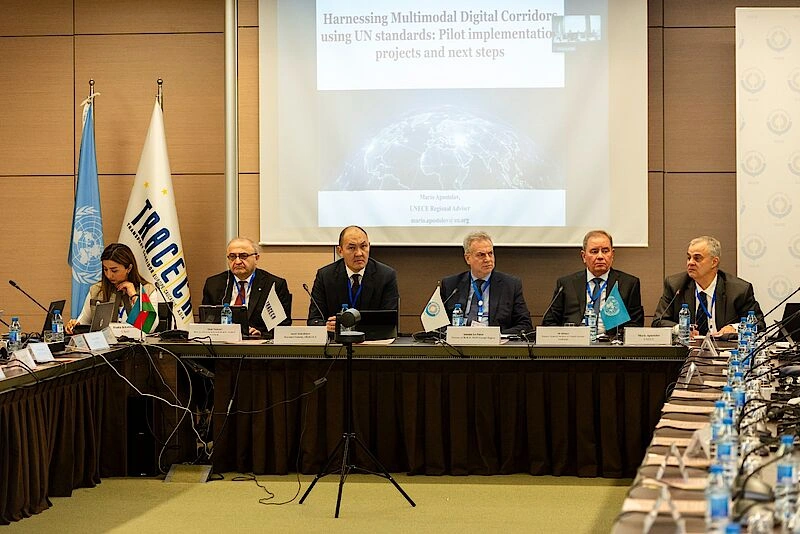
The discussions took place during the 20th International
Capacity-Building Seminar on Trade and Transport Facilitation.
"The seminar was organized by UNECE in collaboration with the
Permanent Secretariat of the TRACECA Intergovernmental Commission
and supported by the Ministry of Digital Development and Transport
of Azerbaijan.
Representatives from Azerbaijan, Georgia, Kazakhstan,
Kyrgyzstan, Tajikistan, Moldova, Uzbekistan, Ukraine, Turkmenistan,
as well as invited experts and participants from Eastern Europe and
the Special Programme for Economic Cooperation of Central Asian
countries (SPECA) took part in the seminar.
The seminar focused on the digital transformation of multimodal
data and document exchange using UN/CEFACT standards in Eastern
European and SPECA countries, including the development of the
Trans-Caspian Transport Corridor," the statement said.
The main goal of the seminar was to strengthen the capacity of
countries to implement digital solutions for trade and transport
facilitation and to discuss practical aspects of applying UN
standards to ensure the compatibility of information systems within
multimodal supply chains.
The seminar opened with welcoming speeches from representatives
of the Ministry of Digital Development and Transport of Azerbaijan,
UNECE, the Permanent Secretariat of the TRACECA Intergovernmental
Commission, as well as the Director of the UNECE Regional Office
for Capacity Building in Europe.
The Secretary-General of the Permanent Secretariat of the
TRACECA Intergovernmental Commission, Asset Asavbayev, emphasized
the key role of digitalization in improving the efficiency and
sustainability of international transport. He noted that this
direction is reflected in the Digital Concept of the International
Transport Corridor TRACECA and is a priority for the organization's
activities.
"Special attention was given to the importance of UN/CEFACT
standards as the basis for compatibility and mutual recognition of
digital solutions between countries and modes of transport.
"Further development of digital transport solutions requires
coordinated efforts from the concerned countries, railway
administrations, and international organizations, including the use
of UN/CEFACT standards and a phased approach to implementing
electronic data exchange," Asavbayev stressed.
As part of the two-day program, several sessions were held to
discuss the results and next steps of pilot projects for the
digitalization of multimodal transport. Presentations were made by
representatives of UNECE, the Permanent Secretariat of the TRACECA
Intergovernmental Commission, the World Customs Organization (WCO),
as well as UN/CEFACT experts, the UN Commission on International
Trade Law (UNCITRAL), the International Civil Aviation Organization
(ICAO), representatives from railway administrations, ports,
relevant national authorities, and international professional
associations," the statement highlighted.
Particular attention was given to discussions on pilot projects
for the digitalization of the electronic railway waybill e-CIM/SMGS
on TRACECA routes, data exchange between ports in the Caspian
region, the development of the electronic road consignment note
(eCMR) and national electronic platforms, as well as the
integration of transport data into customs and other regulatory IT
systems.
"In one of the sessions, the Secretary-General of TRACECA
presented a report on the next steps for the e-CIM/SMGS pilot
project, including further testing, geographical expansion, and
preparation of contractual and technical agreements for wider
application of electronic transport documents.
The seminar also included an award ceremony, 'For contribution
to the development of the TRACECA transport corridor,' during which
representatives of organizations and experts were recognized for
their significant contribution to the development and
implementation of multimodal transport digitalization projects,
including the e-CIM/SMGS pilot project.
At the conclusion of the seminar, participants reaffirmed their
commitment to further advancing the digital transformation of
multimodal transport based on UN standards, particularly UN/CEFACT
standards, and emphasized the need to strengthen coordination
between government authorities, international organizations, and
the private sector to create seamless multimodal digital transport
corridors in the TRACECA region and SPECA countries," the statement
added.
Stay up-to-date with more news on Trend News
Agency's WhatsApp channel