BAKU, Azerbaijan, December 16. The
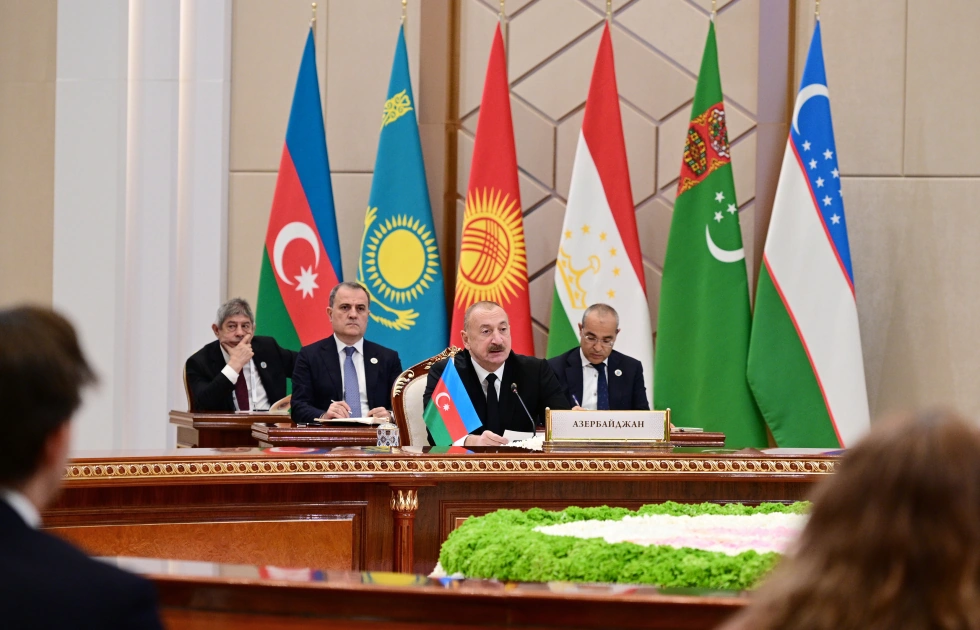
International Forum held in Ashgabat to mark the 30th anniversary
of Turkmenistan’s neutrality has become a clear indicator of an
important shift in the regional agenda: the space between Central
Asia and the Caspian Sea is decisively moving from declarations of
stability to the practical implementation of infrastructure and
energy projects. A significant role in shaping this new logic is
played by the consistent policy of President of the Republic of
Azerbaijan Ilham Aliyev, focused on developing transport, energy,
and logistical connectivity. As a result, the region is rapidly
becoming a hotbed of practical solutions, where the name of the
game is no longer good intentions but the knack for ensuring smooth
transit, energy security, and sustainable
This approach is also evident in the strategic dialogue between
Russia and Türkiye on the Akkuyu Nuclear Power Plant, in the
deepening gas cooperation between Iran and Turkmenistan, and in the
plans of Kyrgyzstan and Kazakhstan to expand their transit
potential. All these initiatives share a common vector: the pursuit
of energy independence and the formation of sustainable transport
corridors amid the fragmentation of traditional trade routes.
Against this backdrop, it becomes clear that without Azerbaijan,
these projects can't get off the ground. The country’s geographical
position and the infrastructure already in place have turned Baku
from a participant into a central distribution hub. Leaving
Azerbaijan out of transit and energy plans will either make them
economically inefficient or deprive them of strategic meaning,
especially given the country’s critical importance for cargo
transit between Central Asia, Türkiye and Europe.
Today, two major corridors serve as the backbone of regional
integration: the Trans-Caspian International Transport Route (the
Middle Corridor) and the International North-South Transport
Corridor (INSTC). It is precisely at their intersection that
Azerbaijan’s role becomes system-forming. In the context of the
erosion of international law and disruptions in global supply
chains – issues explicitly raised at the Ashgabat forum – the
presence of a reliable and politically stable transit hub is of
decisive importance.
The China-Kyrgyzstan-Uzbekistan railway project, actively
promoted by Bishkek, aims to create a new major cargo flow from
China to Europe. According to estimates, its volume could increase
from the current 3–4 million tons to 15 million tons per year.
Kazakhstan, in turn, views the Middle Corridor as a core logistics
route and plans to raise its capacity to 10 million tons by
2027.
However, it is Azerbaijan – with the Port of Baku (Alat) on the
Caspian Sea – that remains the only effective transit link ensuring
the onward movement of these goods through the Caucasus toward
Türkiye and Europe, bypassing Russian territory. Actual cargo
turnover along the Middle Corridor through Azerbaijan’s ports has
already grown by more than 80 percent over the past two years,
confirming its critical role. The Baku-Tbilisi-Kars railway and the
developed logistics network form the key backbone of the route.
This powerful transit infrastructure is the direct result of the
targeted initiatives of President Ilham Aliyev aimed at
transforming the country into a regional logistics hub. Without
Azerbaijan’s transshipment capacities, the Middle Corridor becomes
a fragmented route, while the China-Kyrgyzstan-Uzbekistan project
loses its significance as a European-bound direction.
At the same time, the North–South corridor continues to develop.
Although Iran and Turkmenistan emphasize the eastern route, the
western branch – Russia-Azerbaijan-Iran – remains the most
established and economically efficient. It ensures the delivery of
goods from Russia and Northern Europe to Iran and further to India.
From January through October of the current year, trade turnover
between Azerbaijan and the Islamic Republic of Iran amounted to
$518.2 million, confirming the growing importance of this route.
So, Azerbaijan is not just dipping its toes in the INSTC waters;
it's also keeping the ship afloat while walking a tightrope between
the east and west.
Azerbaijan’s significance is not limited to logistics. The
country acts as an independent guarantor of energy stability in the
South Caucasus and in Türkiye. As a key gas supplier within the
Southern Gas Corridor, Baku ensures diversification of supplies to
Türkiye and Southern Europe. Currently, Azerbaijan supplies around
12 billion cubic meters of gas per year to Europe, while the total
capacity of the Southern Gas Corridor stands at 31 billion cubic
meters, with plans for further expansion.
With the strategic dance between Ankara and Moscow heating up in
the nuclear arena thanks to the Akkuyu NPP project, Azerbaijan
stands as a key player, keeping the energy scales balanced and
stability flowing from the south. Azerbaijan is one of Türkiye’s
largest gas suppliers, alongside Russia and Iran, while supplies
via the TANAP pipeline reduce Ankara’s dependence on a single
source. This is particularly important amid deepening
Russian-Turkish cooperation in nuclear energy, where long-term
technological and fuel commitments strengthen Moscow’s position. In
this context, stable supplies of Azerbaijani gas serve as a
counterbalance, providing Türkiye with the necessary room for
maneuver in its energy policy.
An additional dimension is added by the green energy agenda. In
the context of climate and water challenges actively raised by
Kazakhstan and Kyrgyzstan, Azerbaijan is promoting a project to
export Caspian wind and solar energy to Europe via Georgia and an
underwater cable to Romania. In December 2022, a Strategic
Partnership Agreement on the development and transmission of green
energy was signed in Bucharest between the governments of
Azerbaijan, Georgia, Romania, and Hungary, creating the political
and legal framework for the construction of a 1,000 MW submarine
cable more than 1,100 km long. As a result, the Caspian region is
gradually being integrated into the European energy market.
Special attention should also be paid to the environmental
factor – the shrinking of the Caspian Sea – which is already
directly affecting port infrastructure along the eastern coast.
Against the backdrop of falling water levels and rising costs,
Azerbaijan’s ports are becoming a key element in ensuring reliable
transshipment along the Middle Corridor. In practice, the
effectiveness of Central Asia’s investments in transport projects
directly depends on the stable operation of Azerbaijan’s maritime
and land-based capacities.
Taken together, all these factors lead to a clear conclusion:
Azerbaijan today is not just one of many elements but the
geographical, infrastructural, and political key to the entire
regional connectivity architecture. It is precisely the consistent
and long-term strategy of President Ilham Aliyev to develop
transport corridors, modernize port and railway infrastructure, and
strengthen energy routes that has transformed the country into a
system-forming transit hub. Without this targeted policy, neither
logistics nor energy projects in the region could achieve their
stated goals. For Central Asian countries, this means that they
need to hit the ground running to gain fast, competitive, and
secure access to the markets of Europe and the Middle East, which
is today effectively ensured through Azerbaijan, which under
President Ilham Aliyev has become the only reliable bridge between
East and West, North and South.