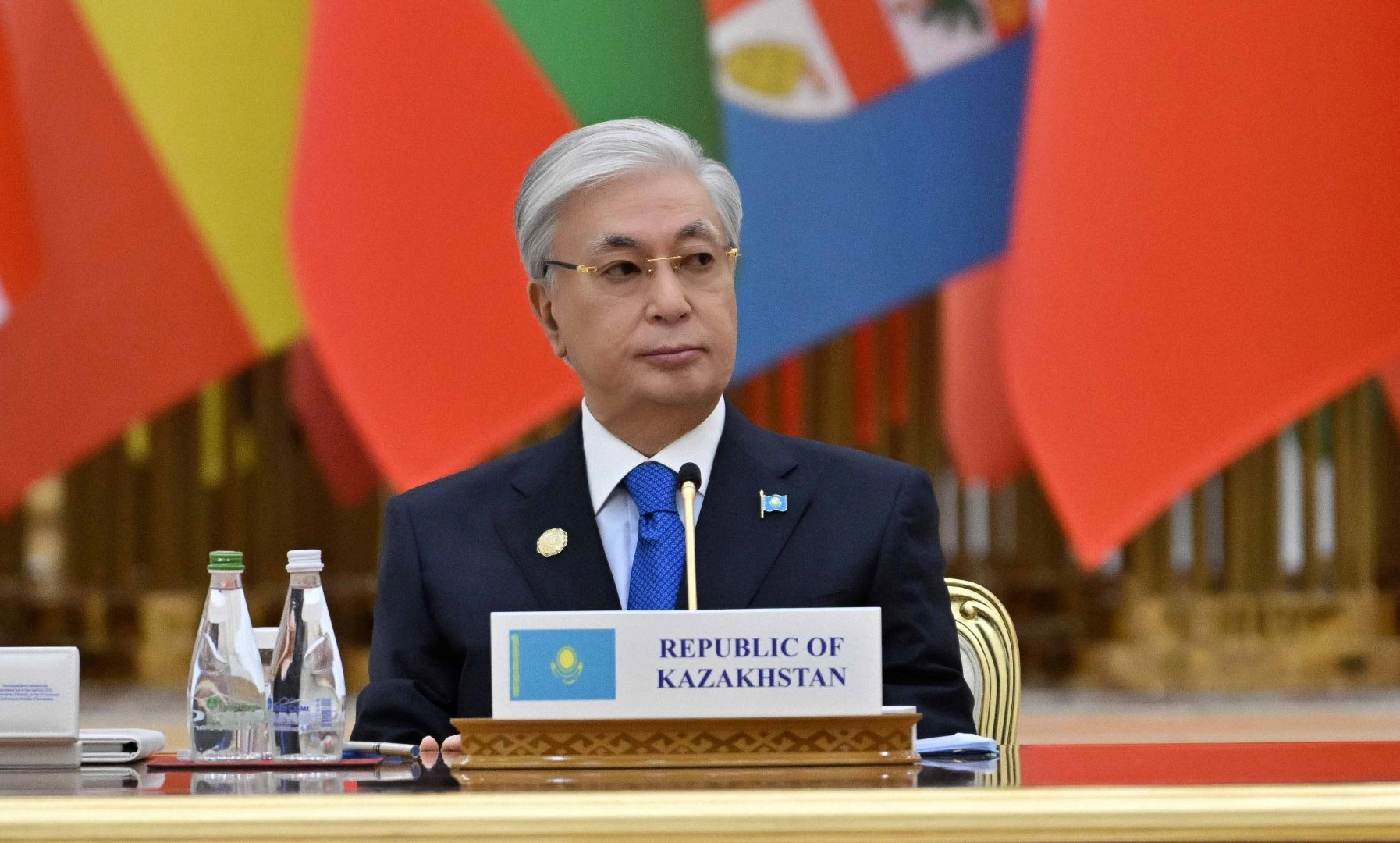
BAKU, Azerbaijan, December 13. The
International Forum in Ashgabat, dedicated to the International
Year of Peace and Trust and the 30th anniversary of Turkmenistan's
permanent neutrality, served as an important platform for
discussing key regional and global issues. The participation of
Kazakhstan’s President Kassym-Jomart Tokayev provided an
opportunity for Kazakhstan to draw attention to vital issues
affecting the region.
In his speech, the President addressed a wide range of topics,
from the crisis of trust in international relations to the specific
challenges faced by the region. Particular attention was given to
water issues, including the situation surrounding the Aral Sea and
the Caspian Sea. Tokayev emphasized the importance of improving the
work of the International Fund for Saving the Aral Sea and proposed
involving Russia as an observer to enhance the fund’s
effectiveness.
The President directly addressed the issue of the Caspian Sea's
shrinking, identifying it as one of the most pressing threats to
the region. He warned that if the current rate of decline persists,
the process may soon become irreversible.
This concern extends beyond the state of the ecosystem. The
Caspian Sea's shrinking affects port operations, maritime
logistics, coastal economies, and local employment. The falling
water levels are already disrupting transportation operations and
imposing additional costs on businesses.
“Kazakhstan has taken the lead in developing a dedicated
intergovernmental program aimed at preventing further ecological
degradation and halting the continued shrinkage of the Caspian Sea.
We call on the global community to support our efforts to safeguard
this invaluable body of water,” Tokayev stated.
The President also pointed out that there is no specialized UN
structure focused solely on water-related issues. He proposed the
creation of an International Water Organization that could
consolidate all existing mandates of various UN bodies.
Tokayev also discussed plans to launch international
consultations on establishing a global water organization at the
Regional Environmental Summit, which will be held in April 2026 in
Astana.
The Caspian Sea issue holds exceptional importance for
Kazakhstan, as it is directly linked to the development of transit
routes. Kazakhstan views the Trans-Caspian International Transport
Route as one of the key elements of regional logistics for
transporting goods between Asia and Europe. Cargo traffic along
this route is steadily increasing, and it is forecasted that by
2027, the capacity of the Middle Corridor may reach 10 million tons
per year. To further develop the route, investments are needed in
ports, railway infrastructure, and logistics services. In this
context, the water level in the Caspian Sea plays a critical role,
as it directly impacts the effectiveness and development of transit
routes.
At the same time, Tokayev noted that despite the global economic
slowdown amid geopolitical tensions, sanctions, and the disruption
of trade chains, Central Asian countries are demonstrating steady
growth. According to him, Kazakhstan’s economic growth this year
will exceed 6%, with GDP surpassing $300 billion, and GDP per
capita exceeding $15,000.
The President underscored that, despite some progress in
conflict resolution, the global situation remains broadly tense.
The world is grappling with a profound deficit in trust and a lack
of understanding regarding the crucial role of cooperation in
achieving sustainable development. He expressed concern over the
erosion of international law, the diminishing influence of
multilateral institutions, and the weakening authority of the
United Nations.
“Unless we restore strategic balance and establish a just world
order, international stability and security will remain mere
phrases or optimistic intentions in negotiations and resolutions of
multilateral forums. Therefore, Kazakhstan advocates for the reform
of the United Nations, which includes expanding the Security
Council and enhancing the role of the General Assembly,” Tokayev
stated.
In his address at the Ashgabat Forum, the President reaffirmed
Kazakhstan's commitment to a consistent approach to regional
development. He identified ecology, water resources, transport, and
the economy as interconnected areas that require joint solutions
and dialogue among states.
Within this context, Kazakhstan views the Caspian Sea as a
critical factor for sustainable growth. The initiatives outlined
stress the importance of practical cooperation between Caspian
states and international partners to ensure stable development and
safeguard the region’s economic potential.